
Extreme weather was the single biggest cause of project delays for UK SME building firms in the second half of 2025. Of the firms that faced delays in the Federation of Master Builders (FMB) and Chartered Institute of Building (CIOB) State of Trade Survey, 40% named extreme weather or climate events as a cause, ahead of planning hold-ups and market uncertainty.
An area forecast can show what’s expected across a region, but the conditions that decide whether a lift, a pour, a delivery or a roofing task can go ahead are the ones directly affecting a site. Measuring those conditions pays for itself in fewer wasted days, less rework, safer working conditions and stronger evidence when delays are challenged, all of which protect a project’s margins.
In this article, we'll cover the weather risks that UK construction sites need to track and how to work out the return on investment (ROI) of weather monitoring. We'll also use example figures for single and multiple sites, demonstrate where the savings come from and illustrate how to turn the numbers into a business case.
The Cost of Weather Delays on UK Construction Projects
Extreme weather conditions are among the most common reasons small builders give for late projects, and unpredictable weather is a growing concern across the construction industry as a whole.
In the second half of 2025, 40% of firms in the Federation of Master Builders (FMB) and Chartered Institute of Building (CIOB) State of Trade Survey named extreme weather or climate events as a cause of delays. That put it ahead of planning hold-ups and market uncertainty.
Larger contractors are seeing the same pattern. Over 70% of UK construction managers surveyed by Aggreko in 2024 had faced major weather-related disruption in the previous year. In a follow-up report, 39% said disruption caused by hot weather had led to penalties. When a penalty is on the table, the evidence behind each delay matters almost as much as the delay itself.
Additionally, weather also doesn't behave the same way on every site. Conditions on one site can be very different from those on another nearby, but an area forecast gives them both the same outlook.
When a site manager stops work for rain that never arrives, or carries on and gets caught by the weather, the result is the same: costly delays that affect the project schedule, subcontractors, plant hire and the client's handover date.
Smarter weather monitoring addresses that by delivering real-time updates on key variables of a site and sending alerts when predefined limits are reached. Managers see the same live readings as the supervisor on the ground, and every reading is logged in a centralised cloud platform, so teams can review conditions the next day or pull reports covering the full length of a project.
Read more:
- Keeping Construction Sites on Track During Weather Disruptions
- Causes of Project Delays and How Smart Monitoring Prevents Them
The Weather Risks Worth Tracking on UK Sites
Our Weather Monitoring Sensors measure wind speed, wind direction, temperature, humidity, rainfall, dew point and wind chill. Custom alerts can be set for wind, rainfall, humidity and temperature thresholds, so site teams are warned in real-time as a limit is reached, before workers at height, open excavations or freshly poured concrete are exposed to dangerous conditions.
High winds
The Work at Height Regulations 2005 require employers to make sure work at height only goes ahead when weather conditions don't put workers at risk. That covers scaffolding, roofing, steel erection and work from mobile elevating work platforms (MEWPs).
Crane operations are just as sensitive, and conditions can change between the morning briefing and an afternoon lift.
Our sensors measure wind speeds from 0 to 180km/h, so supervisors can watch high wind speeds build and base the decision to stop lifting on site readings. When the client or principal contractor later asks why a lift was postponed, the time- and date-stamped log shows the exact wind speeds recorded on site at that moment. As a result, teams have clear proof that stopping work was the right call.
Heat and cold
The Health and Safety Executive (HSE) advises employers to reschedule outdoor work to cooler times of the day, provide free drinking water, shade rest areas and allow more frequent breaks in hot weather.
In cold weather, it recommends warm rest areas, hot drinks, extra breaks and, where possible, delaying work until conditions improve. Each of these depends on knowing when temperatures are actually going to change on site.
Severe temperatures and other extreme weather conditions pose serious risks for construction workers. In extreme heat, workers can develop heat exhaustion without enough fluids and rest, and the NHS describes heatstroke as a medical emergency.
Our sensors track temperatures from -40°C to 60°C, along with humidity and wind chill. Wind chill matters in winter because workers on exposed scaffolds and slabs feel far colder than the air temperature suggests.
Heavy rainfall and ground conditions
HSE notes that wet ground needs a considerably flatter slope to keep excavations stable, and that excavations must be inspected again after any event that could affect stability. Rainfall records help site managers see when heavy rain makes that extra inspection necessary.
Wet surfaces also create slip risks. According to HSE, several thousand construction workers are injured after a slip or trip each year, with around 1,000 of those injuries involving fractures or dislocations.
Rainfall is logged by the hour, day, week and month, so site managers can see how much rain has fallen and how quickly.
Used alongside forecasts, those records help teams put proactive measures in place before severe rain arrives, such as covering materials and fresh concrete, pumping out excavations, moving work away from slopes and wet walkways, and booking the extra excavation inspections that heavy rain makes necessary.
Dust and air quality
Wind and rain also change how dust moves towards neighbouring properties and public spaces, so weather and air quality readings work best when used in conjunction.
Our Air Quality Monitoring Sensors measure particulate matter (PM10, PM2.5, and PM1), carbon dioxide (CO2), carbon monoxide (CO) and total volatile organic compounds (TVOC). Each unit stores up to 180,000 time-stamped records in our cloud-based platform that can be exported as CSV files for audits and regulatory submissions.
When a neighbouring property or the general public raises a dust complaint, teams can check the readings for that date and time and show what levels were recorded.
Tracking these conditions together gives site teams a clearer picture of how the weather is affecting a project from one day to the next. Instead of reacting to each risk separately, managers can see how wind, rain, temperature and air quality combine on their site and plan work around the conditions that pose the greatest threat to safety and progress.
Read more:
- Integrating Environmental Monitoring Sensors on Construction Sites
- Noise Monitoring Compliance on UK Construction Sites
- Construction Air Quality Monitoring and Sensor Data
Calculating the Return on Weather Monitoring
Weather-related costs aren't recorded as a single line in a project's accounts. Lost days show up in labour and plant hire, failed work in materials and remedial costs, late completion in penalties and disputes in consultant fees. For this reason, the full figure is easy to underestimate. But putting these costs side by side with the price of weather monitoring shows whether the investment pays off.
ROI = (Total Annual Benefit - Annual Investment) / Annual Investment x 100
In terms of benefits, the savings tend to fall into 4 groups:
- Reduced downtime: Teams can move labour and plant hire to other tasks when alerts show conditions turning, instead of paying crews to wait for the weather to clear.
- Improved planning: Historical weather data from each site shows local weather patterns, helping projects allow for wet months and windy periods, making accurate forecasts easier to act on.
- Reduced rework: Pours, finishes, groundworks and installations are less likely to be redone because they went ahead in the wrong conditions.
- Commercial protection: Evidence of actual site conditions strengthens extension of time claims and helps contractors push back on liquidated damages.
In the illustrative model below, a weather station costs £75 per week, or £3,900 a year. Against an estimated £16,000 in annual benefit for a single site, that works out at an estimated 310% return.
Example ROI of Weather Monitoring for Single and Multiple Sites
For regional contractors running several projects at once, the table shows the same model across 20 sites as well as for a single site.
|
Saving |
1 Site (Per Year) |
20 Sites (Per Year) |
|
Reduced downtime |
£8,000 |
£160,000 |
|
Improved planning |
£2,000 |
£40,000 |
|
Reduced rework |
£4,000 |
£80,000 |
|
Commercial protection |
£2,000 |
£40,000 |
|
Total Benefit |
£16,000 |
£320,000 |
|
Annual investment |
£3,900 |
£78,000 |
|
Net benefit |
£12,100 |
£242,000 |
|
Estimated ROI |
310% |
310% |
These figures are illustrative and will vary by project, location, season, and the type of work being carried out.
Single weather events can also justify the spend on their own. If weather data helps a site avoid one loss worth £15,000, such as a failed concrete pour or a crane lift that needs rebooking, a year’s investment returns 285%:(£15,000-£3,900) / £3,900 x 100.
Read more:
- How Smart Site Monitoring Protects Construction Margins
- How to Reduce Construction Costs With Smart Monitoring
5 Ways Weather Data Reduces Costs for Construction Sites
Behind these numbers are 5 practical changes in how construction teams make decisions once they have reliable weather data, from safer decisions on the day to stronger evidence after the event.
Warnings before conditions turn
Threshold alerts tell supervisors when wind, rain, humidity or temperature are moving towards a limit. That gives them time to bring workers down from height, secure loose materials, cover fresh concrete or pause a lift while it's still a planned decision, not an emergency. Managers away from site also get proof that the right call was made.
Fewer wasted days
Sensors on the site itself provide accurate weather data on whether rain has actually arrived and how heavy it is, with rainfall tracked by the hour and alerts that can be set on the rain rate. That detail shows whether it’s a passing shower or rain heavy enough to flood excavations and halt groundworks.
Teams can keep working through a dry spell the general weather forecast missed, or switch to indoor tasks as soon as conditions turn, which cuts the cost of crews standing idle.
Better-timed concrete pours and lifts
Our Weather Sensors are built to monitor conditions that affect concrete pours, crane operations and worker safety. Live readings help teams choose the right window for concrete pouring, protect concrete curing from cold snaps and plan lifts around gusty periods. Waiting for better conditions costs far less than breaking out a failed pour.
Stronger delay claims
The Met Office's Downtime Report is designed to support extension of time and compensation event claims for adverse weather conditions under New Engineering Contract (NEC) and Joint Contracts Tribunal (JCT) contracts, by comparing local weather with long-term averages and 1-in-10-year values.
On-site sensors add records from the site itself, with minimum and maximum readings stored alongside dates and times. These are harder to dispute than a site diary entry written at the end of a busy shift, although whether a claim succeeds is still for the contract administrator to decide.
Clearer reporting
Our Environmental Monitoring Solutions combine weather, air quality, noise and vibration sensors, with every reading fed into the same cloud-based platform used for CCTV footage and thresholds that can be customised for each site.
Environmental readings can be exported as reports to support Section 61 compliance and environmental, social and governance (ESG) reporting. They can also be shared in local authority updates, so when a schedule change needs explaining, project managers can show clients measured readings instead of estimates.
Read more:
Bringing Weather Data Together With CCTV
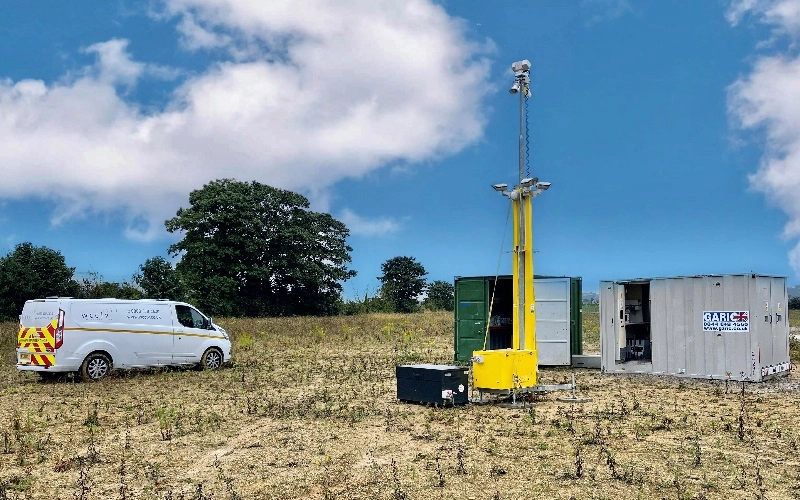
Our Environmental Monitoring Sensors, including Weather Monitoring Sensors, mount directly onto our Rapid Deployment CCTV Towers and can be bolted onto Redeployable CCTV Cameras. Pairing sensor data with video gives every reading visual context.
When an alert fires for high winds or heavy rain, teams can check live footage to see what’s actually happening on site, such as whether materials are secured, an excavation is taking on water, a lift has been paused or crews have come down from height.
Our towers also record 24/7, so footage from the same moment can sit alongside time- and date-stamped readings when a delay or incident is reviewed later.
Because the sensors are deployed as part of the tower or camera system, they don’t need a separate power supply or site Wi-Fi, and their data is sent over the system’s built-in 4G/5G connection.
Sensor readings appear in the same cloud-based dashboard as CCTV footage, so teams can gain a full picture of everything on a desktop or mobile without logging in to separate systems. Keeping CCTV and environmental monitoring with one supplier also cuts down on vendor sprawl, so teams aren’t managing separate contracts, logins, invoices and support arrangements for each system.
Combining weather monitoring with CCTV gives construction teams:
- Visual confirmation of what each alert means on the ground before deciding whether to stop work
- Stronger evidence for delay claims, with footage and time- and date-stamped readings covering the same moment
- Support for health and safety reviews and incident investigations, using footage recorded alongside site conditions
- Installation, calibration and ongoing support from one supplier, with no extra poles or third-party platforms to manage
For construction companies managing several projects, having every site's readings and footage in one dashboard means easier decision-making across sites, reducing the risk of delays, injuries and rework.
Read more:
- Enhancing CCTV Towers With Environmental Monitoring Sensors
- Managing Vendor Sprawl on Your Construction Site: Why Consolidated Monitoring Matters
Building an ROI Case for Weather Monitoring From Your Own Project Data
Weather stations are easier to approve when the case uses a contractor's own figures, not industry averages. A simple 4-step process works well:
- Add up last year's weather costs. Include lost days, rework, extra plant hire and any time spent on weather-related delay disputes.
- Price the monitoring. Work out the weekly or annual cost of sensors for the sites and project lengths involved.
- Calculate the ROI. Use the formula above to turn the expected savings and the monitoring cost into one percentage that's easy to compare with other spending.
- Combine it with site security. Adding weather sensors to your CCTV for a project keeps everything under one supplier and dashboard.
Protecting Construction Programmes and Margins With Better Weather Data
Weather costs construction projects in more ways than lost days. It brings penalties, idle labour, failed pours, rebooked lifts and liquidated damages, along with safety risks for workers at height, in excavations, on wet walkways and out in the heat. Without accurate site records, contractors also struggle to protect project timelines or prove what happened when delays are disputed months later.
Smart weather monitoring gives construction management teams live alerts to act on, historical data to plan with, site records to support claims and better operational efficiency across every project.
The return varies with each site's location, the season, the workforce size and the type of work, but avoiding even one major weather-related loss can cover a year of monitoring.
To find out which sensors would suit your projects, speak with our team about your sites, and we'll recommend a setup for new or existing CCTV Towers and cameras.
