
The UK rail industry plays a vital role in the country’s transport infrastructure and economic growth. For rail organisations and contractors, maintaining and improving it means juggling complex operations with commercial pressures. Leaders and their teams must manage crucial deadlines, increasing scrutiny of environmental and safety protocols and Control Period 7 (CP7) priorities across geographically dispersed contracts.
In 2027 and beyond, smarter rail project planning will depend on teams making informed decisions quickly and confidently. That means connecting site security, safety, environmental and operational information for a clear understanding of multi-site project conditions and challenges.
Our guide explores what rail organisations and contractors should consider when planning smarter, more efficient projects in 2027, and how connected monitoring solutions can simplify control.
Important Priorities For Smarter Rail Projects in 2027
Successful rail delivery demands effective coordination of numerous teams, engineers, activities and priorities. It also requires the ability to respond agilely to changing site conditions and emerging risks.
These challenges amplify when operations span multiple locations and contracts. A project portfolio may include track renewals, station upgrades, signal installations, temporary compounds and infrastructure design changes, each with different risks and management demands.
The following 3 key priorities stand out for effective rail delivery in 2027:
- Stronger operational control: Project leaders need up-to-date information about unexpected challenges so they can direct attention and resources where they're needed most.
- Consistent delivery across sites: Standardised monitoring and reporting help ensure that agreed processes are followed across all operations, solidifying best practices.
- Reliable evidence for decisions and investigations: Clear records help managers investigate incidents, review performance and show how problems were handled.
The Office of Rail and Road (ORR) emphasises addressing health and safety risks early and throughout the project lifecycle, so minor issues don't escalate into serious harm.
The same principle applies to all aspects of operational oversight. Clear monitoring plans (coverage needs, who receives alerts, response procedures, how information is recorded and reviewed) are vital to reduce reactive firefighting and costly losses.
Read on as we discuss and recommend how to connect these key priorities in 2027.
Match Security Systems to Actual Needs with Flexible CCTV
Network Rail crime figures show that cable theft, vandalism and obstruction caused nearly 5 months of delays to passengers and cost the industry over £10 million in 2025/26. Meanwhile, 2024/25 saw 85 rail trespassers suffering severe injuries, highlighting the danger of unauthorised network access, while fly-tipping (classified as vandalism) remains a serious disruption.
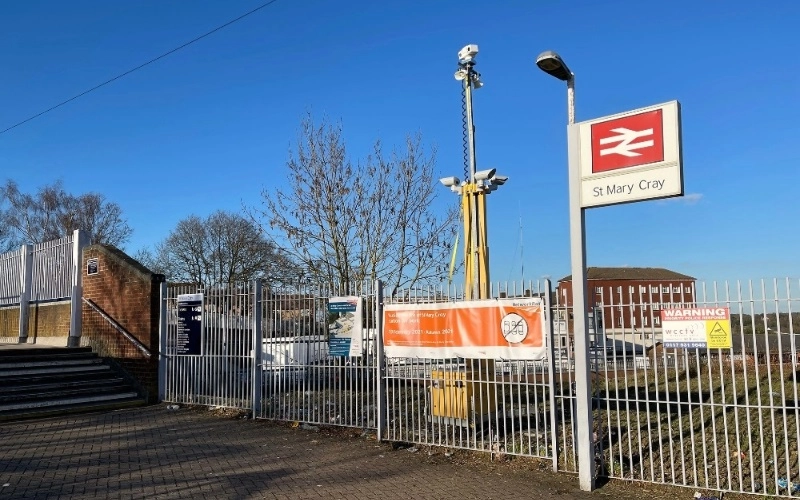
Rail infrastructure and works security require smart strategies and flexible equipment, making mobile CCTV Towers a widely employed solution. Solar-powered towers (with battery backup) can be rapidly deployed without power or internet on-site. Towers usually include HD cameras, infrared sensors and wireless video transmission, delivering high-definition surveillance day and night in nearly all settings.
For example, our Network Rail Tower is specifically engineered to support safety and security in rail infrastructure environments, from live tracksides to depots, level crossings, access points and high-value project compounds.
The Rail Tower requires no hardwiring and can be quickly installed by our team wherever you need coverage. PADS-certified by Network Rail, the unit features HD night-vision cameras, with video feeds viewable in our central cloud-based platform. The Tower can integrate AI threat detection that recognises genuine risks while filtering out false alarms such as moving trains of animals (loud sirens and live audio warnings are triggered upon verified threat detection).
For railway projects that move through different phases, portable solar towers can be repositioned as priorities change. Well-planned CCTV redeployment helps contractors adapt coverage as works move, ensuring equipment is always efficiently utilised.
Additional security measures can include:
- Intrusion Detection identifies suspicious behaviour in work zones or restricted areas and sends alerts for investigation. Since project owners can be held liable if trespassers are injured on site, the system provides essential evidence of illegal entry to help defend against these liability claims.
- Live Video Monitoring enables trained operators to verify alerts and launch rapid responses, including live audio warnings or contacting the police to deter theft and vandalism.
- Automatic Number Plate Recognition (ANPR) records vehicle details at monitored entrances and exits, tightening access control and supporting security operations, reviews and investigations.
A multi-layered coordinated security strategy helps spot potential threats early enough for the responsible team to act and prevent loss.
Read more:
- Our Guide on How Fully Managed Security Services Work
- Asset Protection 101: How Mobile CCTV Stops Theft, Trespass and Damage on Remote Sites
Strengthen Workforce Safety and Site Monitoring
The ORR recommends that health and safety management begin at the earliest stages of any project, stressing the importance of proper planning, clear responsibilities and effective risk controls to support safe project delivery.
Connected technologies play an increasingly vital role in making rail operations safer. CCTV monitoring can provide essential visibility into high-risk activities such as trackside maintenance, electrical infrastructure work and heavy machinery operations, allowing project managers to verify safety practices closely. For instance, PPE monitoring can flag crews working in high-risk live trackside areas without required protective equipment: high-visibility clothing, hard hats, safety boots, face masks or glasses.
The integration of smart detection systems and CCTV offers AI-driven risk and threat identification and alerts (another layer of intelligence). Fast, accurate alerts combined with robust responses turn safety monitoring from a recording process into a proactive prevention strategy.
Smart detection applications include:
- AI-driven PPE Detection flags instances where workers are not wearing required protective equipment in designated areas. Beyond the legal requirement, proper safety gear is critical in high-risk environments, including live track work, level crossings, tunnels and electrical systems. PPE monitoring can issue live audio warnings to workers without appropriate gear and provide timestamped footage/records of incidents to support improved standards. Active oversight tends to encourage safer, more compliant behaviours all around.
- Smoke and Fire Detection recognises and alerts relevant contacts to the early signs of smoke or fire. These AI-powered systems are ideal for monitoring large outdoor infrastructure, rail projects, stores and assets.
- ANPR facilitates safer vehicle and machinery movement around active rail services and work areas.
- Recorded footage and reports can help investigators reconstruct events, review working arrangements and identify lessons for future work.
These technologies are not intended to replace safety professionals. Instead, they provide additional visibility that gives leaders critical information more quickly, enabling proactive health and safety management.
The sooner you spot trackside crews without visibility vests, dangerous hot work near signalling equipment or unauthorised machinery in a restricted area, the sooner you can take corrective action to keep people and assets safe.
Manage Environmental Impacts With Better Data
Rail and transport organisations and contractors must proactively manage the environmental impacts of their rail construction, development and maintenance activities.
This is not only to protect workers and local communities, but to meet regulatory requirements such as the Control of Pollution Act 1974 (CoPA), Control of Substances Hazardous to Health Regulations (COSHH) and the Control of Noise at Work Regulations 2005.
Environmental Monitoring Sensors can provide continuous oversight of conditions that may affect operations, workers and the public, whilst helping projects maintain regulatory expectations and minimise environmental impact
Environmental tracking tools to consider in 2027:
- Air Quality Sensors measure dust, particulate matter, TVOCs, CO, CO₂ and other air contaminants. By setting exposure limits, teams receive alerts when thresholds are reached so they can act quickly to prevent unsafe or illegal exposures.
- Noise Monitoring Sensors record project noise over ranges of 30-130 dB and 20Hz to 12.5kHz. Real-time alerts when preset levels are reached help teams prevent excessive noise, demonstrate compliance and maintain good relations with residents, businesses and local authorities.
- Weather Monitoring Sensors can provide valuable real-time weather data, helping network and project managers prepare for conditions that could affect service delivery, safety, productivity and scheduling.
Continuous accurate data capture replaces periodic measurements and manual logging, improving governance and reporting and promoting more sustainable projects and networks. Environmental reviews can also help improve project alignment, design, cost and schedule.
Read more:
Improve Operational Efficiency Where Possible
Disconnected monitoring systems create inefficiencies, including duplicated effort, unnecessary journeys, avoidable delays and lengthy information searches. Centralised monitoring streamlines workflows and communication, boosting efficiency in most cases.
When managers can review footage, sensor data and records remotely, they can decide whether a site visit is necessary (or if they can address the issue from afar). Timestamped records support investigations and can resolve disputes quickly and inexpensively. Environmental alerts prompt earlier responses, limiting pollutants, work stoppages and regulatory fines. Safety warnings can prevent minor issues from escalating into major operational disruptions and protect rail construction companies from liability claims.
Portable monitoring equipment means that if coverage requirements change, a CCTV tower can be repositioned, with no need to source new equipment.
For rail professionals running multiple schemes, small gains in reporting, equipment use, investigations and stakeholder management add up, creating bandwidth for higher-value initiatives.
Standardise Evidence and Reporting Across the Portfolio
When an accident occurs on site, or a performance dispute arises, strong evidence can often resolve the matter. By contrast, weak records scattered across systems, devices and inboxes can see claims delayed for months and disputes landing in court.
Building a strong evidence base requires standardised reporting that works the same way across every project and contractor. Communication protocols can then be established for each audience, setting out who receives what information and when.
Once everyone adopts the same reporting method, management information needs to be centralised for easy access and use. This means:
- One secure home for video, sensor data and logs, held in the cloud platform.
- Consistent formats and digital timestamping, so evidence is easy to verify.
- Controlled access, so the right people can find what they need when they need it.
Strong, standardised record-keeping supports governance and investigations, simplifies inspections and audits and enables trend analysis that can unlock real value.
It also supports better stakeholder engagement, which is important because inadequate engagement with involved parties (regulators, local communities/businesses, planning authorities, emergency services, transport operators) is the cause of many problems on rail schemes.
How Connected Monitoring Offers Smarter Management of Rail Projects
Too often, leaders lack the visibility they need to manage projects confidently. Instead, they depend on periodic updates, physical visits and manual processes to understand conditions on the ground. This makes it harder to compare performance, identify recurring problems, set priorities and make well-weighed decisions across rail projects.
Cloud-based platforms address this challenge by connecting CCTV and project oversight for all rail schemes in one place. Our dedicated cloud management platform unifies smart detection, sensor readings and related records from up to 81 camera feeds into a central dashboard.
With a unified overview, rail project managers and leaders can understand developing events clearly and manage them assuredly. Teams spend less time searching and verifying information and more time acting on data-backed insights.
The exact information available depends on the systems and integrations you choose. A typical arrangement could combine:
- Temporary CCTV Towers to provide versatile visual coverage and recorded footage.
- Smart detection systems to identify safety incidents (fire, PPE, intrusion, unauthorised vehicles) and generate alerts.
- Environmental monitoring sensors to measure work site conditions to satisfy regulatory compliance.
- Live remote monitoring to provide human alert verification and escalation for security threats.
- A cloud-based platform and specialist software make video feeds, sensor data, alerts and records easily accessible to authorised users in a structured view.
AI analytics trained on thousands of hours of real-world video can add value through:
- Smarter detection that separates routine activity from real threats, so operators focus on genuine alerts, not false alarms.
- Cross-site analysis that highlights recurring incidents, trends, weak points and effective practices.
- Better decisions by giving managers evidence to prioritise actions and direct resources.
Studies show that around half of larger UK firms have integrated AI into their businesses to improve productivity and management information, and adoption is increasing.
Together, AI insights, connected monitoring data and cloud access help rail professionals move from reviewing what happened to more proactively managing activities across their portfolios.
Read more:
Centralised Control for More Efficient Rail Projects
In 2027 and beyond, successful rail projects will focus on gathering reliable data and turning it into actionable insights to improve operational safety and performance.
Deployable CCTV, smart detection, environmental sensors, cloud platforms and AI analytics will play a valuable role in smarter project delivery. These integrated solutions can help rail professionals connect vital information and build a more complete operational picture. Better data informs better decisions, smoother collaboration and stronger performance, helping deliver projects on time and within budget.
With extensive expertise in deployable CCTV and smart platform monitoring, WCCTV helps protect UK rail infrastructure and supports essential schemes with trusted PADS-certified towers. Speak to our team to discuss how connected monitoring could support your project execution in 2027.
