
Utilities such as water, transport, financial systems, energy availability, food and digital communications remain central to public wellbeing, economic stability and UK national security. Critical infrastructure failures can disrupt thousands, even millions, of lives, yet many critical national infrastructure (CNI) teams are being asked to protect ageing assets with inadequate resources.
For contractors building critical infrastructure and operational heads of CNI organisations, 2027 brings demanding challenges in uncertain times. Supply chains are volatile, regulations remain tight and climate-related dangers are real, while physical and cyber threats are becoming more organised.
To support critical development projects and CNI leaders next year and beyond, our article explores key critical infrastructure priorities organisations should consider as they prepare for 2027. We'll cover 6 focus areas, from resilience and multi-site project oversight to environmental controls, infrastructure security, workforce safety and information management.
6 Critical Infrastructure Priorities for 2027
Below, we highlight 6 priorities that apply across most critical infrastructure sectors, along with the technologies that can help you manage them.
1. Strengthen your resilience plan
For national authorities and private sector CNI leaders, operational resilience is mission-critical. In 2018, the Government asked the National Infrastructure Commission (NIC) to study the resilience of the nation’s economic infrastructure, which led to its 2020 report, "Anticipate, React, Recover".
Emergency reaction and recovery procedures are essential to maintaining operational continuity, but your 2027 resilience plan can go further and carefully evaluate:
- Which assets would cause the widest service disruption if they failed (pay particular attention to legacy systems).
- Security vulnerabilities that could allow theft, vandalism or sabotage to cripple essential services or development works.
- How exposed your sites are to extreme weather. The Environment Agency’s latest national assessment found that 38% of roads and 37% of railways in England are in high flood-risk areas, making plans to resolve or mitigate this risk a vital issue today.
- Industry supply chain challenges that may affect the availability of crucial materials, compromising operational delivery and causing project delays.
- Emerging technologies, artificial intelligence (AI) and digital transformation that could improve resilience, performance and risk management.
To create systems that can identify risks quickly and respond rapidly, considerable infrastructure investment is going toward smart CCTV and advanced technologies that give operators earlier warning of threats. These include:
- AI-powered smart detection systems that identify and alert to security intrusions, fire risks, personal protective equipment (PPE) breaches and unusual vehicle movements.
- Weather monitoring stations that track rainfall, wind and temperature, helping teams prepare for severe conditions and mitigate weather risks such as flooding and storm damage.
- Cloud-based management platforms that give leaders a clear, big-picture view of operations, enabling stronger remote risk management. This supports both live and construction phases of critical infrastructure works, especially at initial stages where site vulnerabilities are usually greater.
Read more:
- How Artificial Intelligence is Revolutionising CCTV Tower Monitoring
- Protecting Power Facilities: How Utility Security is Evolving
2. Protect remote and vulnerable assets
Critical sites such as development works, project compounds, water treatment plants, pipelines, farming operations, power grids and other energy infrastructure are common targets for trespass, organised theft and even sabotage. Rail and road infrastructure are similarly threatened, with copper cabling and control systems regularly targeted.
Other critical infrastructure vulnerabilities include:
- Facilities considered environmentally harmful (e.g., fossil fuel energy sector sites) are threatened by environmental activism actions.
- A newer national risk is data centres, now recognised as critical infrastructure, which are also drawing protests over their water and electricity demands.
- Fires remain a high risk: a single blaze at a key electrical or energy sector site can have severe repercussions, triggering domino effects across other infrastructure sectors. In March 2025, a transformer fire at the North Hyde substation closed Heathrow Airport and affected thousands of passengers, homes and businesses, while disrupting essential services, including road, rail and Hillingdon Hospital.
The challenge is that many critical assets are in remote locations with no fixed power or wired broadband. Boundary fencing can be breached, and traditional guard patrols leave blind spots where threats can go undetected for hours.
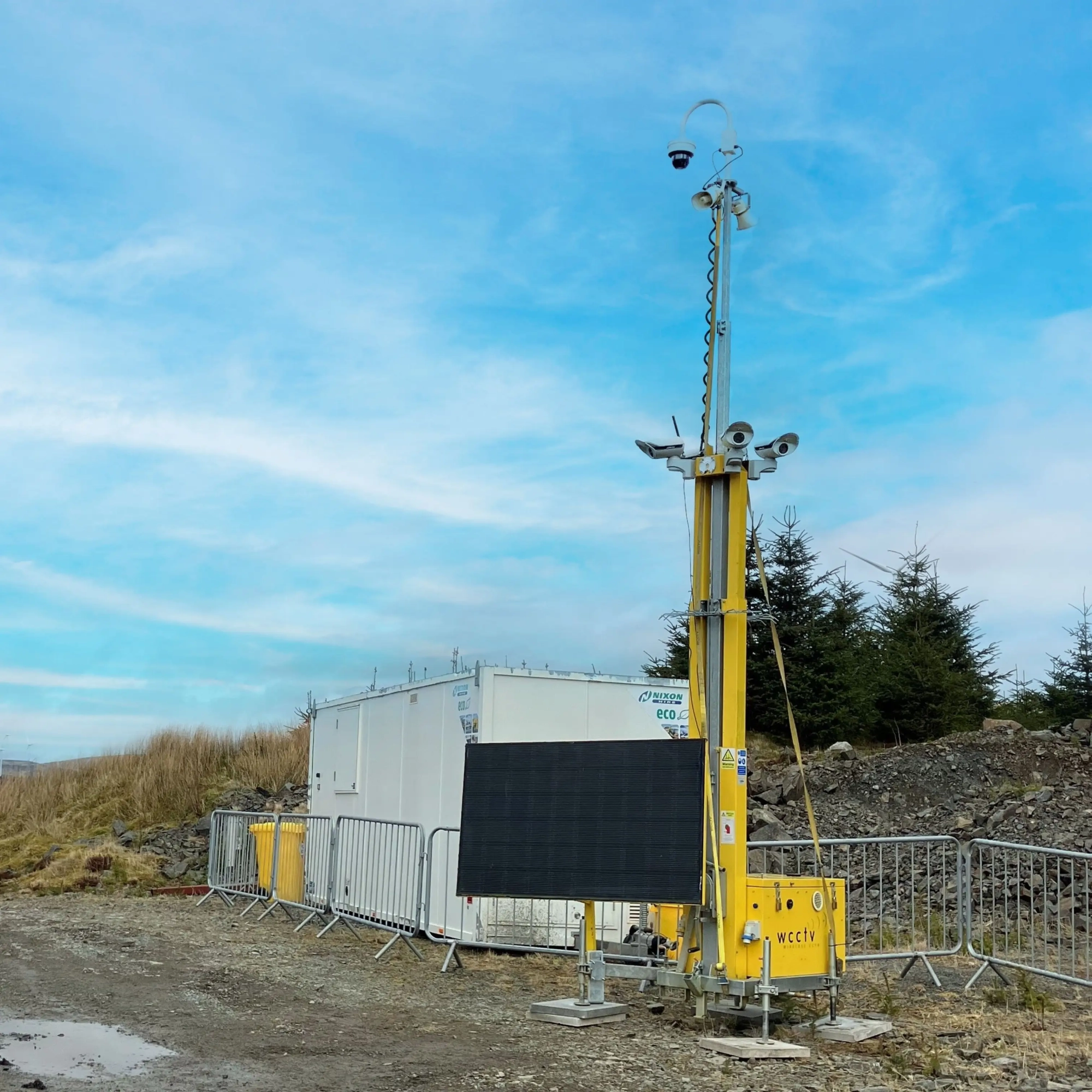
Rapid deployment temporary CCTV towers that provide 24/7 asset protection surveillance without mains power or fixed cabling close these visibility gaps. Solar CCTV units run on solar panels and battery storage, offering high-definition visibility into remote, vulnerable and temporary sites day and night. Towers send live video over secure 4G/5G networks, while accurately timestamping every security event.
Modern surveillance towers can integrate smart detection tools for additional vigilance. Our rapid-deployable, solar CCTV Towers can integrate with:
- Intrusion Detection Systems identify suspicious activities and activate near-immediate deterrents and responses from NSI Gold Accredited live monitoring Built-in AI filters out false alarms from wildlife or blowing vegetation, sending only genuine threats to control centre operators, who issue live audio voice-down warnings, strobe lights and escalated responses to stop further intrusion.
- Automatic Number Plate Recognition (ANPR) tracks vehicles entering and leaving your site or restricted zone. This helps security teams know who is on location and can call the police or activate emergency procedures when unauthorised, stolen or suspicious vehicles and behaviours are identified.
- Fire and Smoke Detection Systems use AI analytics to catch early indicators of smoke and flame. Effective in outdoor environments, these systems alert your teams so they can respond swiftly to reduce the risk of disasters like the North Hyde substation fire.
Records of all incidents are securely maintained in our cloud-based monitoring platform for review or investigation.
Read more:
- How Integrated CCTV and ANPR Keep UK Sites Secure
- The Importance of Solar Farm Security
- Securing Windfarms with WCCTV
3. Manage environmental impacts and compliance responsibly
Environmental performance is now a core focus in critical infrastructure sectors. Operations and project sites must control noise under the Control of Pollution Act 1974 (including Section 61 consents), alongside worker protection rules such as the Control of Noise at Work Regulations 2005 and the Control of Substances Hazardous to Health (COSHH).
Noise near residential areas, particulate matter from development works, chemical spills, water pollution and airborne hazards all expose operators to penalties and reputational damage. In severe cases, environmental violations can cost millions of pounds in fines and may lead to work-stoppage orders.
A key priority in 2027 and beyond is continuous tracking of environmental conditions to:
- Catch unsafe exposures early
- Act quickly to reduce them to protect employees and public safety
- Prove compliance with legal obligations
Internet of Things (IoT) devices, such as our Environmental Monitoring Sensors for noise, air quality and weather variables offer:
- Air Quality Monitoring Sensors continuously track airborne hazards, dust and particulate matter, TVOCs, CO₂, CO and notify contacts when predefined levels are exceeded. This enables your teams to act and suppress dust, machinery emissions and other contaminants.
- Noise Monitoring Sensors track work noise (30-130 dB and 20Hz-12.5kHz frequency) and warn when preset exposure limits are reached, prompting teams to adjust work activities to reduce noise levels.
- Weather Monitoring Sensors capture site-specific climate data, including temperature, wind and rainfall, and can alert when conditions might endanger people or property, especially during high-risk construction phases.
These systems are connected to CCTV and feed into our cloud platform where you can view alerts and video and take action in real-time. Sensor readings are stored and can be pulled at the push of a button to assist investigations and compliance audits.
They provide objective evidence that you monitor environmental exposures continuously and are diligent about preventing development project noise and airborne hazards from endangering employees and local communities.
Read more:
4. Keep workers safe at all sites
Maintaining workforce safety and compliance standards across different assets and dispersed locations is an ongoing challenge for CNI management.
Day-to-day operations fall under the Health and Safety at Work etc. Act (HASAWA) 1974, and crews on infrastructure projects and upgrade schemes also work under the Construction (Design and Management) Regulations 2015 (CDM 2015). Contractors, maintenance crews and engineers often work to tight timelines and under demanding pressures, meaning that mistakes can happen.
Your safety management focus for 2027 should include:
- Gaining better visibility across dispersed sites to reinforce worker and public safety controls
- Standardised incident reporting, so every crew follows the same rules
- Effective contractor management
- PPE compliance and fall protection
- Severe weather and emergency procedures
Modern monitoring and smart detection systems help support these objectives:
- Our AI-driven PPE Detection Systems recognise when crews work without required equipment such as hard hats, high-vis clothing, face protection and respiratory masks. Workers are sent an audio warning and real-time alerts go to managers, so missing PPE is addressed promptly, which is critical during busy operations and high-risk work phases.
- Environmental monitoring sensors connected to CCTV towers help you protect people and property from weather hazards, air pollutants and harmful noise. These systems can issue alerts when predefined limits are reached, allowing teams to pause work before conditions become dangerous.
All incident data and video flows into dashboards in our cloud platform, where it is easily available to support audits, explain safety-related work stoppages and help resolve injury and other liability claims.
Read more:
5. Connect and centralise oversightcentralise oversight
Fragmented oversight remains an operational weakness for many CNI organisations. Stand-alone applications and hardware bought for individual sites create information silos and blind spots.
If possible, the aim for 2027 should be to connect your control systems in a way that simplifies and strengthens oversight, building on the systems you already run rather than adding another silo.
3 priorities can help you get there:
- Build a single view across every site, unifying key responsibilities such as security, safety, environmental and operational information in a single command centre. This way, teams and stakeholders have a common understanding of events across the entire portfolio.
- Develop response plans so teams react quickly to alerts and video evidence, preventing minor issues from blowing up into major disruptions.
- Conduct regular reviews of the data you gather (alerts, event reports, sensor readings, video) to analyse for recurring issues such as an increase in weather hazards or unauthorised vehicles.
Our cloud-based software brings live and recorded video, AI alerts, environmental readings and vehicle details from up to 81 cameras into central dashboards for clear operational oversight. Acting on the latest information shortens the gap between detection and action, which matters most at remote or unmanned sites.
To protect your sensitive information, our cloud platform uses AES-256 encryption, strict access control and regular security updates. The supporting CCTV equipment is fully NDAA-compliant, so it is approved for government projects. Footage of identifiable people is also personal data under the UK General Data Protection Regulation (UK GDPR) and the Data Protection Act 2018, so clear signage, set retention periods and controlled access are legal duties as well as good practice.
Read more:
6. Improve evidence and reporting
Given the complex operations and systems, CNI disruptions are inevitable, from site fires to workplace pollutants and traffic light failures. When major incidents occur, authorities and the public demand answers.
If your records are scattered across disconnected systems and reporting tools, establishing a reliable account takes time and may lack detail. This can bring uncomfortable pressure from regulators and authorities. Not to mention media and social media criticism, investigations, insurance issues and potential damage claims.
To address reporting and evidence challenges confidently in 2027, aim to:
- Build accurate, timestamped records and automated event logs so you have reliable evidence that stands up to scrutiny.
- Unify records (including video, sensor, environmental readings, incident reports) in one place, where they are secure and easily accessible.
- Whether you're answering a government resilience inquiry, a PPE compliance audit or providing environmental information to your ESG team, include relevant data-backed evidence to make stakeholder reporting stronger and more professional.
Capturing and consolidating risk management information automatically in a central control platform can support you towards these goals. Our secure, cloud platform brings together hundreds of thousands of accurate records and builds a wealth of information.
Analysing this valuable data can help you spot developing risks before they become failures, and can reveal vital insights to improve safety, security management, environmental impact and operational performance. Soon, day-to-day monitoring and analysis will become actionable intelligence.
Enhance Resilience and Control of CNI Assets with Smart Monitoring
Recommendations flowing from the NIC's "Anticipate, React, Recover" report highlighted the need to better anticipate future risks and improve actions to resist and recover from them by testing for and addressing vulnerabilities.
This preventative approach holds true in 2027. To prepare proactively for the future, CNI operators should prioritise advanced portfolio visibility, critical infrastructure security, environmental monitoring (including climate change), safer workplaces and building resilience. Integrated CCTV and monitoring technology help make each of these more achievable and ensure systems work together.
To see how our deployable real-time monitoring systems and cloud management platform could support your critical infrastructure operations in 2027, contact our team when you're ready.
