In 2024/25, 35 construction workers lost their lives on UK sites. While this figure is down from 45 the year before, the construction industry remains the most dangerous sector to work in, with a fatal injury rate 4.8 times higher than the all-industry average.
Behind these statistics is a health and safety manager carrying the weight of that responsibility. Every number represents a person, and protecting workers' lives sits at the heart of the role.
If an incident occurs, their career and reputation are on the line. Yet [constant changes in HSE guidance] mean they're always on the back foot, often with insufficient staff and a tight budget for the scale of responsibility, while paper-heavy processes slow everything down.
But the reality is, safety procedures and policies alone don't prevent accidents. Culture does.
This guide explores how to create a strong safety culture at your construction site, one that genuinely protects workers, using tools that lighten the load and make compliance less of a daily grind.
What Does Safety Culture Mean and Why Does It Matter in the Construction Industry?
The Health and Safety Executive (HSE) defines organisational safety culture as "the way we do things around here". It's the unwritten rules that shape how workers behave when no one's watching: whether they take shortcuts, report near-misses or speak up about hazardous conditions.
At its core, safety culture refers to the shared values, beliefs, attitudes and behaviours that prioritise health and safety across all site levels. It goes beyond merely ticking compliance boxes (CDM, HSE, ESG, etc.) and is more about workers viewing safety as an integral part of daily operations.
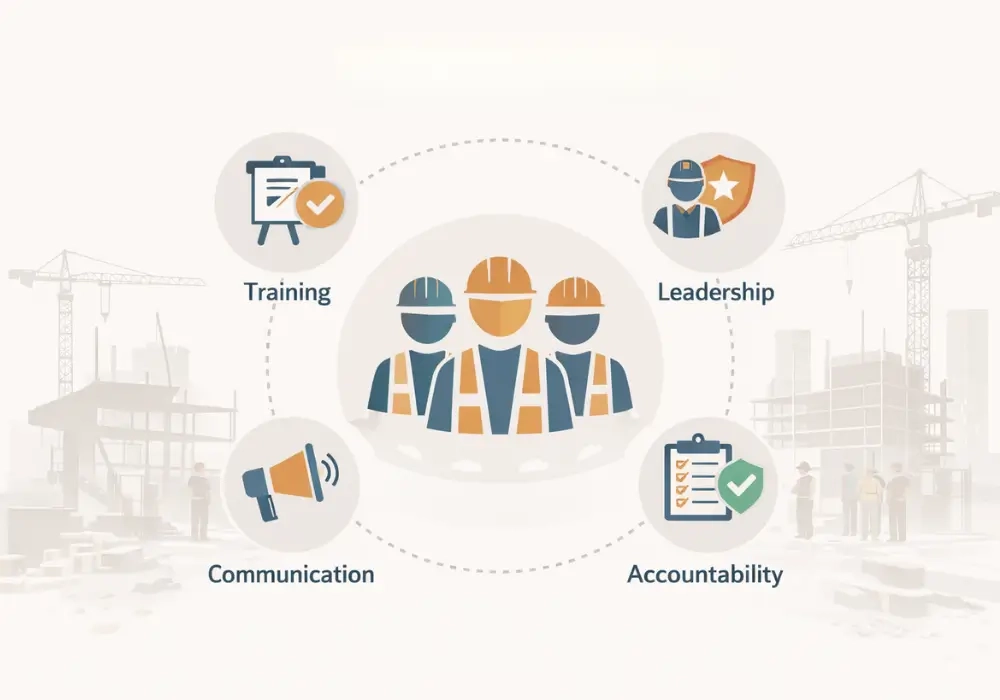
The biggest influences on safety culture include:
- Management commitment and style
- Employee involvement
- Training and competence
- Communication
- Compliance with procedures
- Organisational learning
A construction company's safety culture also has a significant impact on its reputation. When firms lack effective safety management systems, they're more likely to experience major incidents and personal injuries, increasing the risk of regulatory enforcement, fines and/or legal action. These "slips" also damage client and regulator trust while slimming down the chances of winning tender bids.
The importance of workplace safety culture
| Business impact | How safety culture helps |
| Reduced costs | Fewer accidents mean lower direct (medical, legal, insurance) and indirect costs (lost productivity, staff turnover). For context: The total cost of work-related injury and ill health in construction reached £1.4 billion in 2022/23. |
| Less downtime | Construction sites lose an estimated 2.2 million working days per year due to work-related injury and ill health. A proactive management plan prevents safety risks and delays that derail project timelines. |
| Regulatory compliance | With CDM, RIDDOR, COSHH, HASAWA and HSE requirements constantly changing, a safety-first culture keeps you ahead of the curve rather than playing catch-up. |
| Better tender opportunities | Clients scrutinise safety records before awarding contracts. Proactive risk management with embedded safety policies gives you a competitive edge when bidding for work. |
| Increased employee retention and morale | Construction workers want to feel protected. Sites with visible safety commitment see improved morale and dedication, lower turnover and easier recruitment. |
| Reputation protection | One serious incident can damage a company's reputation for years. A strong safety culture protects the firm as much as the workforce. |
Read more: The Modern HSE Playbook for UK Safety Leaders
Why Culture Breaks Down (And How To Prevent It)
Workplace safety culture doesn't break down overnight. It erodes over time through inconsistent safety inspections and reliance on manual, outdated processes to gauge safety performance, safety briefings and training.
Lack of visibility
Blind spots emerge when there's no one to communicate safety expectations, but a health and safety supervisor cannot be everywhere at once. Without constant "eyes in the sky", near-miss reporting doesn't happen, and PPE violations slip through the cracks because no one's watching.
Prevention
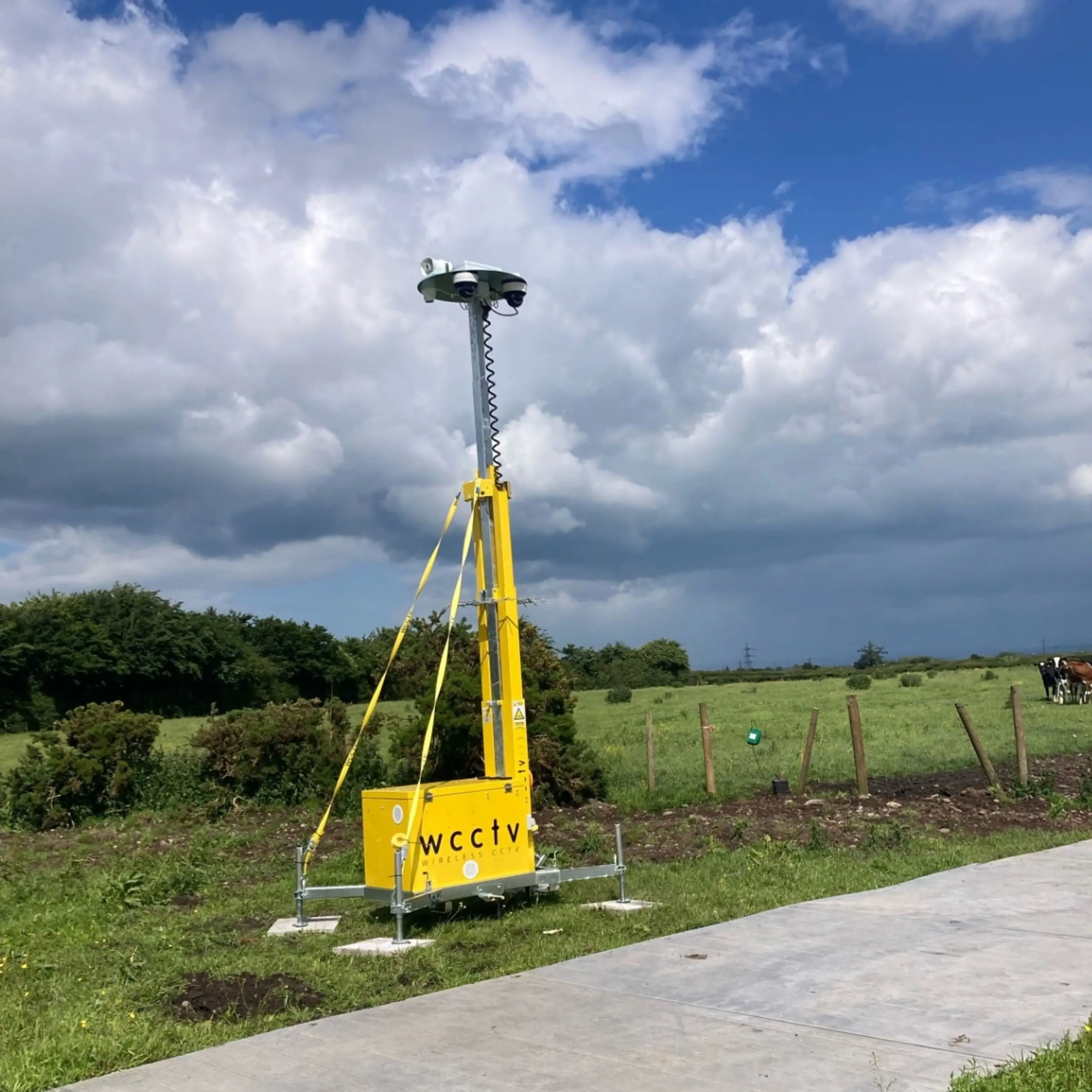
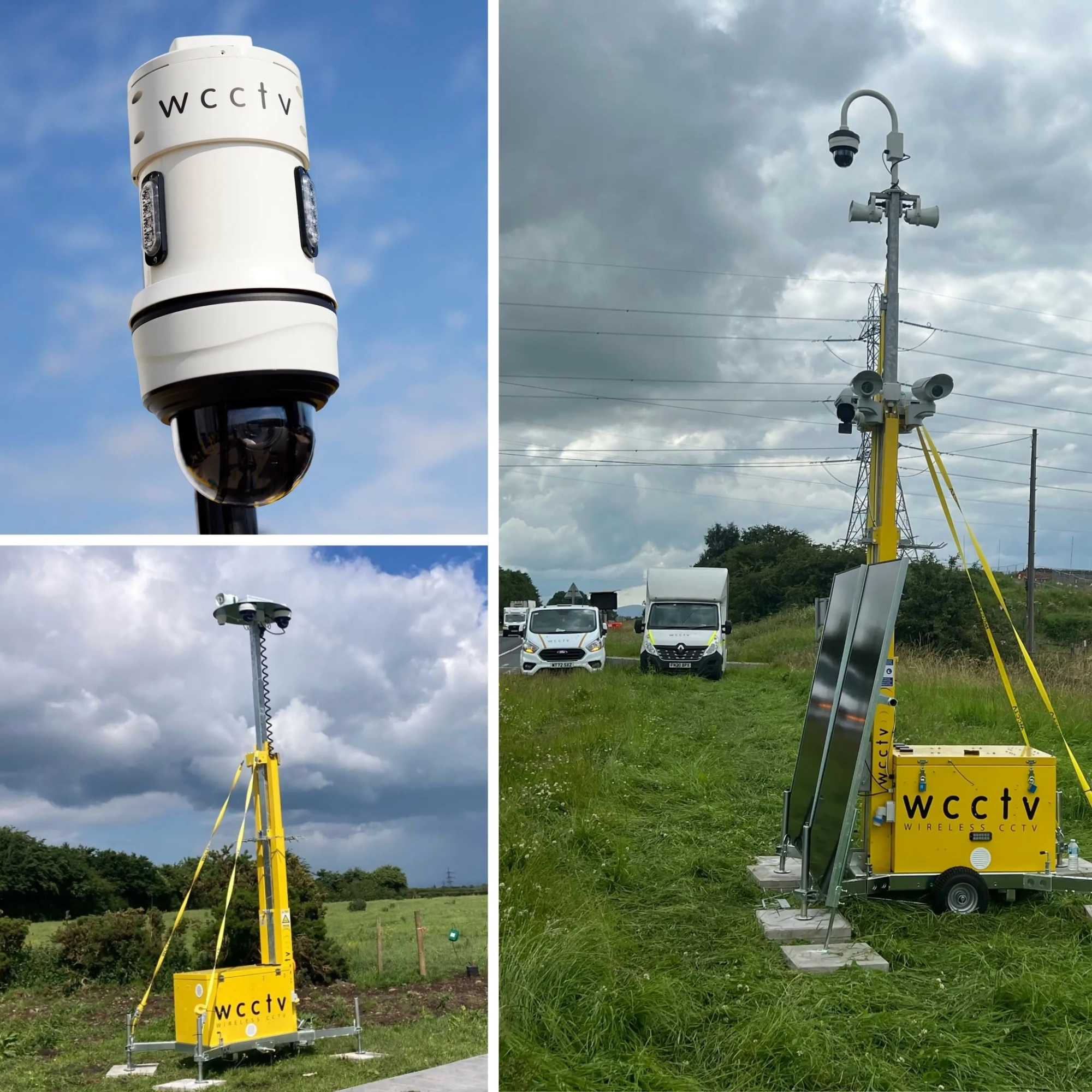
Advanced CCTV Towers with in-built remote monitoring close these gaps. Smart detection systems with PPE monitoring and intrusion detection provide continuous oversight without needing constant human presence. Using AI-video analytics and near-360° PTZ cameras, these systems flag workers missing the required protective gear the moment it occurs, not days later as with manual spot checks.
Read more: The True Cost of Manual Reporting in Construction
Accountability gaps
When safety concerns and expectations aren't consistently enforced, workers notice. If one subcontractor ignores safety protocols without consequences, others become slack too. Safety culture essentially goes out the window when rules apply on paper but not in practice.
Prevention
Cloud-based systems, like Stellifii, consolidate all site data (surveillance, ANPR logs, environmental monitoring, PPE monitoring, smoke/fire detection, etc.) into a single unified platform. Here, health and safety leaders and project teams can pull up detailed records of everything that happens on-site in real-time, and from any device.
Through clear reporting and timestamped evidence, site teams can always be held accountable. When every event is logged with precise data and video footage, there's no confusion about what happened or who was responsible. The goal is to uphold consistent safety standards.
Read more: PPE Detection in Action: Keeping Construction Projects Compliant with HSE
Leadership behaviour
As with most businesses, workers take their cues from senior management, and construction businesses are no exception. If HSE leaders cut corners, rush through safety briefings or treat compliance as an afterthought, those behaviours quickly become the norm on-site. This is one of the quickest ways to derail your safety goals because culture flows downhill.
Prevention
To improve workplace safety culture, leaders must lead from the front. By prioritising health and safety from the get-go, such as wearing PPE in high-risk zones and reporting dangerously high dust emissions, workers will naturally follow those safety practices and, therefore, improve occupational safety across the board.
Manual workloads
Time wasted on manual spot checks, audits, inspections and reporting slows everything down. Health and safety managers end up buried in admin when they should be building culture. Paper-based processes and outdated legacy systems create unnecessary fatigue, and with fatigue comes complacency. What's more, manual work is prone to human error, which can lead to compliance risks.
Prevention
Automated monitoring systems handle the administrative burden. Integrated platforms like Stellifii consolidate CCTV, site monitoring, weather reports and smart detection alerts in one dashboard.
In just a few clicks, HSE leaders can generate timestamped, audit-ready reports that meet compliance requirements. This level of automation cuts back paperwork and mental drain, freeing safety committees to focus on where it matters most.
Read more: 7 Compliance Pitfalls Costing Construction Firm Millions
6 Actions for Creating a Positive Safety Culture in Construction
Construction safety isn't built overnight; it requires continuous improvement and commitment. A strong safety culture starts with a clear understanding of where your company stands and the potential risks your team faces every day. From there, clear safety rules, consistent safety training and proactive leadership behaviours can shape safer decisions and reduce incidents on-site.
Below, we break down 6 practical actions to strengthen safety culture on your construction site:
Action #1: Understand where you stand
You can't improve what you don't measure. Before implementing changes, assess your current safety performance honestly. Start with the basics:
- Review recent incident data, near-miss reports and audit findings from the past year
- Conduct regular safety audits, such as surveying your workforce: What concerns them?
- Physically walk each building site with fresh eyes: Where are the potential hazards vs documented ones?
The HSE's Safety Climate Tool (SCT) 2.0 can be helpful "to measure an element of safety culture" within an organisation. In a nutshell, it assesses workers' attitudes towards health and safety issues. But even informal conversations with your team can reveal gaps where workplace safety is falling short.
Action #2: Lead from the front
As mentioned, safety culture starts at the top. If directors and health and safety managers treat safety as a genuine priority (not an obstacle to productivity), site teams will naturally follow suit.
Here's what that looks like in practice:
- Wearing PPE every time you're on-site, including within high-risk zones
- Flagging and reporting unsafe acts, dangerous dust emissions levels and fire hazards promptly
- Addressing safety issues immediately, not "when there's time"
- Making safety performance a top priority, not an afterthought
- Being visible on-site, not just in reports
Safety leaders can lead more effectively with the help of advanced tools and software. Real-time dashboards showing surveillance, air quality, noise levels, PPE compliance and weather conditions give HSE managers confidence that blind spots are covered and workers are safe.
Action #3: Know the risks
Risk assessments are non-negotiable. But they are also an ongoing process that evolves as site conditions change.
Risk assessments lay the foundation of any good safety management system and involve:
- Pinpointing potential hazards at each construction phase (what's safe in week one might be dangerous by week 10)
- Categorising risks by severity (a coloured-coded system works well here)
- Implementing control measures to prevent injuries and accidents
- Updating safety procedures/policies when the scope of work or site conditions change (ongoing)
Falls from height remain the leading cause of construction fatalities, accounting for nearly half of all deaths. Slips, trips and falls are the most common cause of non-fatal injuries, yet they're often the easiest risk to control (when properly identified).
Air quality, noise and weather also affect worker safety. When thresholds are exceeded, smart systems send automated alerts to designated personnel before conditions become dangerous.
Action #4: Empower your workforce
The thing about safety culture is that it can't be policed into existence; it needs to be owned. That means moving beyond "safety enforcement" to "safety engagement". Workers are essentially the "eyes and ears" of your building site, they see risks that don't make it into formal assessments.
Empowering workers is the simplest way to encourage a better safety culture. Create channels for them to speak up without fear, blame, judgement or dismissal.
Here are a few tips:
- Run regular safety briefings that invite input, not just deliver instructions
- Act on feedback, so workers feel like they can report more
- Recognise (and reward) proactive behaviour, not just compliance
- Involve workers in safety training and developing procedures they'll actually follow
The goal is to embed everyday safety ownership rather than enforcing rules in isolation. When workers understand why safety matters (not just what the rules are), behaviours shift.
Action #5: Train your team
One-off safety training isn't enough. As construction projects progress, workplace safety training needs to keep pace. Think about it: the risks involved during groundworks and demolition vary wildly from the hazards during finishing work (painting, electrics, plumbing, etc.). This means that field workers need constant "refreshers" of safety policies across every construction phase.
Focus areas include:
- Role-specific hazards: Tailor training to actual job tasks, not broad, generic roles.
- Refresher courses: Even experienced workers can develop bad habits over time; regular refreshers (e.g., asbestos awareness, falls from height recaps, etc.) reset expectations.
- Competence tests: Ensure workers are genuinely trained and competent to perform tasks safely.
- Mental health awareness: Managing worker wellbeing (mental health, stress, fatigue) on top of safety is now essential, not optional.
Did you know that male construction workers are 3 times more likely to die by suicide compared to those working in other industries? Recent studies have shown that roughly 30% of respondents working in the industry had experienced suicidal thoughts at least once in 2024.
This makes mental health awareness a vital element of a company's safety culture, as workers who feel supported are less likely to take risks.
Action #6: Monitor and tweak
Creating a strong safety culture in the construction industry is a process of continuous improvement. It involves constantly monitoring safety policies to see what's working and what isn't. This also means that health and safety managers must be flexible and adapt their approach as projects and risks evolve.
Smart tech plays a key role here:
- Fully-managed remote monitoring services provide 24/7 oversight that cuts manual work
- Rapid Deployment CCTV Towers and Temporary CCTV solutions can be relocated as sites change
- Smart smoke and fire detection systems flag early fire hazards in real-time
- IoT-based environmental sensors flag unsafe weather, air quality and noise levels instantly
- Cloud-based platforms consolidate site data for easy reference
- Automated systems timestamp every incident and store up to 180,000 logs for trend analysis
- Smart monitoring systems generate audit-ready reports up to 5X faster than legacy systems
All of this feeds into a single platform that provides tangible proof that your health and safety efforts reduce costs, incidents and risk exposure to workers. This is the type of evidence construction HSE managers need to demonstrate the value of a safety culture to stakeholders and clients.
Build Stronger Safety Culture Today
Safety culture can't be built on policies alone. It's built through visible leadership, consistent standards, engaged workers and systems that make compliance easier, not harder.
For health and safety managers who carry the responsibility of protecting every worker on site, a strong safety culture mindset embeds safe behaviour at every stage of construction. HSE leaders who protect workers, drive compliance and prove safety's value to the business are recognised as respected protectors, not just enforcers.
With over 20-years of experience in construction monitoring, we understand what's at stake when safety isn't embedded from day one. We provide fully-managed surveillance and monitoring solutions that support UK construction firms in building safer, more compliant sites.