
Too often, highways and traffic management teams find themselves reporting on accidents rather than actively preventing them. With increased public scrutiny via social media and political pressure from councillors, leaders can no longer afford to wait for an incident report before responding.
Modern road safety management demands moving from reactive maintenance to proactive risk mitigation, and today's technology enables this. Successful highways managers now leverage real-time monitoring of accident hotspots, environmental conditions and community complaints to identify where interventions are needed most.
These real-time insights are critical to prevent issues escalating, because risks (weather events, noise levels, oil spills, incursions, theft, etc.) shift constantly. Without knowing exactly what is happening on the ground, it's nearly impossible to safeguard the network. It's also difficult to address complaints or demonstrate accountability when councillors and residents demand answers.
The article explores the factors that contribute to high-risk road networks on traffic projects and temporary works. We explain how smart monitoring solutions support earlier intervention and informed decision-making to protect road users, residents and your employees.
Why Proactive Identification of High-Risk Roads and Projects Matters
Government projections indicate Britain's motorways will carry 54% more road users by 2060, making network modernisation and capacity a key priority.
Many of the country's roads are ageing and rural areas are underserved, necessitating considerable investment and work. We have seen this in recent years, with modernisation projects and service expansion by utility providers causing road works to increase 42% from 2019 to 2023.
This rise in activity has added to the safety concerns local authorities must deal with as unpredictable and dangerous driving behaviours near active work areas frequently cause accidents and casualties.
A recent Road Safety Foundation report indicates that crash rates on major local authority roads in England are 4X those on National Highways' strategic road network, highlighting the dangers on these networks.
To improve safety, road authorities need smarter, more effective ways to monitor their networks, especially roadworks and traffic projects. A successful strategy starts with identifying high-danger zones/conditions, then taking proactive steps to make them safer.
Proactive monitoring powered by specialised technology and AI insights helps highlight and explain risks around temporary work sites, making them easier to control. Besides improving road safety for all users and workers, a preventive strategy also puts you on the front foot when addressing complaints from the community, councillors or MPs.
Factors That Create High Risks on Road Networks
The factors that create higher road network risks range from dangerous driving and environmental hazards to road design weaknesses.
Let's take a deeper look:
Road design factors
Certain road designs inherently carry higher crash risk, such as sharp horizontal curves, steep grades, and inadequate banking, which contribute to collisions. Additionally, poor road conditions (e.g., inadequate drainage, surface deterioration, lack of clear road markings) compromise driver control and increase crash rates.
Many road crashes in the UK occur at busy intersections and junctions. The Chartered Institution of Highways and Transportation (CIHT) cited 24,000 collisions at priority intersections in a single year. This stresses the importance of strong visibility at merge points during temporary road projects, to understand all the risk factors.
A better understanding helps to shape better solutions, for example, clear signage at temporary traffic schemes and appropriate barriers around work areas.
Dangerous driving hotspots
Dangerous driving is one of the most urgent road safety risks facing society. Illegal street racing, car cruising and anti-social driving are common complaints on urban roads. Rural networks aren't immune either. With limited traffic enforcement in remote areas, country roads also attract reckless and illegal driving.
Networks where vehicles consistently exceed the speed limit tend to see more severe crashes, with speed being a factor in roughly 27% of fatal collisions. Besides the direct danger to drivers, excessive speed also increases the threat to pedestrians, cyclists and road crews working alongside live traffic.
Solutions like Automatic Number Plate Recognition (ANPR) that assist the enforcement of dangerous driving can encourage more responsible driver behaviours near road projects in speeding hotspots.
Congestion hazards
Recurring congestion and bottlenecks increase the likelihood of rear-end collisions, incursions into restricted areas like temporary traffic works and erratic driving linked to impatience and confusion.
Roadworks on already congested routes aggravate the problem. Active construction zones force lane narrowing, temporary barriers or abrupt speed limit changes. Directing traffic and public transport onto unsuitable roads spreads disruption beyond the work zone, potentially overwhelming a vital section of the network. Gridlock delays emergency responses, increasing the risk that crash injuries become fatal.
Proactive management anticipates many of the risks and disruptions of traffic works, enabling you to limit them with:
-
Well-thought-through detours
-
Clear alternate route indicators
-
Emergency and public transport priority lanes, where necessary
-
Clear and complete traffic and safety signage and lights
-
Proper advance notification across all relevant platforms (social media, council sites, local papers/radio, road signage)
Environmental and weather dangers
Unpredictable environmental variables are a major cause of unexpected hazards on UK highways project sites. Severe weather can drastically alter driving conditions and risk levels, especially at night, increasing the risk of incursions into work areas.
Over time, flooding and other extreme weather degrade road surfaces, compounding safety and congestion risks and sometimes necessitating emergency repairs in hazardous conditions.
Installing CCTV towers with smart IoT-based weather sensors and infrared (IR) night-vision helps you track and prepare for environmental events that might endanger your road users and employees.
Rural and remote networks
While urban and local roads are often classified as higher-risk due to the density of unprotected pedestrians and cyclists, rural networks are disproportionately more dangerous.
In 2024, 60% of all UK road fatalities occurred on rural roads, even though these routes carry less traffic. Common hazards associated with rural roads include poor visibility and lighting, frequent flooding, rugged terrain and deteriorating road surfaces (potholes, erosion, loose gravel).
Due to their remoteness and dispersed populations, these locations often have limited monitoring infrastructure and emergency services compared to urban areas. An accident at an unmonitored temporary traffic project could turn into a major emergency before help arrives.
Modern technology can boost surveillance coverage, strengthening project safety, road condition monitoring and protecting workers and rural residents.
Public complaints
Modern highway managers treat public complaints as a key barometer of emerging problems on their networks. Residents, commuters and local businesses are often the first to flag congestion, poor signage, unsafe temporary barriers, equipment and other obstacles around roadworks.
Trending complaints in the same area reveal patterns that may point to escalating dangers or inconvenience. Combined with traffic data, CCTV footage and incident records, these reports help you verify complaints and prioritise countermeasures to limit disruptions and risks from traffic works.
7 Smart Monitoring Solutions For Proactive Project Risk Management
Highways management has been transformed by rapid deployment CCTV and safety monitoring technology, enabling complete power autonomy through 4G/5G connectivity and solar options. Our NDAA-compliant solutions are built to deliver visibility into temporary traffic works, infrastructure projects, disruptive maintenance and similar challenging short-term assignments.
Below, we highlight 7 AI-powered solutions that can be integrated and layered to enhance traffic project security, safety, environmental monitoring and project management in one system
1. CCTV Towers
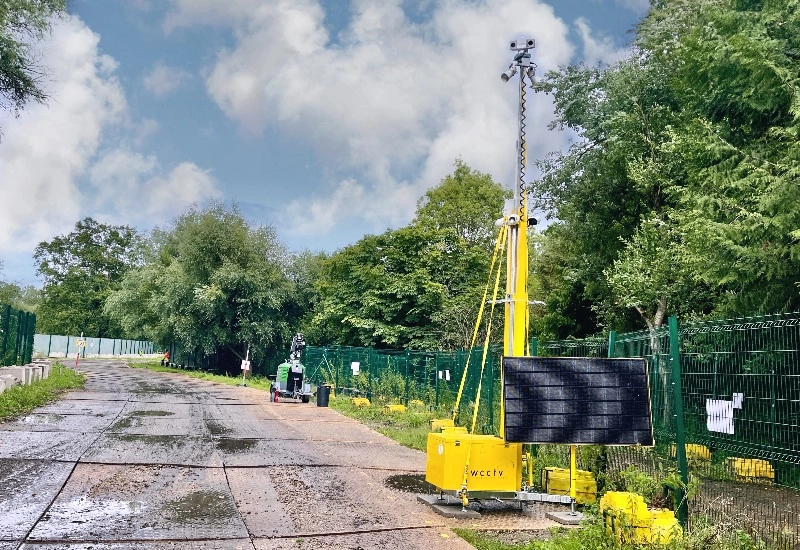
Our highly visible CCTV Towers with high-definition PTZ (Pan-Tilt-Zoom) cameras can be installed in 20 minutes (for basic setups), providing immediate real-time coverage of projects on high-risk routes.
For maximum flexibility, our self-contained Mini CCTV Towers are designed to be quickly set up by a single person. Solar-powered Mini Towers can be easily repositioned by your team without our assistance, offering cost-effective surveillance at any roadworks hotspot.
How CCTV towers help proactively manage high-risk areas:
-
Modern CCTV systems give traffic managers clear views of temporary high-risk areas, including maintenance and similar work schemes. They can support PPE monitoring to ensure workers in high-risk zones are always wearing proper safety equipment. In addition they gather and retain verifiable evidence of all incidents for investigations and regulatory purposes.
-
Mobile solutions operate without hardwiring, on-site internet or permanent infrastructure, making them well-suited to monitor rural areas lacking power or Wi-Fi.
Read more:
2. Traffic Management CCTV Towers
Smart Traffic Management Systems combine high-quality CCTV coverage with AI-driven intelligence to track events around work (planned or emergency) in busy locations. The towers gather data throughout the project to guide safer, smoother traffic flows around worksites moving forward.
How traffic management systems support proactive risk management:
By accessing our Traffic Management CCTV system, you can view work-location traffic conditions on your phone or laptop, enabling you to take measures to limit disruptions and dangers, where possible.
Read more:
3. Weather Monitoring Sensors
Our CCTV Towers support Weather Monitoring Sensors that track climate variables (wind, rainfall, humidity, temperature) in real-time.
Using infrared night vision, the system delivers live data and intelligence in even the worst light and weather conditions, allowing your team to react swiftly to climate-related risks day and night.
How weather monitoring supports proactive risk management:
- Live weather data helps you assess the impact of flooding, snow or winds in high-risk areas where your team or contractors are working.
- This visibility enables you to ramp up safety measures or adjust work operations before conditions worsen and also respond to emergencies faster.
4. Environmental Monitoring Sensors
For maintenance and traffic projects, our IoT-based Environmental Monitoring Systems measure air quality and sound levels continuously to protect workers and the public:
-
Air Quality Monitoring Sensors monitor dust, fine particulate matter, TVOCs and CO₂, helping contractors manage airborne pollutants, protect crews and local communities and limit complaints about emissions.
-
Noise Monitoring Sensors measure sound levels across a wide frequency and decibel range, and alert managers before conditions breach compliance thresholds or become unsafe.
How environmental monitoring supports proactive risk management:
-
These systems monitor air quality and noise volumes 24/7, allowing you/contractors to actively control levels within permitted thresholds to avoid violations that endanger residents, road users and employees.
-
Data-backed records of all environmental incidents support compliance efforts expected by regulatory agencies (the Environmental Agency, the Health and Safety Executive).
Read more:
5. Intrusion and Smart Detection Systems
As a cost-effective security add-on to our CCTV solutions, Intrusion Detection Systems use AI-powered analytics to analyse live footage and spot suspicious behaviours near project sites. Near-immediate alerts are triggered when a threat is detected.
The fully-managed security service is backed by NSI Gold Accredited Remote CCTV Monitoring centres, with trained security professionals watching surveillance cameras, verifying threats and warning off intruders through the unit's speaker.
As an extra deterrent, you can add Mobile Keyholding Response. This service provides licensed professionals who immediately check the site upon receiving alerts, saving contractors the stress of being called out.
The same CCTV Towers that support security surveillance can also integrate other Smart Detection Systems. The most widely used on projects is PPE Detection and Monitoring. This setup instantly flags and alerts designated managers if employees or crews on roadworks are not wearing the required protective equipment.
How intrusion detection and PPE monitoring support proactive risk management:
-
Visible security and active workplace protection safeguard assets and infrastructure and ensure safety remains a priority.
-
PPE detection protects crews and inspection teams, which is especially critical near high-traffic and high-speed roads.
6. Automatic Number Plate Recognition (ANPR) Systems
Automatic Number Plate Recognition (ANPR), as an add-on to our CCTV systems, tracks vehicle movements across high-risk project locations throughout the duration of the work. ANPR recognises and logs vehicle details such as speed, make, model and colour. If a vehicle speeds or enters a restricted area, the ANPR system retains a time-stamped record of the incident for investigation and review.
How ANPR helps in proactive risk management:
-
ANPR data provides actionable insights that help curb dangerous driving and control vehicle movement in and around active, hazardous roadworks.
-
The system retains all incident data (with visual evidence) to assist claims related to accidents and worker safety
7. Cloud-based management platform
Our cloud-based platform consolidates all network information (from up to 81 camera feeds) into a single, secure system. Rather than sending out physical patrols to check on works and temporary traffic schemes, managers can tap into this dedicated platform where advanced software lets them review the following from wherever they are:
-
High-definition video streams
-
Environmental monitoring data
-
Smart detection data
-
Safety and security alerts
How centralised platform control supports proactive risk management:
-
The platform presents recorded and live footage to verify security, safety, environmental and weather issues affecting all work locations. This helps leaders make better, evidence-based decisions to safeguard their teams, resolve public complaints and tackle threats decisively.
-
The ability to assess situations remotely via unified dashboards significantly reduces the time, costs and safety risks of travelling to isolated locations.
Improve Safety With Proactive Monitoring of Project Risks
Proactive real-time monitoring helps highway managers identify hazardous conditions that could impact road maintenance, upgrades, and temporary traffic schemes. Mobile CCTV solutions give you eyes on high-risk locations 24/7 and the flexibility to move surveillance as work evolves.
Managing oversight from a smart centralised platform builds a wealth of data (near misses, congestion, unauthorised access, adverse weather, and environmental hazards).
Armed with this information, you are better placed to implement targeted measures that reduce dangers and improve project safety for workers, road users, and your community. You can also reassure councillors and the public that your decisions are backed by data-based evidence, fostering trust with all stakeholders.
To discuss smart traffic and workplace monitoring designed to simplify management and save lives in high-risk locations, contact our team today.

