Traffic managers who are unaware of critical incidents on their local network are immediately on the back foot. When unsafe roadworks, traffic scheme disruptions, environmental hazards or infrastructure damage aren't resolved in a reasonable time, the consequences can escalate rapidly.
Without project oversight, there is often a lag between the event and when traffic teams get all the relevant information about it. This visibility gap delays investigations, increases public frustration and exposes councils and managers to justified criticism. To close this gap, councils are increasingly investing in mobile CCTV monitoring technology.
These automated solutions identify safety, environmental, security and traffic incidents to enable better decision-making. Because they work without mains power, fixed broadband and permanent infrastructure, these systems can be deployed quickly wherever visibility is needed, from temporary traffic management schemes to infrastructure projects and emergency diversions.
Our article highlights the costs of ineffective project monitoring and discusses how advanced, automated systems improve the identification and investigations of incidents, helping you control key network sections more effectively.
The Costs and Consequences of Poor Network Visibility in the UK
Poor incident detection and traffic controls on local roads carry both operational and reputational consequences.
Let's explore each in more detail:
Operational repercussions
When managers can't "see" safety, security and environmental issues before they escalate, operational performance is severely affected.
-
Road safety and project risks: Without on-the-ground insights into risky conditions on your roads and worksites, accidents are far more likely. Traffic incursions into closed lanes or restricted work zones pose real dangers. Drivers or workers approaching an unseen incident (e.g., an overturned trailer) have no warning of the hazard ahead, increasing the risk of secondary collisions.
Without strong visibility and control, these incidents can lead to serious accidents, injuries and fatalities. -
Traffic disruptions: Unexpected traffic jams occur regularly across nearly all networks, and the situation is often worse around roadworks. A collision or a broken-down vehicle can create a bottleneck and a long tailback, placing additional stress on busy contractors.
Until you have eyes on the situation and send a team to manage it (with diversions, signal adjustments, public communications), disruption and potential danger can escalate. -
Team strain and inefficiencies: Delayed investigations often force your teams to work under increased pressure to catch up on lost time. Working in constant crisis mode can create an endless cycle of more incidents, complaints and stress, affecting employee wellbeing and morale.
When teams jump reactively from one crisis to the next, there is less bandwidth for proactive, strategic management. So vital traffic plans and maintenance to improve network efficiency and enhance safety are pushed further down the road.
Traditional inspections (physical PPE checks, site safety checks ) are time-consuming and costly. Staff must travel to locations, which may take hours out of their busy schedule, and their reports may only be finalised the next day. -
Poor data quality: Forward-focused local authorities are using data-driven insights, including historical data and predictive analytics, to help leaders make better decisions and allocate resources efficiently. High-quality data collection depends on all incidents being included in the information sets.
Without complete data, managers may make decisions based on unreliable, inaccurate information, risking the council's money, resources and reputation. Defending decisions and motivating spending in council meetings also becomes more difficult without strong objective evidence.
Reputational, legal and financial consequences
Reputational harm
Highways and traffic managers must account to several constituencies. Councillors, commuters, MPs and local communities all expect transparent communications on issues such as roadworks, missing infrastructure (due to theft) and system failures. Without accurate data, you may not be able to explain why traffic, environmental and safety incidents occurred and how they were managed.
Continuous complaints and failure to answer councillors' questions with valid evidence will hurt your professional reputation. Transparent messaging backed by proof is essential to maintaining your constituents' trust and confidence.
Financial impact
Poor monitoring of incidents, including compliance breaches, traffic incursions, theft, trespassing, and other risks around temporary traffic projects and construction zones, increases the chance of costly accidents, loss and work delays.
Legal liability
Councils and leaders who fail to meet certain legal obligations expose themselves to liabilities and compensation claims. Relevant legislation in this regard includes:
-
Section 41 of the Highways Act 1980 places a duty of care on authorities to ensure roads are maintained and kept free of hazards such as potholes, ice or obstructions.
-
If the council is sued for damages, Section 58 of the Act obliges it to prove that staff took reasonable care to ensure the roadway was not dangerous for traffic.
-
The Traffic Management Act 2004 requires councils to minimise disruption and keep traffic moving efficiently on their networks.
Advanced traffic and incident data support well-targeted roadwork and traffic scheme efforts. Visibility into high-risk areas also guides reasonable responses to hazards, protecting your team from liability and complaints.
Smart Incident Monitoring Systems for Managing Local Roads
Deploying modern CCTV solutions where they're needed, when they're needed, without delays, helps traffic managers better understand conditions on their roads and construction projects. Advanced detection of risk factors, including extreme weather, fire threats and safety compliance, enables rapid responses to limit disruptions and losses.
Below, we highlight 4 key monitoring systems that simplify and strengthen oversight and control.
1. Security oversight: Protecting projects, assets and infrastructure
Temporary traffic and roadworks projects can create new security vulnerabilities. Equipment is often left on-site overnight, the area may be poorly-lit and work often takes place in remote locations.
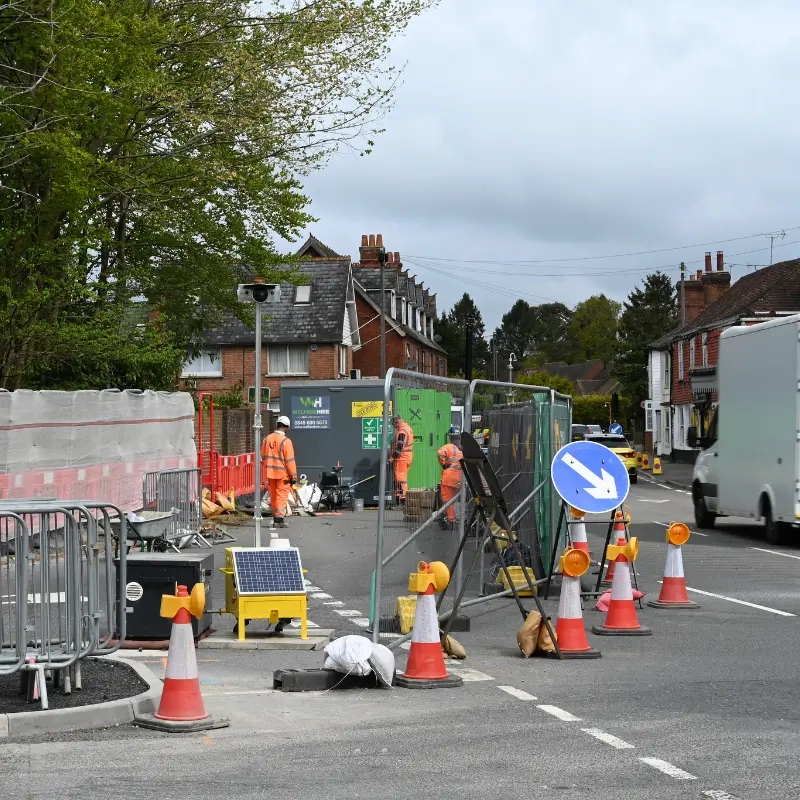
Our rapid deployment CCTV Towers can be installed in 20 minutes (for basic setups) to provide security coverage wherever it's needed, including temporary worksites and diversions. Once installed, the towers are a highly visible deterrent to trespassing, theft and anti-social behaviour.
Security can be bolstered through our AI-powered Intrusion Detection Systems, which automatically identify unauthorised access and trigger immediate alerts. This fully-managed security service is backed by NSI Gold-Accredited remote monitoring partners, with trained professionals responding to threats within seconds and summoning the police if necessary.
As an extra measure, you can include Mobile Keyholding Response, where licensed security specialists check the site upon receiving a confirmed alert.
These cameras and sensors also help to detect incidents such as site traffic incursions and suspicious vehicle behaviours and movements.
Operating with solar and wireless 4G/5G connectivity, CCTV and Traffic Management Towers are particularly suited to temporary operations and rural areas where permanent surveillance is impractical or expensive.
Key benefits:
-
Prevent theft, vandalism and unauthorised access
-
Secure rural locations without fixed infrastructure
-
Help keep projects on track
Read more:
2. Safety monitoring: Protecting workers and road users
The same CCTV equipment used for security also supports crucial safety initiatives. High-definition PTZ cameras deliver 24/7 insight into multiple working environments and traffic projects. Gathering continuous data can help detect high-risk areas, revealing frequent site incursion spots, speeding patterns and regulatory non-compliance.
Day and night visibility lets your team remotely access video to ensure safety procedures are being followed. This is particularly relevant for maintenance and roadworks near high-speed routes. Fully autonomous Mini CCTV Towers are an ideal solution to monitor these risky, evolving roadworks and temporary traffic plans. Solar and battery-powered, these compact units can be installed and repositioned by one person.
Smart Detection Systems with built-in AI can be fitted to our CCTV Towers to flag safety incidents such as PPE non-compliance and fire risks:
-
PPE Monitoring and Detection Systems use AI-driven analytics to identify when workers are not wearing required protective equipment. This automatic tracking helps contractors enforce compliance and protect their crews on high-risk road projects.
-
Smoke and Fire Detection Systems warn of early signs of smoke and fire. AI video detection is better suited to open-road environments and reacts faster than traditional fire alarms, enabling rapid response to protect your assets.
Key benefits:
-
Improve oversight of temporary traffic management schemes
-
Supports safer operations near live traffic
-
Strengthens PPE compliance, fire safety and incident detection
-
Provides timestamped data and video evidence for incident investigations
Read more:
3. Environmental monitoring and compliance
Today, smart IoT-based sensors extend site visibility beyond CCTV surveillance. This technology lets local authorities and contractors track environmental conditions throughout all projects to manage safety and compliance.
By deploying advanced Environmental Monitoring Sensors on our CCTV Towers, work teams can track noise and air quality levels against permitted limits. They can also stay fully updated on site-specific weather conditions that might affect operations.
-
IoT Air Quality Sensors continuously monitor dust, fine particulate matter, TVOCs, carbon monoxide (CO) and carbon dioxide (CO₂). This real-time data helps contractors responsibly control airborne pollutants from work activities.
-
Noise Monitoring Sensors capture sound over ranges of 30-130 Decibels and 20Hz to 12.5kHz. The system alerts project managers before noise levels breach thresholds or become a health hazard.
-
Weather Monitoring Sensors track wind, rainfall, humidity and temperature conditions 24/7. Precise climate updates let you adjust work schedules, protect crews and prepare emergency responses to limit weather-related disruptions, damage and rework.
Key benefits:
-
Monitor environmental impacts in real-time
-
Strengthen workplace safety
-
Reduce community complaints
-
Provide data-backed evidence to justify route closures or detours
-
Improve compliance with environmental regulations
-
Create environmental records for audits
-
Support ESG reporting
Read more:
4. Project overview: Complete visibility from one platform
Effective safety and traffic oversight demands a clear understanding of what's happening across multiple locations. Whether managing a temporary traffic scheme, a remote rural project, planned maintenance or emergency repairs, you need high-quality, current information to make the best decisions.
Our dedicated cloud platform provides a centralised view of live and recorded footage, incident alerts and environmental data from all monitored sites. Customised software and cloud connectivity ensure you can access this essential overview on your phone or laptop at any time, from any connected location.
The platform transforms fragmented reporting into smart unified dashboards, enhancing investigations and easing admin for management and their teams, freeing everyone from constant firefighting.
Key benefits:
-
High-level view of project performance, incidents, complaints and site activity
-
Live and historic footage can be accessed from anywhere
-
Improves decision-making through complete project data
-
Creates a centralised operational picture across multiple sites
Get Complete Visibility and Automatic Incident Detection with Smart Monitoring
When road incidents go unseen with no data collected, managers lack the information to prevent similar incidents from recurring. The result? A repeat cycle of accidents, loss, complaints, councillors' interrogations and potential lawsuits.
Delivering a modern road network demands reliable project visibility and proactive management. Mobile traffic solutions that can be deployed quickly wherever visibility is required provide these capabilities. A CCTV Tower installed to secure a temporary roadworks site can also support worker safety, provide project oversight and integrate environmental and fire threat monitoring.
When your team is remotely alerted to unplanned incidents quickly, you have the control to minimise disruption, reduce risks and provide the public with the reliable, safe service they expect.
To explore our market-leading monitoring solutions for high-risk, remote, project and temporary environments, contact our team before your next undertaking.