In the construction industry, health and safety officers can't manage what they can't see.
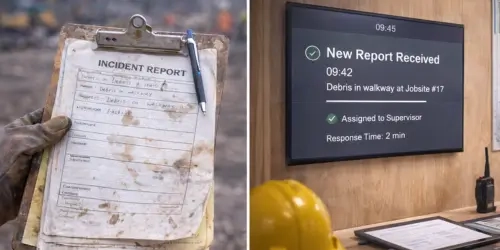
Yet many construction companies still rely on outdated legacy systems (periodic spot checks, manual reporting, etc.) where important safety information can easily slip through the cracks. Site safety data ends up scattered across disconnected spreadsheets, incident logs live in filing cabinets and environmental readings are stored in entirely different systems.
When something goes wrong, site managers are forced to piece the problem together from fragmented sources, which leads to reactive responses as opposed to preventative ones. In those moments, safety leaders and project management teams end up relying on judgment calls instead of clear, current evidence.
This is where live data visibility makes a real difference. By bringing information into a single view, project managers can see exactly what's happening on-site in real-time.
In this article, we break down the importance of data visibility in construction site safety, how it helps reduce risk and improve on-site decision-making for current and future projects.
7 Reasons Why Real-Time Data Visibility Matters in the Construction Industry
Data visibility means having instant access to up-to-date information about what's happening across all building sites. It isn't based on last week's summary or a report someone forgot to send, but rather live data, available when you need it.
Here's why that matters and makes a big difference for the construction industry:
-
Improved decision-making: Site teams make better decisions when they notice incidents or compliance gaps as they unfold. No second-guessing; they see the problem and act on it instantly.
-
Project predictability: Schedule tracking and monitoring progress become easier when data is presented in a single view. Instead of waiting days for progress updates, real-time visibility allows project managers to spot delays early and adjust resource allocations to keep construction projects on track.
-
Team alignment: Fragmented data opens the door for miscommunication between teams. When site managers and safety officers work from the same dashboard, communication naturally improves because they use the same up-to-date information.
-
Risk management: Site safety risks can escalate in an instant, and they don't wait for your next scheduled inspection to occur. Real-time visibility lets you monitor worker safety and air quality readings as conditions change, allowing you to step in long before injuries or fatal accidents take place.
-
Cost control: Mishaps on-site cost money: claims from safety incidents, compliance violation penalties and project delays. Visibility helps you catch problems before they escalate into site shutdowns or HSE On top of this, paying for multiple vendors with similar functionality doesn't make financial sense.
-
Regulatory compliance: HSE regulators expect recorded evidence of safety measures and continuous monitoring. Audits are simplified when live and historical data are visible and accessible.
-
Positive reputation: Construction firms with enhanced visibility across all safety conditions show proactive risk management and adherence to industry standards. By mitigating risks before they escalate, they build trust with clients and stakeholders and solidify their reputation as a reliable, safety-first company.
Read more:
- The Rise of Smart Safety Systems in UK Construction
- How HSE Regulations Are Evolving to Advance Construction Site Safety
How Smarter Monitoring Systems Outperform Traditional Methods
Traditional site monitoring can't keep up with modern construction. Periodic inspections, paper logs and reactive reporting made sense when construction sites were smaller, and regulators expected less from project teams.
Here's a quick overview of how smart monitoring, with real-time data visibility, outweighs outdated legacy systems:
| Feature | Smart monitoring | Traditional methods |
| Data access | Live, 24/7, from any device | Delayed; relies on manual input |
| Incident logging | Instant timestamped site data | Manual, prone to human error |
| Compliance evidence | Always audit-ready | Delayed; project managers manually compile site data from multiple sources |
| Risk detection | Proactive; pattern-based | Reactive; after incidents occur |
| Multi-site visibility | Centralised dashboard for multiple sites | Fragmented, siloed data |
| False alarm filtering | AI-powered threat detection filters false alarms with near-pinpoint accuracy | High false alarms risk |
| Admin burden | Minimal | Extensive |
Traditional methods fall short in the construction industry because they create blind spots and "hidden risks".
When site safety data lives in separate spreadsheets and different vendor tools, project teams only ever see part of the picture. Near-misses go unnoticed, and trends aren't picked up. By the time the information reaches decision makers, it's already outdated, and incidents have most likely already occurred and/or caused damage.
Smart site monitoring closes those gaps. Connected CCTV cameras and cloud platforms, like Stellifii, feed every reading and alert into a single dashboard. Health and safety officers can pull up this information via searchable timelines and export reports in just a few clicks.
Read more:
- How Real-Time Construction Site Reporting Works
- How Smart Monitoring Systems Enhance Construction Site Safety
The Technology Enabling Better Data Visibility in UK Construction
So, what does good data visibility in construction site safety look like in action? It starts with the right technology:
Rapid deployment surveillance
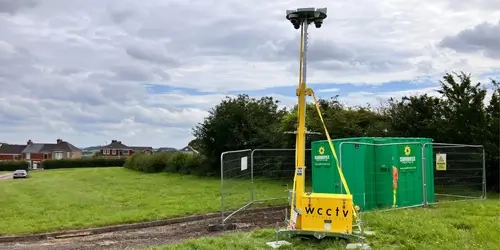
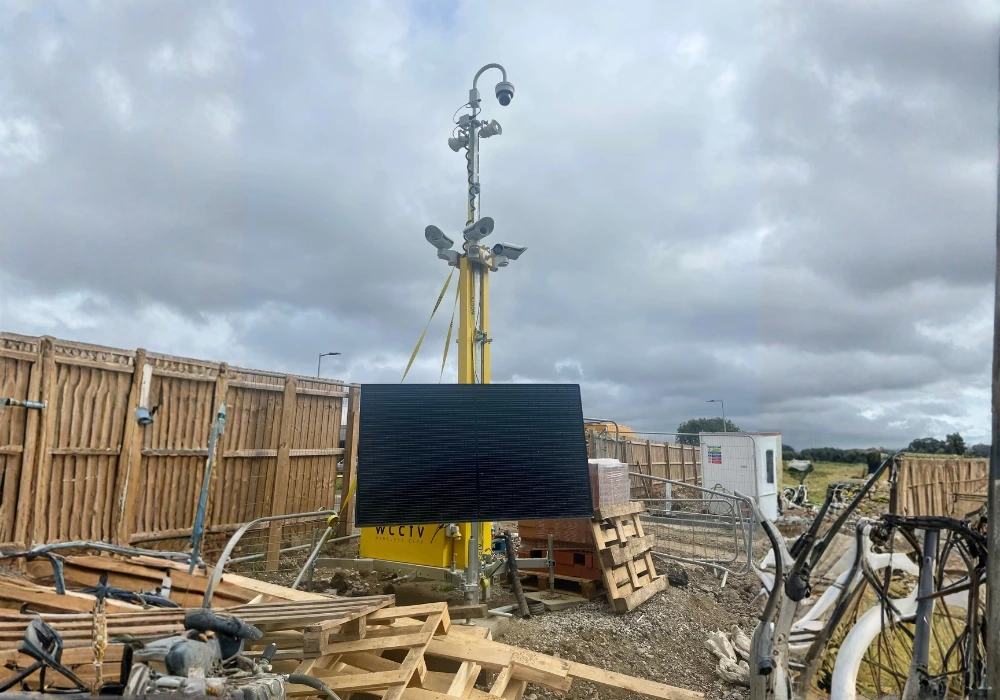
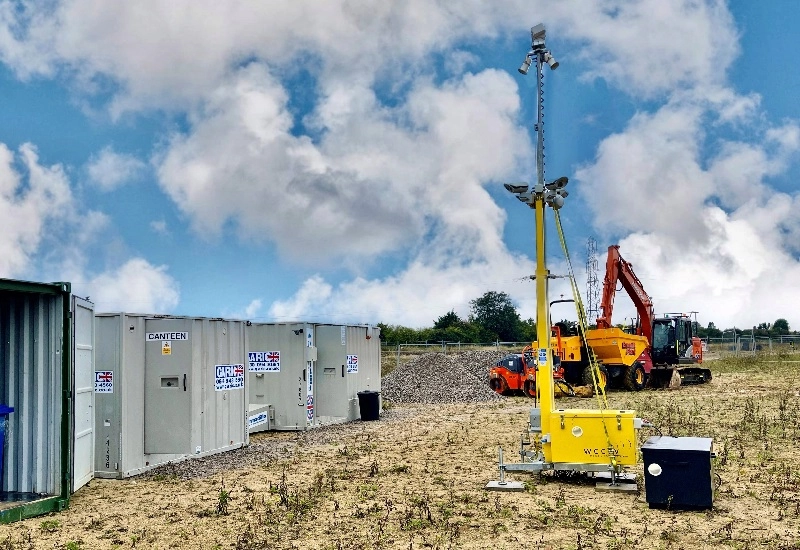
CCTV Towers and Temporary CCTV solutions provide 24/7 site coverage across large, complex building sites. Standing up to 6 metres tall with a near-360° field of view, they actively capture everything that happens on-site.
When connected to professional remote monitoring services at NSI Gold Accredited monitoring facilities, footage is reviewed live and actions are triggered immediately (voice down challenges, mobile keyholding dispatch, etc.). This level of surveillance eliminates blind spots and transforms site activity into actionable insights, giving safety managers full visibility at all times.
Read more: The Best Options for Construction Site CCTV
AI-video analytics
Intelligent software uses machine learning and artificial intelligence (AI) to analyse footage continuously. Systems distinguish genuine safety threats from false alarms, timestamp each event and create searchable logs without human intervention.
Integrating seamlessly with our CCTV Towers and Redeployable Cameras, smart AI-powered systems give construction professionals a complete visual record of site activity, accessible in minutes.
Read more: Smart Analytics Insights in Construction
Real-time alerts
Real-time alerts enhance visibility in the construction industry by turning raw video feeds into actionable notifications and insights. When site teams receive instant alerts, whether from a PPE violation or a perimeter breach, they can make more informed decisions and implement preventive measures/corrective actions before small issues become significant problems.
Read more: Reducing Construction Site Incident Rates Through Real-Time Monitoring
Smart detection systems
Safety managers cannot be everywhere at once, especially across multiple sites.
Smart detection devices close that visibility gap. By automatically identifying PPE violations, intrusions and smoke/fire hazards, these add-on features catch safety issues in high-risk areas without human involvement.
Read more: PPE Detection in Action: Keeping Construction Projects Compliant with HSE
Advanced access control
Automatic Number Plate Recognition (ANPR) logs all vehicle movement on site. It captures (and timestamps) entry and exit times to create a clear digital trail for internal reviews, police investigations and external audits.
Read more: The Benefits of Automatic Number Plate Recognition (ANPR)
IoT technology
Environmental solutions with Internet of Things (IoT) tech track various atmospheric metrics that cameras can't capture, storing up to 180,000 timestamped logs for trend analysis:
-
Air quality sensors monitor particulate matter, CO₂ and VOCs for ESG and Control of Substances Hazardous to Health Regulations (COSHH) compliance.
-
Noise sensors track noise levels (30-130 dB), ensuring sites are fully compliant with Section 61 industry standards.
-
Weather monitoring systems provide live data on wind, temperature, humidity and rainfall. This information allows project management teams to make more informed decisions about worker safety on-site.
Read more: The Role of Environmental Monitoring in Meeting CDM 2015 Requirements
Unified dashboards
Stellifii streams all the above into a single, AES256-encrypted dashboard. Surveillance, environmental data, safety protocols, smart detection logs and incident reports all live in one place, giving teams a clear, consolidated view of construction safety and ensuring audit readiness, even when inspectors arrive unannounced.
On top of this, integrated monitoring generates reports up to 5X quicker than legacy systems, freeing health and safety officers from hours of manual work.
Read more: Unifying Security and Site Monitoring: The New Standard for UK Contractors
5 Best Practices for Improving Construction Visibility
Smart technology is only part of the solution to enhanced visibility across your business.
Here are 5 quick steps you can take to improve safety for current and future projects:
-
Consolidate monitoring systems: Move away from outdated, fragmented technology and multiple vendors. Choose platforms that integrate surveillance, site condition data and access controls into a single dashboard.
-
Automate data capture: Manual entry creates gaps and is prone to human error. Use smart software that logs events automatically while creating a digital trail with timestamps and video evidence.
-
Set alert thresholds: Define when alerts will be issued: PPE violations, environmental spikes and/or access control issues.
-
Review data regularly: Visibility means nothing if no one checks the data. Schedule daily/weekly reviews to spot trends, identify problem areas and track improvements.
-
Train your teams: Make sure project managers and site teams know how to access live dashboards, interpret data and act on real-time insights.
Read more: Choosing a Monitoring Partner That Understands UK Construction
Construction Data Visibility Done Right
Guesswork isn't a site safety strategy. When data is fragmented or delayed, HSE leaders are pushed into reacting to incidents instead of stopping them earlier.
Data visibility is important for construction site safety because you can see what's happening across your building site in real-time. Potential hazards are identified early, decisions are backed by concrete evidence and audits become much more straightforward.
With 6 regional hubs and over 2 decades of wireless monitoring expertise, we deliver fully-managed monitoring solutions that give construction companies complete, real-time visibility from day one.