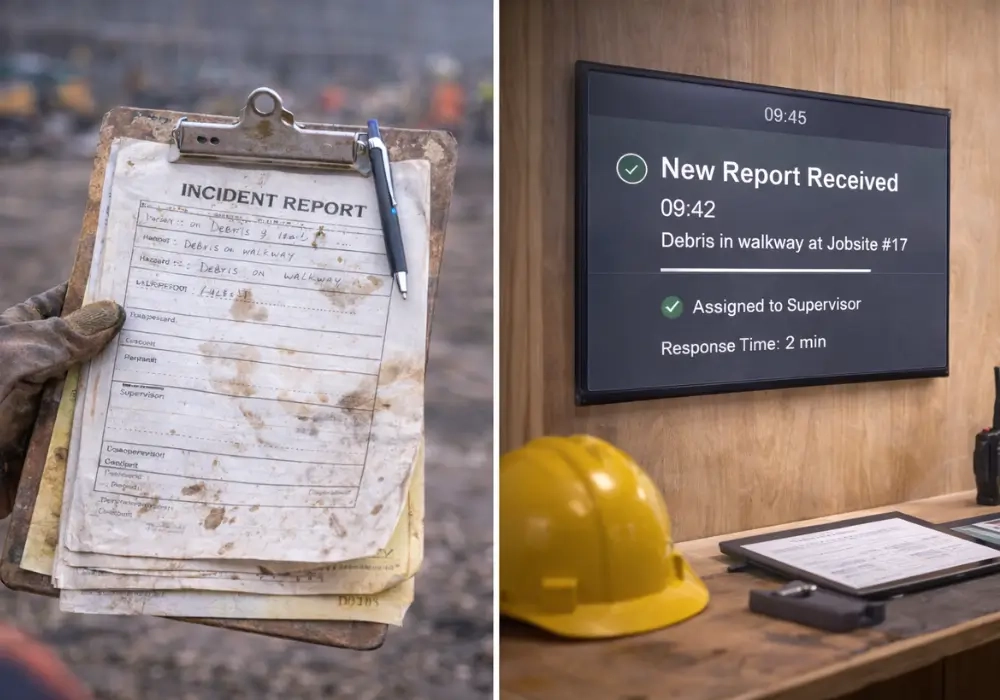
If you've ever spent hours pulling together incident logs, chasing inspection records or scrambling to find documentation before an audit, you already know the problem many health and safety officers in construction face.
Traditional reporting methods are slow and fragmented. By the time a weekly report lands on your desk, the data is already outdated. And if something goes wrong mid-project, compiling reports becomes hard and time-consuming when you're sifting through handwritten notes and isolated spreadsheets.
But there's an easier and smarter solution to all this: real-time reporting. Instead of waiting for end-of-week summaries, contractors and safety officers see what's happening on-site as it happens. Every incident and environmental reading is timestamped, providing up-to-date data when it matters most.
This article breaks down how real-time construction site reporting works, why it's replacing legacy systems and how it turns reporting from a reactive burden into a proactive safety tool.
Why Real-Time Site Reporting Matters and Why It's Replacing Legacy Systems in Construction
Traditional reporting tools like isolated spreadsheets and periodic site walks were never designed to keep pace with modern construction projects.
Nowadays, sites are bigger and more complex, and compliance expectations have increased. Safety officers already stretched thin find it difficult to manage dozens or even hundreds of construction workers and keep up with evolving HSE regulations. Relying on manual logs and weekly reports simply doesn't cut it anymore.
Here's where traditional methods fall short:
-
Delayed information: Weekly or monthly reports mean decisions are based on outdated project data. By the time an issue is flagged, the damage has likely already occurred.
-
Fragmented records: Data scattered across spreadsheets and different vendor tools makes it nearly impossible to get a complete picture of site activities.
-
Communication gaps: Manual handovers between shifts and site teams create opportunities for miscommunication and mistakes.
-
Human errors: Handwritten notes and informal emails increase the risk of data errors.
-
Reactive decision-making: Without live insights, site managers and safety leaders spend more time reacting to incidents rather than preventing them.
Did you know that many construction companies spend around 60-80% of their IT budget to keep existing legacy applications running? That's before you even factor in the cost of project delays, errors and compliance violations.
Here's how real-time reporting tools change this:
-
Faster decision-making: Site teams act on accurate data rather than waiting for weekly updates.
-
Operational efficiency: Instant reporting removes delays caused by manual data entry.
-
Improved data accuracy: Data captured automatically reduces errors and duplication.
-
Better compliance: Safety checks, environmental logs and audit trails have immediate visibility.
-
Reduced admin burden: Reports generate automatically; no need to wait for project reporting from site teams.
Read more:
How Real-Time Construction Site Reporting Works
Real-time reporting relies on connected technology (cameras, sensors, software, cloud-based platforms) to gather, analyse and process site data. Each device/component feeds into a centralised system that logs site activities the moment they happen and makes this information accessible whenever it's needed.
Here's a quick overview:
| Key technology | What it is | How it works |
| Smart surveillance | Captures visual evidence 24/7 | CCTV Towers and Temporary CCTV with PTZ cameras stream live footage to NSI Gold Accredited centres |
| AI-video analytics | Detects incidents automatically and filters false alarms | Machine learning and smart software analyse footage, flag issues and timestamp events |
| IoT-based sensors | Tracks environmental conditions | Air quality, noise and weather conditions are tracked continuously |
| Smart detection | Identifies specific threats and logs every incident | PPE violations, intrusion alerts and smoke/fire warning trigger instant alerts |
| Access control | Logs site entry/exit | ANPR technology records all vehicle movements |
| Cloud dashboards | Consolidates all project data in one place | Platforms like Stellifii bring everything into one platform for instant access |
Smart surveillance
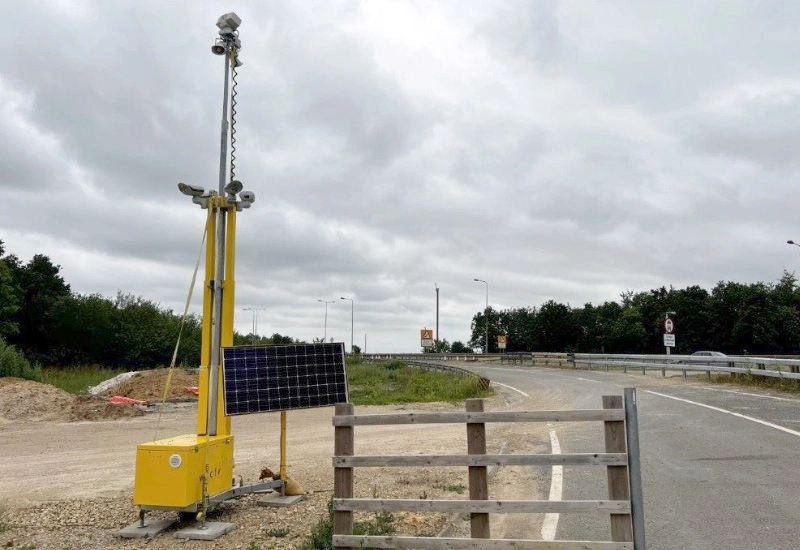
Rapid Deployment CCTV Towers and Temporary CCTV solutions provide 24/7 visual coverage across construction sites. Standing up to 6 metres tall with near-360° PTZ cameras, they capture everything happening on-site, both day and night.
When paired with professional remote monitoring services linked to NSI Gold Accredited centres, trained operators review site footage in real-time. So, when incidents occur, these professionals take various actions such as voice-down warnings or dispatch mobile keyholding teams. Every incident is logged with video evidence, creating an audit trail that's ready when you need it.
Smart surveillance systems also support add-on integrations such as smart detection systems, Automatic Number Plate Recognition (ANPR) and IoT-based environmental sensors that give site teams complete oversight.
Read more: The Best Options for Construction Site CCTV
AI-video analytics
Systems powered by artificial intelligence (AI) analyse live footage the moment they receive it. They distinguish real threats (intruders, theft attempts, PPE violations) with near-pinpoint accuracy while filtering out false alarms caused by passing traffic, wildlife or gusts of wind.
Machine learning algorithms detect patterns, flag anomalies and timestamp each event automatically, creating a digital trail with searchable logs of site activities without any manual input.
Read more: How Artificial Intelligence is Revolutionising CCTV Tower Monitoring
IoT sensors
Some construction site hazards don't show up on cameras. This is where smart environmental monitoring solutions are making a real difference when it comes to ESG construction reporting:
-
Air quality sensors track fine particulate matter (PM1, PM2.5, PM10), CO₂, TVOCs and other toxic fumes and pollutants. These logs are vital to show due diligence and compliance with the Control of Substances Hazardous to Health Regulations (COSHH), as well as ESG
-
Noise monitoring devices track a wide range of sound (30-130 dB) and frequency (20Hz to 12.5kHz) levels present on building sites. Every reading is timestamped and logged, making Control of Noise at Work compliance easier and corrective action faster.
-
Weather monitoring systems monitor live atmospheric metrics such as temperature (-40°C to +60°C), hourly rainfall, wind speed (0-110 mph) and humidity (10-99%). Systems transmit data wirelessly, supporting better planning, safety and compliance across a range of industries.
Adding IoT-backed capabilities to your site monitoring systems makes it easy to meet various safety regulations in the UK. These systems store up to 180,000 timestamped readings for trend analysis and compliance reporting.
Read more: Environmental Compliance with Noise Monitoring Sensors
Smart detection systems
Add-on smart detection systems take monitoring further by identifying specific site risks in real-time:
-
PPE detection and monitoring systems flag construction workers entering hazardous zones without the required safety equipment (safety goggles, hearing/eye protection, safety harnesses, etc.). Systems send HSE managers instant insights and alerts for swift corrective action.
-
Smoke and fire detection devices pinpoint the earliest signs of fire hazards (thin smoke trails, flickering light, colour changes, etc.) and trigger immediate response while timestamping each incident for internal review and/or external audits.
-
Intrusion detection systems can differentiate between an intruder scaling a perimeter fence and harmless activity/false alarms caused by wildlife or "normal" worker behaviour.
Read more: PPE Detection in Action: Keeping Construction Projects Compliant with HSE
Access control
Both Construction (Design and Management) CDM Regulations and the Health and Safety at Work Act (HASAWA) 1974 stipulate that construction project reporting must include unauthorised access prevention.
Automatic Number Plate Recognition (ANPR) logs every vehicle entering/exiting all construction zones, creating a timestamped, digital record without the need for manned security. These automated reporting features give health and safety officers a clear roadmap of who was on-site, when they arrived and when they left. This information is also useful for police investigations and insurance claims.
Read more: How Integrated CCTV and ANPR Keep UK Sites Secure and Compliant
Consolidated dashboards
Our cloud-based platform, Stellifii, is where all the above-mentioned site data comes together. Stellifii consolidates surveillance, site monitoring, access logs and smart detection alerts into a single, unified dashboard accessible from any device.
Want to pull a report for an HSE inspection? Need historical vehicle logs from 3 months for an insurance claim? Or perhaps you need to inform stakeholders with a project progress update? All of this real-time data is available within a few clicks alongside your surveillance footage. Search by date, time or event type and generate reports up to 5X faster than legacy systems.
Read more: Unifying Security and Site Monitoring: The New Standard for UK Contractors
Proof that Live Site Reporting Works
The move toward smarter site reporting isn't new to the construction industry, yet many firms remain hesitant to make the change. If you're still on the fence about embracing the digital era in construction management and reporting, here's proof of why it works:
-
40-50% incident reduction: Companies using AI-powered continuous monitoring report significant drops in safety incident rates.
-
5X faster reporting: Cloud-based dashboards, like Stellifii, consistently generate audit-ready reports faster than traditional reporting methods.
-
61% improved working schedules: Reports show that contractors using real-time construction project management software (with real-time reporting) adhere to project milestones better.
-
70% reduction in project delays: Real-time data and reporting can significantly reduce project delays.
-
15% cut in cost overruns: Some construction businesses have reduced budget overruns when implementing real-time reporting software.
Read our case studies to explore how we help companies like yours solve real-world issues.
Construction Site Reports Done Right
Construction project reporting shouldn't be something you dread. With the right system in place, compliance becomes straightforward, supported by real-time insights that drive faster, more informed decisions.
Smart monitoring systems and cloud-based platforms like Stellifii replace piles of paperwork with live, timestamped data that's always audit-ready. Whether it's an unannounced HSE inspection or internal reports to keep stakeholders informed, you've got evidence at your fingertips in just a few clicks.
With 6 regional hubs and over 20-years of smart monitoring expertise, we offer fully-managed cloud reporting tools to construction firms of all sizes across the UK.