Real-time reportingWorkplace hearing loss costs the UK construction sector over £30 billion each year in medical treatments, compensation and lost productivity. Construction workers are 3X times more likely to experience hearing issues than the average employee, and once hearing is gone, there's little that can be done to fix it.
For health and safety managers, reducing noise exposure is a legal duty under Health and Safety Executive (HSE) standards. Failing to control it can result in enforcement action, £20,000 fines (per incident) and long-term harm to your workforce.
The solution? Smart noise monitoring.
In this article, we'll explain why noise exposure is a serious risk in UK construction, what HSE regulations expect and how smart noise monitoring protects workers while keeping you on the right side of regulatory compliance.
Why Noise Exposure is a Serious Issue for Construction Sites
Construction noise is one of the biggest occupational hazards because it's invisible to the naked eye.
Unlike visible workplace injuries, the effects of excessive noise develop over time, which makes it hard to monitor until considerable damage has already been done. What's more, noise pollution (including construction noise) is the second-largest environmental danger to workers' wellbeing.
Here's a closer look at the dangers of unmanaged noise in the construction industry:
Long-term health issues
-
Permanent hearing loss: Prolonged exposure (above 85 decibels (dB)) causes noise-induced hearing loss (NIHL) and permanent damage to nerve endings in the inner ear. Neither surgery nor a hearing aid can correct this type of hearing loss.
-
Tinnitus: Constant ringing, buzzing and/or humming in the ears are conditions that never fully restore. Tinnitus is often linked to sleep disturbances and heightened irritability.
-
Cardiovascular problems: Excessive environmental noise is associated with increased arterial hypertension (high blood pressure), myocardial infarction (heart attack), stroke, stress‑related physiological responses and heightened stress/cortisol levels.
-
Sleep disturbances: Noise pollution can disrupt sleep and cause insomnia for workers and nearby communities.
Safety issues
-
Reduced awareness: High noise levels interfere with communication and warnings on-site. For instance, workers might not hear fire safety warnings during loud activities such as demolition or excavation.
-
Unsafe behaviour: Noise disturbance has been found to slow down brain performance and decision-making, which can affect how workers behave while performing duties.
-
Increased injuries: When workers can't hear warnings or their concentration is impaired due to high noise levels, they are at a higher risk of injuries and fatalities.
Legal issues
-
Noise complaints: Loud and prolonged construction noise can lead to complaints from neighbours. In fact, London, Leeds and Huddersfield are among the UK’s noisiest construction hotspots, each receiving around 600 public noise complaints every month.
-
After-hour breaches: The Noise Pollution Control Act 1974 limits noisy construction work between 8 AM and 6 PM, Monday to Friday, and between 8 AM and 1 PM on Saturdays. If you work outside these hours, you can face penalties, site shutdowns and legal action.
-
Enforcement action: Noise Abatement Notices under Section 80 of the Environmental Protection Act (EPA) 1990 can be issued when noise becomes a "statutory nuisance" when exceeding 87 dB(A) limits.
HSE Noise Regulations for UK Construction: Breakdown
In the UK, the Control of Noise at Work Regulations are enforced by the Health and Safety Executive (HSE). Here are some of those regulations every construction safety manager needs to know:
| Regulation | Purpose | Compliance requirements |
| Control of Noise at Work Regulations 2005 | Protects workers from hearing damage |
|
| Construction (Design and Management) CDM Regulations 2015 | Manage construction health and safety risks across all project phases |
|
| Control of Pollution Act (CoPA) 1974 | Control construction site noise levels |
|
| Environmental Protection Act (EPA) 1990 | Enforces statutory nuisance complaints |
|
| Health and Safety at Work Act (HASAWA) 1974 | Employers' general duty of care to workers |
|
| Personal Protective Equipment at Work Regulations (PPER) 2022 | HSE legislation for proper workplace PPE |
|
| British Standard BS 5228-1:2009 + A1 2014 | Guidance for vibration and noise control in construction/open sites |
|
| Considerate Constructors Scheme | Voluntary membership for worker wellbeing, community relations and environmental impact |
|
Legal noise exposure limits in the UK
There are 3 noise exposure thresholds under Regulation 4 of the Control of Noise at Work Regulations. For the purpose of compliance, this means health and safety officers must observe both daily/weekly average personal exposure (dB(A)) and peak sound pressure levels (dB(C)).
| Threshold | Average decibel | Peak sound pressure |
| Lower exposure action value | 80 dB(A) | 135 dB(C) |
| Upper exposure action value | 85 dB(A) | 137 dB(C) |
| Exposure limit value | 87 dB(A) | 140 dB(C) |
Should construction noise exceed these limits, site managers must conduct thorough risk assessments and mitigate exposure "so far as it is reasonably practicable".
Typical construction noise levels
Construction sites are naturally noisy. Activities such as piling, drilling, excavation, jackhammering and operating heavy machinery can quickly surpass safe thresholds within minutes. The problem? Exceedances may go undetected until damage is done without continuous monitoring.
For context, here's a quick breakdown of the typical sound levels certain construction activities produce:
-
Piling: 95-115 dB
-
Drilling (rock): 95-110 dB
-
Jackhammering: 100-115 dB
-
Heavy machinery: Up to 120 dB
Non-compliance risks
-
CoPA fines reaching up to £20,000 per offence
-
Noise Abatement Notices under Section 80 of the EPA
-
Enforcement action
-
Site shutdowns and project delays
-
Employers' liability claims
-
Reputational damage
Read more: Rethinking Construction Compliance Through Smart Monitoring Systems
3 Ways Smart Noise Monitoring Protects Workers' Hearing and Ensures Compliance
In a nutshell, smart noise monitoring uses IoT technology to track noise levels across building sites. Smart noise management is seen as both a health protection measure and a compliance safeguard in modern construction.
1. Real-time alerts
Noise monitoring is a type of environmental monitoring solution that protects surrounding communities and displays regulatory compliance through accessible data and automated reports.
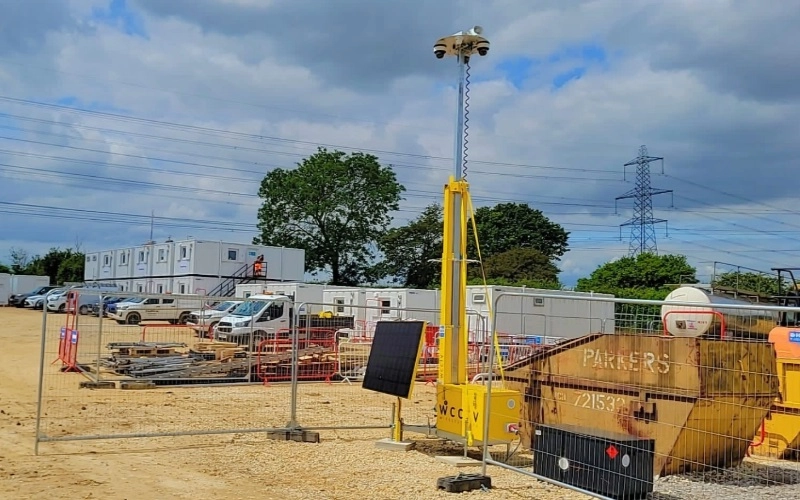
Integrated with advanced CCTV Towers/Temporary CCTV and cloud platforms like Stellifii, noise readings feed into a centralised dashboard together with surveillance footage.
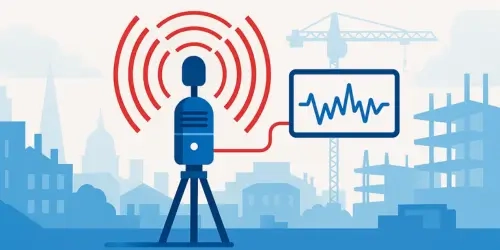
Using a condenser microphone, noise sensors monitor a wide sound (30-130 dB) and frequency (20Hz to 12.5kHz) range across outdoor environments in real-time. When readings reach predefined thresholds, site managers receive alerts before violations occur, allowing for immediate action.
Unlike manual spot checks that only record sound readings here and there, continuous monitoring helps you track trends, pinpoint problem areas and maintain compliance with ESG and Section 60/61 standards without physical site presence.
What's more, add-on smart detection systems can be used to make sure workers are equipped with the right PPE (e.g., hearing protection) during noisy tasks. These mobile device systems alert managers when safety gear is missing and timestamp every event for data analysis and external audits.
For teams working under Section 61, BS5228 or local regulations, smart noise detection with live alerts isn't just best practice; it's essential.
Read more:
2. Weather data improves accuracy
Weather factors such as temperature and wind speed influence how sound travels across a building site. Wind direction, for example, carries noise toward/away from workers, and heat/humidity levels affect how sound is absorbed.
For the most accurate data in noise management, it's best to integrate noise sensors with weather and air quality monitoring systems:
-
Weather sensors track real-time atmospheric conditions such as temperature, wind speed and humidity, all of which can influence how sound travels and is recorded.
-
Air quality monitors pollution levels and airborne particulates that may also affect workers' hearing and ambient sound readings.
This combination gives health and safety officers a much clearer picture of site conditions, leading to fewer false alarms and regulatory infringements.
Read more: The Role of Environmental Monitoring in Meeting CDM 2015 Requirements
3. Automated compliance
Smart noise sensors automatically store up to 180,000 timestamped logs, creating a continuous record for trend analysis and regulatory compliance. Every reading is transmitted into Stellifii via 4G/5G networks, where both current and historical data can be accessed at any time.
With Stellifii, every sound reading is:
-
Recorded with location-specific timestamps
-
Analysed using AI-video analytics and smart monitoring software
-
Stored in industry-approved cloud infrastructure with AES256 encryption
This level of visibility ensures nothing slips through the cracks and provides concrete evidence should disputes arise. For safety officers, this allows you to intervene early to protect workers' hearing when thresholds are reached and gives you complete oversight from afar.
Additionally, Stellifii generates audit-ready documentation up to 5X faster than legacy systems. Through remote access, noise levels and historical trends can be reviewed in just a few clicks, whether investigating employee complaints or preparing documentation for HSE inspectors.
Read more:
5 Benefits of Smart Noise Monitoring in Construction
Smart noise monitoring offers many advantages for those in the construction industry:
-
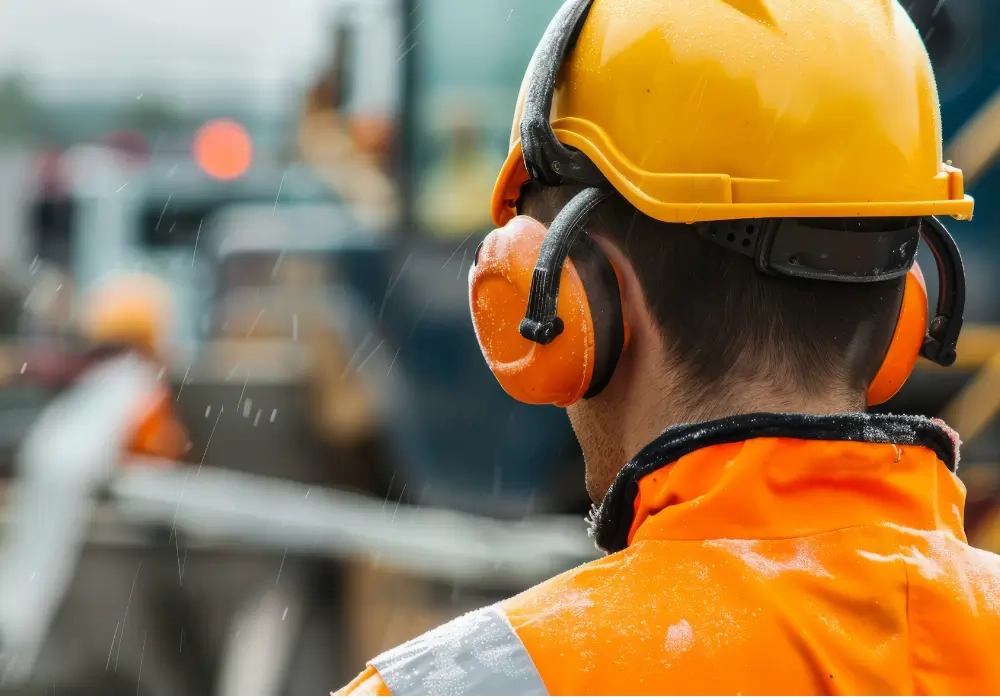
Worker protection: Continuous monitoring catches noise exposure risks before they cause permanent hearing damage to workers. Smart detection ensures staff wear PPE during noisy tasks automatically.
-
Easier HSE compliance: Real-time reporting and alerts allow quick intervention when thresholds are reached, reducing the risk of compliance breaches. Timestamped logs and automated documentation through Stellifii make audits easy.
-
Operational benefits: Early warnings prevent non-compliance risks that trigger Noise Abatement Notices, site shutdowns and lengthy HSE inspections. Proactive noise management keeps projects on track and workers safe.
-
Minimal legal action: Complying with HSE, ESG and CDM regulations reduces the risk of compensation claims, enforcement action and non-compliance violations.
-
Cost benefit: Unified site monitoring generally means fewer claims, lower insurance premiums and cheaper site monitoring rates compared to traditional methods.
Read more: How Smart Monitoring Systems Enhance Construction Site Safety
6 Ways to Deploy Real-Time Construction Noise Monitoring
Ready to implement smart noise monitoring on your construction site?
Use this 6-step guide to get started:
-
Conduct a risk assessment: Identify high-noise activities regularly carried out on-site, such as demolition, excavation, drilling and earthworks. Evaluate how sound travels beyond your site boundary and pinpoint noise-sensitive receptors, including schools, hospitals and residents.
-
Choose the right sensors: Select IoT noise sensors from reliable UK-based service providers, like WCCTV, that cover a wide decibel and frequency range for accurate measurements across all site activities.
-
Position strategically: Monitoring providers will place sensors at site boundaries, near noise-sensitive receptors and in high-noise producing areas. Consider multiple mobile devices for large construction sites.
-
Integrate with existing systems: Connect add-on noise monitors to CCTV Towers and integrate with other environmental monitoring solutions for complete oversight.
-
Set thresholds: Configure noise sensors with predefined sound level thresholds to enable rapid response before limits are breached.
-
Review and tweak: Use automated reports to track trends and demonstrate due diligence with various HSE regulations.
Read more: Choosing a Monitoring Partner That Understands UK Construction
Monitor Noise Levels the Smart Way
With construction workers being 3X times more likely to suffer work-related hearing issues than the average employee, noise management couldn't be more important. When noise exposure isn’t properly controlled, the risk isn’t only limited to workers; it also puts health and safety officers' reputations on the line.
Smart noise monitoring becomes a safety manager's "eyes and ears" on-site, giving full visibility into exposure levels across every working zone. With continuous recording and timestamped audit trails, site teams can intervene early before thresholds are breached and long before regulators get involved.
With over 20-years of wireless monitoring expertise, we provide fully-managed noise monitoring solutions that protect workers' hearing and keep contractors on the right side of HSE law.
Don’t let unmanaged noise put your next project at risk. Monitor sound levels the smart way: the WCCTV way.