Health and safety managers in UK construction are under a lot of pressure. Stakeholders demand proof of due diligence, Health and Safety Executive (HSE) inspectors arrive unannounced and clients scrutinise compliance records before awarding contracts.
Getting health and safety management wrong can lead to fines of over £160,000 and even worse, put the lives of workers at risk. In fact, 35 construction workers were killed in work-related accidents in 2024/25 alone, with falls from heights accounting for around 25% of these deaths.
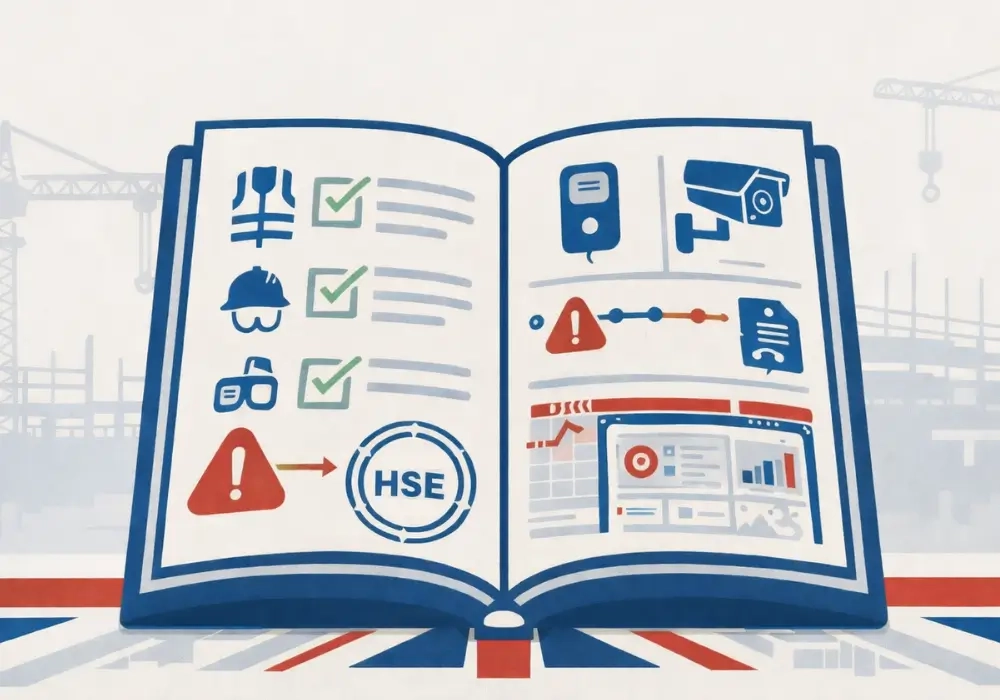
A modern safety HSE playbook for UK safety leaders can change that. By combining proactive risk assessment, integrating real-time monitoring and prioritising CDM 2015 compliance, overstretched safety leaders can move beyond reactive management and cut admin time, prevent incidents and prove due diligence to directors, clients and regulators alike.
This article outlines what effective health and safety management looks like and how UK contractors can achieve safer sites, fewer delays and stronger compliance confidence.
Why Health and Safety Management Matters in UK Construction
There's no denying that construction is one of the UK's major hazard industries, where one decision on site can be the difference between a safe shift and a serious incident.
According to Labour Force Survey (LFS), nearly 700,000 non-fatal work-related injuries occurred in 2024/25, with slips, trips and falls accounting for roughly 30%. On top of this, 13,000 annual deaths in Britain are said to be linked to past exposure to harmful chemicals and dust, and the total costs of self-reported workplace injuries and ill health in 2023/24 cost the industry close to £23 billion.
These aren't just statistics; they're a reminder of what's at stake when health and safety management slips down the priority list.
A structured safety playbook makes safety visible, measurable and proactive, helping you achieve:
-
Real-time visibility: Smart monitoring allows you to see exactly what's happening across all building sites through integrated systems and cloud-based dashboards.
-
Better worker protection: Identify risks (PPE violations, fire hazards, high noise levels) early and act before an injury occurs.
-
Reduced project delays: Fewer incidents mean fewer stoppages, HSE investigations and rework.
-
Less legal exposure: Demonstrating due diligence and compliance with HSE and CDM 2015 standards reduces the risk of costly fines and enforcement action.
-
Consistent compliance: Automated reporting and record-keeping keep you audit-ready at all times.
Read more: How Smart Monitoring Systems Enhance Construction Site Safety
UK Construction Health and Safety Laws Explained
The UK's construction industry operates under some of the strictest health and safety regulations in the world. These laws help to prevent harm, promote accountability, and ensure everyone who steps on site goes home safely.
Here's a quick summary of the most important HSE regulations every UK contractor must know:
| Regulation | Purpose | Compliance requirements | Consequences |
| Health and Safety at Work Act (HASAWA) 1974 | A legal framework for all UK workplaces. | Employers must conduct proper risk assessments, provide safety training and take "reasonably practicable" steps to ensure worker welfare. |
|
| Construction (Design and Management) CDM Regulations 2015 | Core regulation governing safety during design, planning and construction. | Principal contractors must define roles and responsibilities for clients, designers and subcontractors, and provide health and safety planning before work starts. |
|
| Working at Height Regulations 2005 | Governs all work at height where falling is a risk. | Safety leaders must plan and supervise all fall-risk activities, including scaffolds and ladders, as well as plan for emergencies and rescue. |
|
| Personal Protective Equipment at Work Regulations (PPER) 1992 | Requires proper risk assessments and determining which PPE is required. | Safety managers must conduct thorough risk assessments. Employers must provide PPE free of charge and confirm it's in good working order. |
|
| RIDDOR 2013 (Reporting of Injuries, Diseases and Dangerous Occurrences Regulations) | Requires formal HSE reporting of all occupational deaths, illnesses and injuries. | Safety leaders must report serious incidents (e.g., when workers are off work for more than 7 days) to the HSE within 10 days. |
|
| Control of Substances Hazardous to Health Regulations (COSHH) | Protects workers from exposure to harmful dust, chemicals and fumes. | Safety managers must conduct detailed health assessments for health and hazardous substances. They must also implement "Best Practicable Means" (BPM) methods to reduce risks and keep detailed logs and records (in some cases, for up to 40 years for silica exposure). |
|
The HSE's role
The Health and Safety Executive is the UK's national regulator for workplace safety. In a nutshell, it focuses on proactive risk controls so that everyone on-site, from employees to visitors, is safe.
HSE inspectors assess whether construction firms have "suitable and sufficient" control measures for identified risks, like advanced PPE detection in high-risk working zones, and are responsible for:
-
Setting and enforcing safety standards across the UK
-
Conducting unannounced inspections and investigations to check compliance
-
Providing guidance and codes of practice
-
Prosecuting serious breaches for non-compliance/repeated offences
Health and safety leadership expectations
-
Conduct and document thorough risk assessments before construction begins
-
Ensure "suitable and sufficient" control measures for identified risks (including signage)
-
Provide adequate safety training for all employees
-
Continuously monitor all construction zones for compliance/accountability purposes
-
Keep up-to-date records of policies, training, inspections and incidents
-
Record safety incidents and notify HSE of serious injuries/illnesses within 10 days
-
Revise safety playbooks, training and controls accordingly
Read more: How IT Managers Can Support Hybrid and Remote Construction Safety Management
Safety responsibilities under CDM 2015
| Role | Duties under UK law |
| Client(Under Regulation 4) |
|
| Principal designers(Under Regulation 8) |
|
| Principal contractors(Under Regulations 12 and 13) |
|
| Workers(Under Regulation 15) |
|
Read more: The Role of Environmental Monitoring in Meeting CDM 2015 Requirements
Modern HSE Management Best Practices: 4 Step Guide
Use this proven HSE playbook guide to reduce admin burden, prevent incidents and demonstrate due diligence in the construction industry:
Step #1: Always think of the risks
Focus on managing real risks rather than just documenting them by using the "Plan-Do-Check-Act (PDCA)" model:
-
Plan: Pinpoint site dangers with thorough risk assessments. Construction-specific hazards include working at height, confined spaces, electrical work, crane operations, high noise/dust levels and the handling of hazardous substances.
-
Do: Determine the appropriate BPM methods to prevent these risks, such as smart PPE detection to ensure workers use the correct protective gear (reflective vests, hearing protection, safety goggles, etc.) during risky activities, or advanced weather sensors to monitor wind speed before teams work from heights.
-
Check: Continuously watch working zones via internal inspections and/or smart site monitoring to identify patterns and verify the effectiveness of your proposed safety management plan.
-
Act: Respond to findings by adjusting controls and updating risk management policies as needed.
Step #2: Get the team involved
Even with the best system, real safety performance is only as effective as the people who use it. Creating a "safety-first" jobsite means safety is built into every decision on site and everyone takes ownership of their environment.
This culture starts at the top. When safety becomes non-negotiable for leadership, it naturally becomes the standard for the entire team.
Beyond the cultural benefit, the HSE requires construction employers to appoint a "competent person" (someone with the necessary skills and experience) to implement and oversee all health and safety measures.
Here are a few tips:
-
Be an example: Managers must follow the same safety protocols they expect their team to follow. For instance, wearing the correct PPE in designated areas and reporting hazards as soon as they happen.
-
Risk assessment consultation: Involve workers who will actually perform the work to help determine practical controls for high-risk activities. For example, while the textbook threshold for stopping crane operations might be 38 mph, crane operators may suggest halting work at 35 mph based on experience.
-
Conduct toolbox talks: Address real site conditions with detailed briefings and safety training. Use actual site photos and recent near-miss examples to communicate risks in ways that feel relevant to your team.
-
Consider recognition programmes: Praise teams who display excellent safety practices. Recognition strengthens safety management much better than punishment.
-
Encourage reporting: Build a “no-blame” reporting culture where workers feel safe speaking up about hazards and near misses. It’s the fastest way to spot risks before they become incidents.
Step #3: Incorporate digital tools
At the end of the day, effective safety management requires real-time visibility, not spot checks spaced days or weeks apart. Smart monitoring tools enable complete oversight across multiple sites while creating audit-ready reports with minimal effort from you and your team.
-
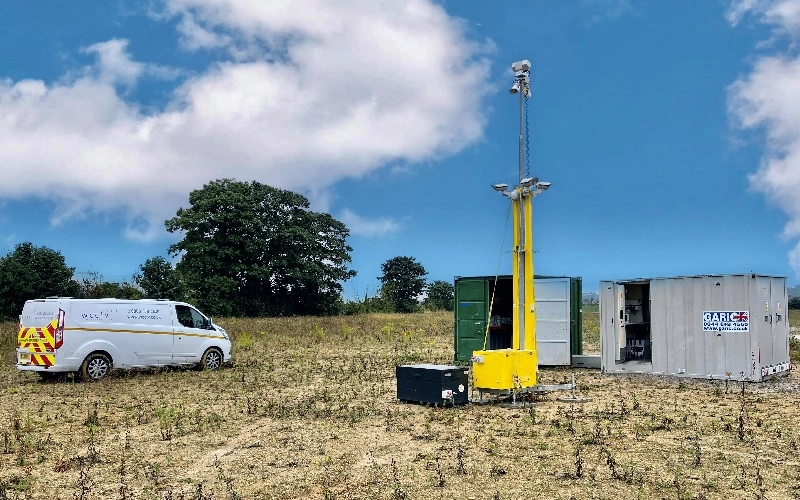
Advanced CCTV surveillance: CCTV Towers equipped with PTZ (Pan-Tilt-Zoom) provide near-360° coverage across all working zones. Night vision cameras deliver 24/7 monitoring regardless of lighting or weather conditions and Redeployable Cameras offer flexible monitoring that adapts to changing site layouts or when temporary CCTV is needed.
-
24/7 Remote monitoring: When CCTV cameras detect potential violations, live data is transmitted to NSI Gold monitoring centres, where trained personnel verify incidents in real-time. They initiate quick actions (live audio voice-down challenges, mobile keyholding dispatch, etc.) to prevent crime and maintain the safety of workers without burdening you or your ops team. This smarter approach to safety management ensures managers only respond to genuine threats, reducing unnecessary callouts for false alarms.
-
IoT-based environmental solutions: Smart sensors track air quality (particulate matter, CO₂, harmful fumes), noise levels (30-130 dB) and weather (temperature, wind speed, humidity) in real-time, which could impact workers' safety and ESG obligations.
-
Smart detection systems: Advanced PPE detection systems use AI-video analytics to identify workers entering high-risk areas without the required equipment. Intrusion detection software prevents unauthorised access that could endanger employees' lives and smoke/fire detection instantly flags the earliest warning signs before small issues escalate.
-
Advanced integrations: Automatic Number Plate Recognition (ANPR) documents all vehicles entering/exiting building sites. Body Cameras record worker-public interactions and flag anti-social behaviours (ASB). Time Lapse Video documents project progression at set intervals in real-time.
-
Data consolidation: Stellifii, our cloud-based platform, sets the baseline standard for UK contractors. It consolidates all safety, security and environmental data into a unified dashboard accessible from any device. View live CCTV footage, environment readings and PPE alerts all in one place, while generating audit-ready compliance documents up to 5X faster than legacy systems.
Read more:
-
Weather Monitoring Tools That Keep Construction Projects on Track
-
Unifying Security and Site Monitoring: The New Standard for UK Contractors
Step #4: Keep comprehensive records
Did you know you can fail an HSE inspection, not from actual safety violations, but because you didn't keep continuous monitoring logs or verify employee training? Maintaining accurate records of everything that happens on-site, from staff training to safety checks, is crucial when proving HSE compliance.
Cloud platforms, like Stellifii, automate much of this process for you. Every incident, environmental reading and PPE violation is automatically timestamped with the exact date/time and location, creating a clear paper trail that satisfies HSE inspectors. No more manual walkabouts or scrambling to find handwritten reports in archive files; just simple, hassle-free compliance management at your fingertips.
Common HSE Pitfalls and How to Avoid Them
Here are a few common HSE pitfalls and ways to prevent them in the construction industry:
| Pitfall | Prevention |
| Poor risk management |
|
| Inadequate PPE provisions |
|
| Exposure to harmful substances |
|
| Poor record-keeping |
|
Read more: 7 Compliance Pitfalls Costing Construction Firm Millions
5 Ways Modern Safety Playbooks Benefit UK Construction
A modern HSE playbook benefits UK contractors in several ways:
-
Worker protection: Spotting risks early helps stop accidents before they happen. Digital tools like PPE detection and environmental sensors flag issues like missing protective gear and rising dust levels before they harm workers and become project-stopping problems.
-
Reduces legal risk: Continuous, automated monitoring shows proactive risk management and a clear record of everything that's happening on-site. If HSE inspectors arrive with little warning, you have time-stamped evidence to demonstrate due diligence without breaking a sweat.
-
Keep projects on track: When HSE inspectors can see organised, audit-ready records, projects are less likely to be stopped and investigated. Cloud access means compliance data is available in just a few clicks, keeping projects moving and sidestepping costly overruns.
-
Cost savings: Bringing safety and site monitoring into one system like Stellifii reduces costs by up to 88%, lowers insurance premiums, minimises compensation claims from workers and avoids HSE penalties, all while saving you time on reporting.
-
Supports sustainability: Ongoing monitoring of air quality, noise and energy consumption helps meet Net Zero and ESG obligations.
Speak With Us About Stellifii - Contact form jump
Implement HSE Safety Management the Smart Way
A structured HSE playbook gives UK safety leaders real-time visibility across their sites, protecting workers and reducing project delays while maintaining compliance. By taking a risk-led approach, integrating digital tools into your safety management plan and keeping records of everything that happens onsite, you're always audit-ready when HSE inspectors arrive unannounced.
With over 20-years of expertise in safety monitoring, we provide fully-managed safety and security solutions to UK construction companies of all sizes.
Contact our team to discuss how integrated monitoring and Stellifii can form the foundation of your modern HSE playbook strategy today.