
Public sector professionals responsible for delivering projects and services face serious daily challenges, ranging from roadworks fatalities to town centre crime. At the same time, they're expected to manage anti-social behaviour (ASB) and environmental impact, keep residents informed about planned works and manage regulatory compliance and liability claims responsibly.
To improve performance, modern delivery plans are incorporating technologies that provide greater visibility into safety, environmental and security issues. Centralised monitoring platforms help managers to oversee more areas with fewer personnel, demonstrating responsible public spending.
To support leadership teams in 2027, we spotlight 6 priority areas where public bodies and their partners can improve community spaces and service delivery. We also highlight centralised monitoring solutions that support safer streets, parks, town centres and neighbourhoods.
1. Tackle ASB, fly-tipping and crime hotspots with mobile CCTV monitoring
Anti-social Behaviour (ASB), theft, vandalism and fly-tipping damage public assets and spoil the enjoyment and safety of places people live and work.
Addressing these problems should be part of a wider community safety strategy, alongside patrols, lighting, enforcement and engagement. A visible, well-managed programme gives residents and businesses reassurance and builds community trust.
To tackle hotspots in 2027, aim to:
- Identify hotspots with evidence: Combine incident reports, complaints and enforcement data, then match the response to the problem.
- Plan for events and risk spikes: Build temporary coverage into planning for upcoming events, festivals, markets and sports fixtures, when footfall and risk change quickly.
- Establish response procedures: Define who receives alerts and who reacts to confirmed incidents; remote monitoring centres can intervene swiftly through audio challenges or light/alarm warnings.
- Make evidence easy to access: Ensure footage can be found quickly to support enforcement, investigations and insurance claims.
- Reposition equipment efficiently: Move coverage as risk priorities shift instead of investing in a new system for each location.
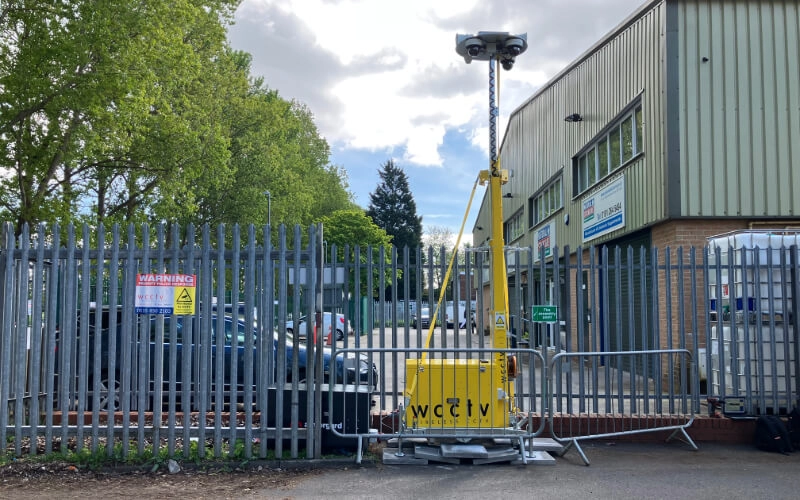
Relocatable CCTV towers let you move surveillance to where it is needed most instead of investing in fixed infrastructure. Mobile towers offer solar power and wireless transmission and can be easily redeployed between town centres, streets, parks, car parks, rural areas, depots and works zones. They can also integrate intrusion detection systems that use AI to flag suspicious and anti-social behaviours (vandalism, trespassing) to monitoring partners.
Flexible public monitoring supports better resource management in line with the Government's Efficiency Framework, which emphasises using resources effectively, prioritising activities that deliver the greatest benefit and reducing avoidable costs.
Additional CCTV monitoring tools can be connected to address risks such as unauthorised vehicle incursions, fly-tipping and arson:
- Automatic Number Plate Recognition (ANPR) records vehicle movements, enabling you to check vehicles entering or leaving controlled areas. Visible controls reduce unauthorised and illegal activities since people know they're being recorded. If car drivers or their passengers commit theft, reckless damage, fly-tipping or ASB, you have a log of vehicle details (registration, make, model, colour, speed) to support investigations and prosecutions.
- Smoke and fire detection systems use AI to identify early signs of fire and alert the relevant responders. These smart detection systems are ideal for catching deliberately set fires in outdoor spaces, enabling teams to react quickly to protect people and property. Visual, timestamped evidence of fire incidents also makes it easier to investigate arson and take further action.
CCTV footage and alerts feed into a central cloud-based monitoring platform, supporting vigilant remote security monitoring and evidence gathering. This helps to both deter theft, fly-tipping and ASB as well as prosecute offenders where necessary.
Read more:
- Deployable vs Fixed CCTV: What's More Proportionate for Public Sector Use
- How Mobile CCTV Effectively Reduces ASB
- Ultimate Guide on Fly-Tipping Prevention
- How to Expand Network CCTV Coverage Without Expanding Budget
2. Protect work crews and the public through greater visibility
Public sector works create numerous risks, from excavations and moving machinery to pollutants and exposed electrical cabling. While protecting your workforce is crucial, safeguarding passers-by and residents is as important. Strong public sector safety management goes beyond periodic inspections; it requires continuous visibility so managers can address hazards before they cause accidents.
To improve safety for workers and the public in 2027, you should:
- Review risks as conditions change: Reassess when work phases change, footfall rises (e.g., during events, school holidays) or extreme weather approaches.
- Set clear expectations supported by training: Make sure your teams have the necessary knowledge about PPE standards, incident reporting and how to manage interactions with the public.
- Oversee high-risk and high-footfall areas remotely: Reduce time-consuming physical inspections at isolated, weather-exposed or busy locations.
- Support wellbeing and mental health: Staff who work alone, out of hours or face abuse from the public can experience real stress, so provide clear escalation channels and support.
- Strengthen incident reporting: Accurately record all incidents and how they are handled so you have the necessary documentation to respond to compliance audits and stakeholders' questions.
Since they're typically taxpayer-funded, public sector projects face closer scrutiny than most. This means a photo of workers without proper safety gear or producing dust near a creche without responsible controls can be shared on social media and become a problem before you’ve had a chance to respond. Spotting and correcting such issues early is vital to protect your people, the public and your reputation.
Connected CCTV with PPE detection systems use AI analytics to flag when teams work without legally required PPE, sending real-time alerts to managers and audio warnings to workers so failures are swiftly corrected.
The same approach provides early warning of environmental hazards. Environmental monitoring sensors track noise, airborne pollutants and weather conditions, alerting project managers when preset thresholds are reached. Early notifications enable teams to adjust operations to restore acceptable conditions and implement protections when weather becomes unsafe.
Timestamped footage and alerts stored in a cloud platform offer an accurate record of what happened, when and how. These insights ensure you're always ready to address complaints, investigations, safety reviews and injury claims.
Read more:
3. Manage environmental impact and regulatory risk
As the UK targets net zero carbon emissions by 2050, public sector teams are under growing pressure to keep works projects environmentally friendly and community spaces safe for the public. Depending on the location and activity, projects may have to comply with the Control of Pollution Act 1974 (CoPA), the Control of Noise at Work Regulations 2005 and various local noise ordinances and permits.
Breaches of these regulations can result in steep fines, enforcement actions, work stoppages and complaints from affected communities.
To manage environmental responsibilities and regulatory risk in 2027, aim to:
- Set clear monitoring requirements: Define and set exposure limits based on project rules, contractor agreements, legal limits and local permit requirements.
- Monitor conditions continuously: Track conditions throughout the project's duration and have clear reporting/reaction procedures so breaches are addressed promptly.
- Maintain records that demonstrate compliance: Record readings, threshold alerts and responses to support compliance audits and stakeholder enquiries.
Environmental monitoring sensors with connected cameras allow teams to track environmental variables accurately at all times, reducing the need for manual measurements.
- Noise monitoring sensors record project noise over ranges of 30-130 dB and 20Hz to 12.5kHz. Real-time alerts when preset thresholds are reached prompt teams to act to maintain noise exposures within safe, legal limits, protecting workers and the local community.
- Air quality monitoring sensors track airborne hazards and pollutants, including particulate matter, total volatile organic compounds (TVOCs), carbon dioxide and carbon monoxide. Teams receive alerts when predefined thresholds are reached, allowing them to adjust work to bring levels down.
- Weather monitoring sensors provide real-time weather data, assisting teams to prepare for conditions that could affect worker and public safety, service delivery or work scheduling.
Consistently gathered data help you identify recurring problems and investigate complaints. Combined with appropriate response procedures, these tools support regulatory compliance and responsible management of the environment.
Read more:
4. Communicate openly with the public and stakeholders
Residents, businesses and community groups expect to be kept informed about events and operations that will affect them. This makes open, ongoing communication vital, especially regarding potentially disruptive traffic, development or major maintenance works.
A big challenge here is that projects usually involve multiple contractors, suppliers and stakeholders, each with different reporting processes. This can complicate accountability and make it harder to stay fully informed of operations.
To ensure transparent communication and reporting in 2027, aim to:
- Establish shared reporting standards: Define what project teams must report, how often information is updated, who reviews it and how exceptions are escalated.
- Standardise procedures: Set consistent expectations for inspections, site security, safety reporting, incident escalation and environmental monitoring.
- Improve access to information: Provide progress updates and incident reports to teams who need them to do their jobs.
- Keep the public informed about planned works: Share timings, closures, diversions and reasons in advance. Use appropriate channels (community media, your website, social media, on-site signage) and provide updates on progress or changes.
- Strengthen stakeholder engagement: Hold regular reviews so issues are owned and resolved transparently; agree who speaks for the project authority at each stage.
You can deploy temporary CCTV and a cloud-based platform to verify activities and progress remotely, and share visual evidence to support reporting and performance reviews and answer public enquiries. Visible, active CCTV coverage also allows you to share success of monitoring in public and community spaces.
When everyone shares the same view of events, it not only enhances communication at senior levels, but also helps keep managers, subcontractors, suppliers and work teams informed of progress and performance. This improves accountability and encourages everyone to deliver what's expected since they can see what they're doing right and where they might be falling short.
5. Strengthen evidence to defend against liability claims
Public bodies must show how schemes are managed and how public funds are spent. Reliable records provide that evidence, protect you from liability claims and support investigations, performance reviews and dispute resolution.
For example, if a member of the public alleges injury or property damage near a work area or traffic scheme, clear evidence helps you respond quickly and fairly.
A strong approach to managing evidence in 2027 should focus on:
- Clear documentation requirements: Specify which records your teams must retain and submit, including incident reports, inspection records, environmental data, maintenance logs and corrective actions.
- Consistent record-keeping: Use agreed formats, timestamps and processes across projects and public locations.
- Accessible documentation: Ensure authorised users can quickly retrieve records for audits, investigations, insurance claims and reporting.
Platforms that organise and secure records (footage, sensor data, incident logs, alerts) in central dashboards put you in a better position to respond to enquiries, claims and disputes.
Stronger documentation that everyone trusts improves director-level communication and collaboration among directors, managers and their teams. It also helps identify trends that can inform better work procedures and management strategies.
Read more:
6. Connect oversight across projects and teams
Public facility and project management teams must ensure community and workforce safety at all times. Yet crucial risk-related information is often spread across multiple systems, leaving managers juggling 5 or 6 tools to understand what is happening on the ground.
To improve oversight across your public portfolio in 2027, you should:
- Connect relevant data: Bring monitoring records, alerts, environmental data, incident reports and operational information together in one place.
- Create a clear view across all projects: Use consistent reporting standards to compare performance and drive continuous improvement.
- Identify trends across projects: Review data for recurring issues, emerging risks, hotspots and improvement opportunities.
- Maintain strong governance: Define clear rules for data access, security and information sharing.
Our cloud-based management platform centralises monitoring information from multiple locations and up to 81 cameras in one place. With a single login, you can monitor works and public areas from wherever you are, spotting emerging risks sooner.
With clear portfolio oversight in one place, you improve visibility and risk management across all your responsibilities. You also strengthen decision-making, communication between stakeholders (your team, private sector partners, authorities and the public) and ultimately project success.
Read more:
Enhance Public Delivery in 2027 with Smarter Monitoring
Successful public sector delivery is increasingly driven by evidence-based information, strong governance, transparent stakeholder communication and effective project management.
Integrated monitoring that brings together environmental, safety and operational information can help public sector professionals protect their communities, improve service delivery and manage stakeholder engagement more confidently in 2027.
For over 20 years, WCCTV has provided deployable CCTV and remote monitoring to public sector leaders overseeing essential but complex operations. For advice on how an integrated CCTV and monitoring platform can support your 2027 delivery goals, get in touch with our team and let's chat.
