Highways managers sometimes have to decide whether to install fixed CCTV cameras at critical network spots or to deploy a temporary, mobile solution.
Fixed cameras provide stability and continuous monitoring, making them well-suited to locations with ongoing visibility needs. Mobile surveillance, on the other hand, offers rapid coverage and adaptability, making it better for temporary projects and work zones.
With advancements in mobile technology, there is little difference in performance (frame rates, image quality) between the two options. Portable towers and mini units powered by solar or battery can now be deployed in under an hour, delivering high-definition footage, responsive camera control and AI-powered risk detection.
Councils must weigh factors such as visibility requirements, budget and infrastructure constraints to determine the right strategy for each circumstance. Our article breaks down deployable vs fixed CCTV, explaining the benefits of each and how leaders can decide which solution is a better fit for their specific requirements.
Fixed vs Deployable CCTV: Understanding the Right Fit
To help you understand the value each solution brings, let's explore their features, benefits, drawbacks and common use cases.
Fixed infrastructure: For reliable permanent coverage
Traditional, fixed CCTV systems are usually hardwired into mains power, making them a permanent or long-term network asset.
Permanent systems use fibre-optic broadband or Wi-Fi to transmit alerts, live feeds and footage to CCTV operators and security personnel. Delivering continuous remote surveillance, they are widely employed to monitor traffic, deter crime and gather operational, road safety and traffic planning data.
Where fixed CCTV is appropriate:Where fixed CCTV is appropriate:
-
High-traffic junctions (mainly urban): Busy intersections and other merge points with high traffic volumes and ongoing safety and congestion issues. With around 24,000 collisions recorded at priority intersections, oversight of these hubs is essential to improving road safety.
-
High-risk locations: Hotspots associated with regular criminal and anti-social behaviours where a permanent visual deterrent supported by security interventions is required.
-
Continuous enforcement support: A record number of 5 million drivers were caught speeding in England and Wales during 2024, highlighting the importance of actively enforcing against dangerous driving behaviours. Permanent cameras support consistent enforcement of Highway Code transgressions, such as speeding, reckless traffic weaving and restricted-lane use.
-
Strategic transport lanes: Fixed systems provide continuous visibility along strategic routes. This insight helps improve long-term traffic analysis, congestion monitoring and evidence-backed planning and safety initiatives.
Advantages of static CCTV systems
-
High-quality fixed systems offer excellent stability and image capture due to their permanent mounting.
-
While these systems require a higher upfront investment, they generally have lower operating costs over time for locations where long-term/permanent visibility is necessary.
Drawbacks of static CCTV systems
-
Traditional monitoring systems can take months to bring online. Approvals, permissions, design and installation (trenching, wiring, grid/broadband connections) all delay implementation. Once eventually installed, these structures are difficult and expensive to move.
-
Budget constraints often block the investment in permanent monitoring infrastructure because the funds simply aren't available for the period.
-
Fixed installations typically require reliable power and internet connectivity. Many locations, including underserved rural communities, lack that support, making traditional setups highly impractical and/or expensive.
In short, fixed assets are appropriate where monitoring requirements are predictably long-term, not immediately urgent and the cost-return is justified.
Read more:
Deployable CCTV systems: Mobile and cost-effective
Mobile surveillance units are designed for environments where monitoring needs change frequently, rapid deployment is critical or where local infrastructure is lacking.
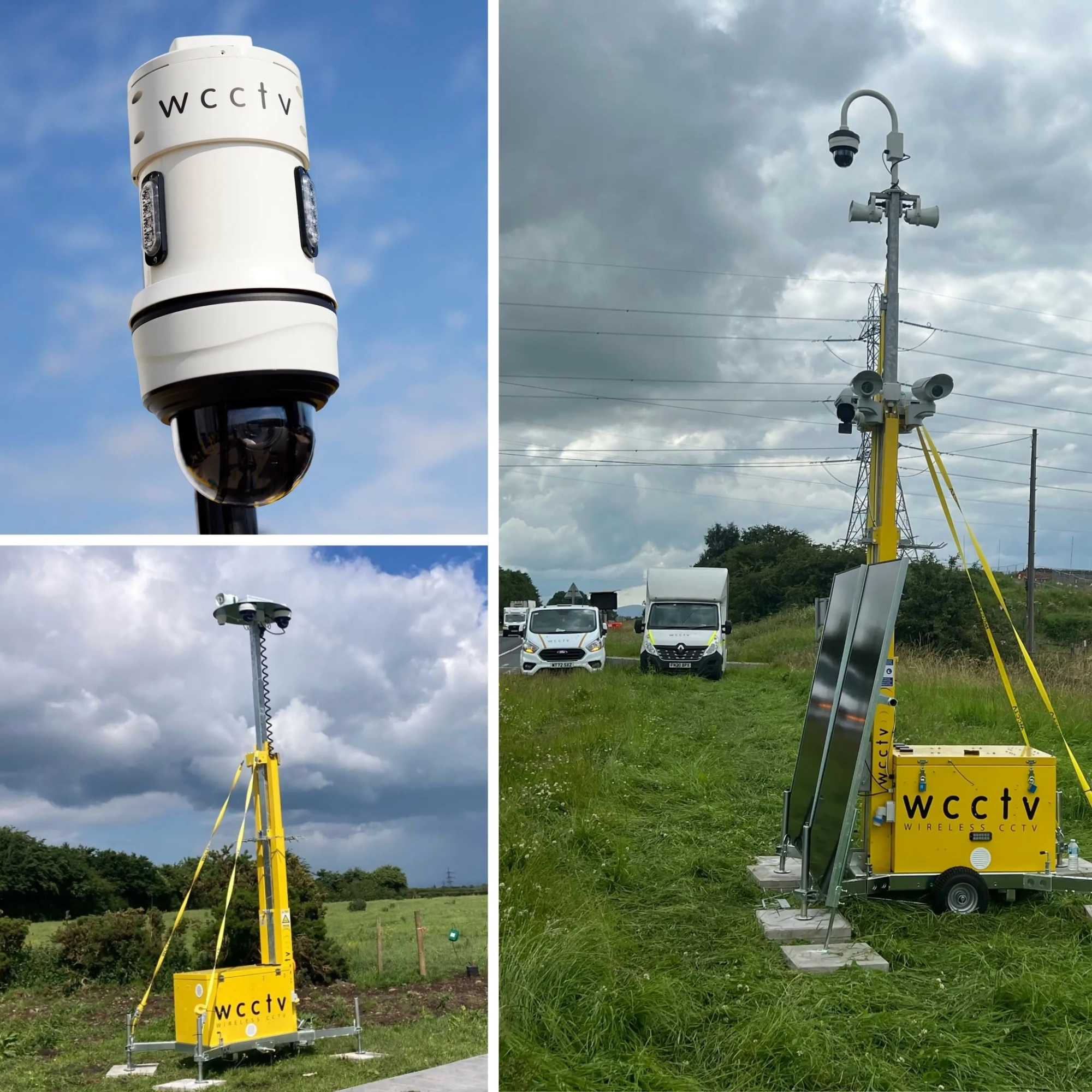
Portable CCTV solutions can be installed in 20 minutes (for basic setups) utilising rapid-deployment towers, mobile trailers or pole-mounting. These self-contained units operate independently of local utilities, using solar panels and high-capacity batteries. They transmit data via 4G/5G connectivity or secure Wi-Fi networks, providing highways teams with advanced visibility into conditions on the ground.
Where deployable CCTV is appropriate:
-
Roadworks and maintenance sites: Mobile setups provide an immediate view of work zones, helping to verify traffic control measures and improve on-site safety and public communications. They also gather essential data and evidence throughout the project to assist in complaint handling and investigations.
-
Major infrastructure works: Deployable CCTV is often used to monitor complex, long-term infrastructure upgrades. Greater visibility helps oversee contractor compliance and safety controls near busy roadways, while reducing disruption caused by weather, environmental factors and regulatory inspections.
-
Shifting risk areas: Temporary solutions are well-suited to locations where crime or risk patterns fluctuate, allowing you to move the deterrent as security needs shift.
-
Remote and off-grid areas: When working in challenging terrains and rural areas without power or internet, a deployable tower is often the only viable way to get eyes on the site.
-
Public events and emergency responses: For events such as marathons, parades or road flooding and other emergencies, rapid-deployment systems help manage safety, control noise levels and prevent traffic incursions.
-
Temporary traffic management schemes: By accessing the CCTV platform, traffic teams can view live and recorded footage, allowing them to spot traffic and safety issues and take corrective actions.
Advantages of temporary surveillance
-
Mobile units can be deployed almost anywhere within minutes and easily repositioned on the site if required.
-
Affordable rental systems allow you to implement surveillance at priority locations without a major budget spend. You only pay for the coverage you need, when and where you need it.
-
You can deploy reliable monitoring in areas lacking power and broadband infrastructure.
-
Our advanced traffic solutions can integrate a range of specific monitoring tools, including safety management, security, project oversight and environmental monitoring. These functions are consolidated into a single platform with smart software for effective remote management from your phone or laptop.
Drawbacks of deployable system drawbacks
-
Using temporary cameras to monitor permanent high-traffic hotspots can get too expensive over time. (These spots are better served by fixed surveillance).
-
Performance may be compromised when environmental conditions limit solar generation. One way around this is to rely on stored energy in portable batteries to maintain uptime when solar production is weak. For example, our autonomous CCTV tower range, including Traffic and Mini Towers, can operate for weeks with fuel cell battery integration.
In summary, mobile surveillance units are flexible, fast-response solutions that can be deployed and repositioned as conditions and risks evolve, making them especially suitable for temporary, off-grid environments.
Read more:
Fixed vs Deployable CCTV: A Quick Comparison Guide
The comparison table below offers a quick summary of the key differences between permanent and mobile setups.
|
Feature |
Fixed CCTV |
Deployable CCTV |
|
Setup Time |
Setup usually takes weeks or months. Involves civil works to install. |
Can be up and running in minutes or hours using mobile equipment and portable towers. |
|
Power/Data |
Requires mains power and transmits feeds through fibre optics or wireless broadband. |
Operates on solar power, battery and wireless connectivity (4G/5G). Doesn't rely on the mains grid. |
|
Mobility |
Permanently installed and stationary, so it lacks flexibility. |
Highly portable, making for easy relocation within monitored areas and onto new projects. |
|
Upfront Cost |
Higher upfront capital expenditure. |
Lower upfront investment since mobile units can be rented only when needed. Predictable monthly operating expenditure. |
|
Maintenance |
Requires ongoing infrastructure maintenance. Repairs and maintenance costs come from the council's budget. |
Minimal maintenance, usually covered by the supplier when required. |
|
Scalability |
Slower to expand due to longer authorisation, planning and installation periods. |
Easy to scale by integrating additional cameras and specialist monitoring solutions. |
|
Best For |
Fixed cameras are best suited for long-term oversight in stable environments, such as monitoring critical merge points, high-traffic areas and locations with permanent risks and security requirements. |
Ideal use cases include evolving locations, temporary traffic schemes, road construction sites, event security coverage, remote locations, blind spots, emergency responses, short-term diversions and challenging site layouts. |
How to Choose Between Deployable and Fixed CCTV
The choice between fixed or deployable setups comes down to which solution is more practical for each particular circumstance. For instance, you don't need fixed monitoring for a roadworks diversion that will only operate for six weeks.
On the other hand, temporary towers don't make economic sense to manage a critical, high-traffic city junction that requires continuous uptime. Here, establishing a fixed view through permanent infrastructure is more practical and viable.
The following considerations help guide your choice between the two options:
-
Duration of the operation: If the operational requirement is under 2 years, fixed infrastructure is often not cost-effective.
-
Location infrastructure: Power availability is a critical factor in deployment. Fixed systems rely on stable networks such as grid power and internet, while mobile units can operate independently using self-contained power (usually solar and fuel cell batteries).
-
Flexibility needs: If the project is phased, such as works that move along a rural road, a mobile tower can move with the project. This flexibility ensures continuous coverage at a lower cost compared to installing fixed surveillance across the larger work area.
-
Deployment timescales: If monitoring is needed within hours/days rather than months, deployable CCTV can be up and running far more quickly than a permanent installation.
-
The nature of network priorities: Highways teams need to manage ever-changing priorities, including emergency repairs, weather hazards, utility works, resident complaints, security risks, special events and parking area/roadside vandalism. Mobile CCTV assets can be redeployed as priorities shift, helping teams track multiple projects efficiently and effectively. They can also often add flexible, specialised integrations (e.g., security monitoring).
8 Rapidly Deployable Tools for Improved Network Visibility
We offer a range of mobile monitoring solutions that help highway managers proactively control safety compliance, security, project oversight and environmental monitoring in temporary and high-risk environments.
Let's take a look at 8 AI-powered tools that can be integrated into our single smart platform for ultimate simplicity and control.
1. CCTV Towers
Our mobile CCTV Towers with advanced cameras and solar/battery power can deliver near-instant surveillance at nearly every type of location. They are widely deployed to monitor construction sites, temporary traffic projects, emergency routes and areas without electricity or fibre broadband.
Standing up to 6 metres tall, CCTV and Traffic Management Towers are a proven deterrent against theft, vandalism and anti-social behaviours.
Our compact solar-powered Mini Tower offers a self-movable option for complete flexibility. Designed for single-person installation without requiring on-site commissioning, it can be effortlessly redeployed around temporary and infrastructure-poor environments as tracking requirements change.
All our Towers feature high-definition, PTZ (pan-tilt-zoom) cameras that record footage day and night (in clear and low-light conditions). In dynamic and high-risk zones, the system immediately starts capturing essential evidence to help fight crime, strengthen compliance and investigate public complaints.
2. Intrusion Detection Systems
Our smart Intrusion Detection Systems use AI analytics to analyse CCTV feeds, protecting sites against unauthorised access and criminal behaviour. Removing the stress burden from you and your contractors, NSI Gold-Accredited professionals act on verified alerts and respond immediately to warn off intruders.
This remote, fully-managed security service provides 24/7 protection against infrastructure damage and asset theft without the need for fixed installations or large security teams.
Optional Mobile Keyholding Service adds an extra safeguard by dispatching a licensed professional to the site to investigate after an alert is triggered.
Read more:
3. Automatic Number Plate Recognition (ANPR) Systems
Our mobile surveillance solutions can be equipped with Automatic Number Plate Recognition (ANPR) to track and log all vehicles travelling through key entrance and exit points. The system uses AI imaging to accurately record details, including vehicle number plate, speed, make, model and colour.
With digital audit trails and visual evidence, ANPR delivers fast, reliable vehicle monitoring in priority areas. This visibility strengthens access control and restricts unauthorised entry and incursions that could endanger workers and the public.
4. Smoke and Fire Detection
AI-enabled Smoke and Fire Detection can be added to our CCTV Towers to accurately and urgently flag fire risks. This smart detection solution recognises fire indicators more quickly than standard alarms, while filtering out false triggers (diesel emissions, steam, dust) to avoid unnecessary alarms. Smart video detection also works more reliably in outdoor environments such as traffic projects than conventional alarms, which often struggle in open spaces.
The flexible solution can be added when temperatures rise, or heatwave conditions increase the risks of fires on roadworks, infrastructure projects and sites containing hazardous and/or flammable materials.
5. PPE Detection
AI-powered PPE Monitoring Systems can be connected to our CCTV Tower range to enforce PPE compliance in workplaces as required by HSE regulations. These systems spot PPE breaches, notify managers and record timestamped evidence to drive safety improvements. They can also issue a live audio reminder to personnel not wearing their safety equipment.
Because it’s mobile, this type of monitoring can be matched to your exact operational needs. It can be specifically targeted at priority areas such as restricted zones or high-traffic channels to minimise the chance of regulatory breaches.
Read more:
6. Weather Monitoring Sensors
As an add-on to our CCTV Towers, Weather Monitoring Sensors capture temperature, humidity, wind and rainfall data throughout infrastructure, maintenance and traffic projects.
Quick setup allows temporary sites to adapt to changing weather conditions, ensuring safety and minimising disruptions. The data gathered helps leaders respond transparently to complaints about roadwork delays, unsafe working conditions or schedule changes.
Read more:
7. Noise Monitoring Sensors
IoT Noise Monitoring Sensors can be deployed rapidly on our Towers to measure sound levels on sites and issue alerts if noise gets close to thresholds. High-sensitivity microphones optimised for outdoor conditions record ambient sound across ranges of 30dB to 130dB and 20Hz to 12.5kHz.
They support work projects, temporary traffic schemes and festival events through active monitoring to avoid compliance violations, crew and traffic safety issues and community complaints.
8. Air Quality Monitoring Sensors
Easily installed Air Quality Monitoring Sensors continuously monitor dust, CO₂, CO, particulates, and TVOCs to control airborne hazards and emissions from work activities at all times. For temporary projects, quick setup ensures immediate worker and public safety and compliance with COSHH regulations and the Control of Pollution Act 1974.
Like all our environmental monitoring tools, the system retains time-stamped data records and incident reports throughout the project's duration.
Read more:
Complete oversight in one platform: Our dedicated cloud-based platform unifies data and feeds from these 8 tools (incorporating up to 81 camera feeds) into a single system with actionable AI insights. You and your team can remotely access dashboards and view the following securely in a smart central hub:
-
Live and recorded video streams
-
Smart detection and safety data (fire, PPE, intrusions)
-
Environmental monitoring data
-
Safety and security alerts
-
Incident and compliance information
With high-definition visuals, timestamped data and the latest AI-powered reports, leaders make better, evidence-based decisions to safeguard work teams, resolve public complaints and address threats effectively.
Access Smart Monitoring Quickly and Affordably
When comparing fixed and mobile surveillance systems, one is not better than the other; it all depends on circumstances.
Fixed cameras provide stability and continuous monitoring, while mobile surveillance offers adaptability, affordability and quick coverage. This means that for temporary traffic schemes and work projects, deployable and versatile setups make the most sense to ensure smart monitoring of shifting priorities.
If your visibility into construction sites, highway projects, traffic initiatives or emergency events is not as dynamic as the challenges you face, contact our team today. Let's explore how cost-effective, highly adaptable solutions can boost security, safety, environmental monitoring and project oversight across your public sector network.