
Modern highways and traffic managers are often expected to monitor more of their network with the same, or even fewer, resources. Increased roadwork levels involving hundreds of different contractors have heightened safety, security, environmental and coordination risks on UK roads.
Ongoing, fast-developing operations demand flexible monitoring to support effective oversight and safe project delivery. Extending fixed CCTV installations to cover short-duration projects is usually not an option: it's expensive, takes too long to install and the new structure often becomes redundant after the works are complete.
Rapidly deployable CCTV systems are a popular solution to this dilemma. Mobile systems allow highways teams to set up and expand CCTV coverage quickly and easily. Monitoring can be implemented precisely where it's needed, strategically extending visibility while remaining cost-effective.
In this article, we explore how flexible monitoring strategies enable traffic and highways professionals to achieve greater visibility, make better use of resources and manage high-priority activities effectively without substantially increasing spend.
Why Visibility Across Networks is Vital for Performance and Safety
Strong visibility helps leaders better understand conditions and emerging risks in operations under their control to intercept problems before they snowball.
Budget constraints often force highways teams to focus monitoring primarily on high-traffic and high-risk locations. This means worksites, temporary traffic schemes, rural networks and emerging problem areas may remain largely unseen, except when visited as part of a scheduled inspection.
This visibility gap can have serious consequences. Accidents, traffic incursions, safety violations and compliance breaches occur every day on roadwork sites, temporary traffic operations and underfunded rural roads. Incidents may go unreported by contractors or isolated communities, creating longer-term safety and security risks.
Expanding network coverage helps to close visibility and information gaps. A smart approach to building out this surveillance is directing monitoring (CCTV cameras and IoT sensors) where it delivers the most value, eliminating blind spots and giving you eyes on all high-risk areas.
Advanced visibility helps you monitor temporary projects more effectively, detect issues sooner and take preventive steps to avoid accidents, injuries, public complaints, compliance failures, disruption and loss. The overall result of preventive management is safer, more compliant and successful projects.
Read more:
When Flexible Network Coverage is Better than Fixed Infrastructure
The key to expanding monitoring coverage cost-effectively is flexibility and mobility. This means:
-
Installing monitoring only where and when it's needed
-
Setting up coverage quickly, and packing it up or repositioning it equally swiftly
-
Only paying for a monitoring solution for the period it's required
Fixed CCTV and security system cameras can provide excellent coverage and image capture due to their permanent mounting. However, because they're static structures, they have limited adaptability. They can't be easily moved once a project is complete or if crime migrates to another area. Other drawbacks of fixed installations include:
-
The approvals, permissions and design processes for permanent infrastructure can take months.
-
Installing the system involves complex civil works including trenching, cabling and grid/internet connections, which also takes weeks or months.
-
A permanent system is usually hardwired into the mains grid and relies on fibre-optic broadband. Many locations lack this stable power and internet connectivity.
-
Commissioning and rolling out a permanent CCTV system is expensive, and there may be no budget for such capital expenditure.
Mobile monitoring systems have become an attractive option for local authorities wanting to extend coverage quickly, flexibly and affordably. Mobile setups are purpose-built for traffic projects where monitoring needs change frequently, and rapid deployment is mission-critical.
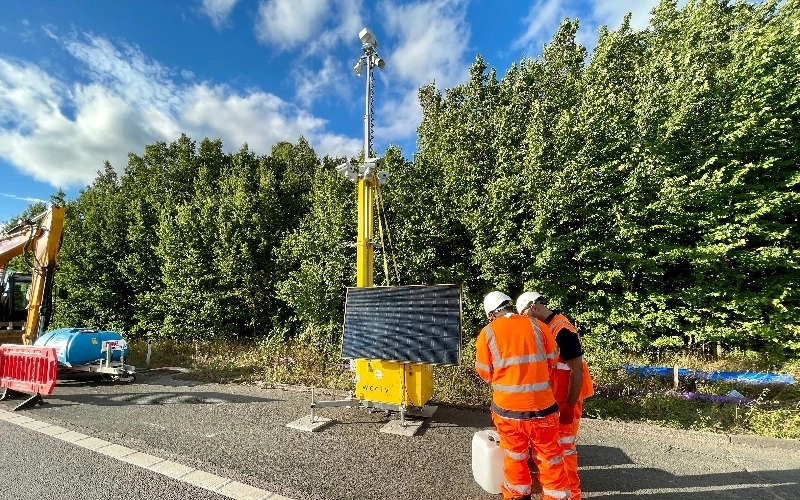
Portable solutions can be installed in 20 minutes (for basic setups) utilising rapid deployment towers or trailers. Mobile towers like our Traffic Management units are fully self-contained, using solar power, battery storage and 4G/5G connectivity. Since these systems require no mains electricity or internet connection, they can operate in nearly every environment, including remote rural regions.
This flexibility enables highways teams to scale monitoring to multiple sites as new roadworks, crime hotspots, emergency repairs, infrastructure upgrades, and public events occur across the network.
Cloud-based platforms let you manage several locations and responsibilities from a single control hub. Customised software gives you access to clear footage from all cameras, enabling high-level insights and control at all times.
Read more:
How To Expand Network Coverage Without Straining Your Budget
Highways teams must work within limited budgets and increasing public scrutiny around how taxpayer money is spent.
Mobile monitoring solutions allow you to replace significant capital expenditure with a more affordable model. Rather than investing in a permanent structure to monitor a year-long infrastructure upgrade, you can hire a portable setup for the 12 months.
This arrangement matches expenditure with operational needs, converting high upfront costs into more manageable, predictable monthly expenses.
Let's look at some of the numerous benefits of this flexible approach:
-
If the project moves along a 2-mile carriageway, monitoring coverage can travel with it, ensuring a comprehensive view of site conditions at all times.
-
Once the work is complete, mobile surveillance can be relocated to the next priority location. This way, a single asset can support multiple projects during a budget period.
-
Choosing temporary monitoring solutions for short-term operations, you avoid the cost of an expensive fixed investment that delivers no value once works are finished. You also minimise the risk of councillor and public complaints about a poor investment decision.
-
The ability to monitor several locations and risk areas from a central platform significantly enhances operational efficiencies. Remote access to live and recorded CCTV footage helps to verify site safety, security and performance without placing additional pressure on busy teams.
-
Remote monitoring eliminates countless hours conducting physical site visits. When incidents occur, teams can review them within minutes and quickly decide a course of action to prevent any problems from escalating.
-
When managers and their teams spend less time travelling, they can focus their time and resources on issues that genuinely require intervention.
-
Maintaining video and incident records in secure, affordable cloud storage can also save on costs.
Overall, deployable monitoring enables smarter resource allocation and more efficient, productive teams. In fact, some companies using CCTV towers for site security report up to 88% savings on their security bill.
Flexible Monitoring Solutions That Expand Network Coverage Affordably
WCCTV's versatile monitoring solutions help local authorities build out their existing system with additional cameras and smart risk management tools, as needed. Designed for quick deployment, our Traffic Management and CCTV Towers can be up and running within 20 minutes (for basic setups).
These autonomous, solar-powered, 4G/5G wireless systems don't need grid/broadband infrastructure and perform reliably in harsh weather. They can be easily relocated as work progresses, ensuring you never lose sight of priority and risky events, while keeping budgets in check.
Our cloud-based management platform unifies all relevant network data and footage captured into central dashboards for smart, intuitive control. The secure platform supports seamless integration of:
-
Environmental monitoring solutions (air quality, noise, weather conditions)
-
Smart detection systems (PPE, intrusion identification, smoke/fire detection)
-
Automatic Number Plate Recognition (ANPR)
-
Security oversight bringing in up to 81 camera feeds
For operational ease, our systems can be managed without large teams or reliance on your IT department. For instance, our versatile Mini Tower can be installed by one person and repositioned on sites without our assistance, making it ideal for emergency repairs and situations such as block-by-block street excavations.
All our Towers are connected to a live remote monitoring service operated by an NSI Gold Accredited partner. Control centre specialists observe clear images of live video feeds and ensure all relevant events are responded to. Via the custom app, you and your team can remotely access and review video footage, automated logs, alerts and reports to assess risks and coordinate responses.
It's useful to take a closer look at the various solutions that can integrate with our CCTV Towers and cloud management platform to provide near-360° project oversight.
|
Solution |
What It Delivers |
Key Operational Benefits |
|
ANPR uses Optical Character Recognition (OCR) to log vehicles travelling through designated entry points and restricted zones. Besides number plate details, high-resolution ANPR cameras can capture make, model, speed and the vehicle's colour in nearly all lighting conditions. |
|
|
|
Uses AI analytics to detect and alert managers when workers are not wearing the required PPE. The system activates live audio warnings to personnel not following PPE rules. |
|
|
|
Smoke and Fire Detection uses AI to pinpoint and flag the early signs of smoke or fire, filtering out false alarms. Intelligent video-based detection works effectively in wide-open outdoor spaces where many conventional alarms don't work properly. |
|
|
|
Weather Monitoring Systems capture site-specific climate data, including:
The system can be set to alert when certain thresholds are approached. |
|
|
|
IoT-enabled sensors use a condenser microphone to track sound and frequency (30-130 dB/20Hz - 12.5kHz) across active workplaces. The system can be set to issue alerts before permitted limits (Exposure Action Values (EAVs)) are reached. |
|
|
|
IoT sensors continuously capture readings for:
Monitors and alerts to avoid breaches of exposure thresholds (e.g, Workplace Exposure Limits (WELs)). |
|
|
|
High-definition, night-vision PTZ cameras capture events around your perimeter and/or the designated zones you set. AI trained on behaviour and motion detection scans continuously for potential threats (unauthorised access, theft attempts, trespassing and vandalism). Our add-on Mobile Keyholding Response service offers an extra layer of protection by dispatching a professional operator to investigate confirmed intruder alarms. |
|
Depending on your requirements, you could integrate all systems for comprehensive coverage. Alternatively, you could connect only, say, environmental monitoring to support regulatory compliance, reduce complaints and build sustainability into traffic projects. Any monitoring system can be seamlessly scaled by adding integrations and CCTV units. It can similarly be downsized when tools are no longer required.
To help you control spending, our systems can be rented, removing the cost and complexity of fixed infrastructure. Whether it's roadworks, emergency repairs, planned maintenance or a street parade, you only pay for coverage where and when you need it.
Read more:
- AI-Powered Risk Detection: Smoke, Fire and PPE Compliance
- Asset Protection 101: How Mobile CCTV Stops Theft, Trespass and Damage on Remote Sites
- Weather Monitoring Tools for Construction Sites
7 Practical Tips for Expanding and Positioning CCTV Camera Coverage
Expanding the coverage of a CCTV surveillance system involves strategic camera placement, selecting appropriate technology and leveraging networking tools to extend range.
Here's a quick 7-step guide to camera choices and implementation:
-
Conduct a thorough risk assessment to help develop an effective camera placement strategy, taking into account site dimensions, current security measures and identified vulnerabilities.
-
When positioning cameras, use site maps to plan placement and conduct walk-tests to identify blind spots and viewing angles in CCTV coverage. Minimising blind spots can be achieved by overlapping camera views and using wider-angle lenses.
-
PTZ (Pan-Tilt-Zoom) cameras are ideal for covering wide areas as they can zoom in on specific incidents without losing image clarity. They rotate side-to-side and tilt up and down to provide maximum coverage of the monitored zone.
-
Long-range cameras are recommended for large sites or perimeters where standard cameras cannot reach.
-
Solar-powered and wireless cameras are well-suited to locations where running cables is difficult, as they connect to Wi-Fi, allowing for easy installation and relocation.
-
Regularly review CCTV footage to identify newly created blind spots due to changes in the environment or obstructions.
-
Crucially, it's vital that cameras can be integrated into a central system to facilitate remote viewing and active management.
Access Quick, Affordable Monitoring Coverage Today
Smart, deployable monitoring setups give highways leaders the oversight they need to manage essential projects confidently. Flexible rentals of advanced cameras with AI-powered insights enable traffic teams to target monitoring exactly where it's needed, within tight budgets. This cost-effective strategy helps reassure councillors and your community that their roads are responsibly and professionally managed.
Our mobile surveillance and intelligent monitoring tools are designed for rapid deployment and offer quick coverage. With over 20 years of experience in wireless surveillance, we have the solutions to help you take urgent control of safety, security, environmental and other project priorities wherever they matter.
If your current CCTV system isn't delivering what you need or aligned with your budget, contact our team today. Let's discuss smarter monitoring solutions and explore how you can cover more of your road with less spend.

