If you're managing IT systems in construction, you're probably dealing with multiple vendors across your sites. One provider for CCTV, another for environmental performance and a couple more for access control and compliance reporting.
On the surface, this seems manageable. But the hidden costs add up quickly: subscription fees eat into your IT budget, misaligned security protocols and compliance gaps caused by switching between tools just to get a clearer picture of what's actually happening on-site.
This legacy-based approach bloats your tech stack and increases operational costs, but also wastes your teams' time, which can all be avoided. The risk of compliance failures and duplicated effort is no longer worth it when smarter monitoring options are available.
This guide explains how managing vendor sprawl on your construction site becomes easier by switching to consolidated monitoring. One unified system that handles routine tasks, risk assessments and compliance reporting with very little effort from you and your team.
Construction Vendor Sprawl: Explained
Vendor sprawl happens when construction firms accumulate too many tools over time, each addressing a specific monitoring need. What starts as a practical decision gradually leads to "system overload", which is expensive to maintain and difficult to manage.
Here's what vendor sprawl typically looks like:
-
Multiple interfaces and dashboards: IT managers log into 5-6 separate tools throughout the day just to check basic site status. One platform for surveillance, another for air quality control. This constant back and forth wastes time and increases the risk of missing something important.
-
Fragmented data: Site teams manually consolidate site readings via legacy systems like spreadsheets and handwritten reports. Isolated data silos and disconnected systems that don't "talk" to each other delay response times and make compliance documentation far more time-consuming than necessary.
-
Overlapping functionality: Paying for multiple tools with the same functionality (or similar) increases operational costs and causes confusion for site teams about which platform to trust.
-
Slow response times: Incident response takes longer when vendor tools operate independently and don't sync data between platforms and applications. Missing critical threats, such as a fire hazard, for instance, can have a devastating effect on your business.
-
Compliance and security gaps: Minimising cyber risks is harder when managing multiple tools, especially when each vendor has its own login, security protocols and data handling practices. Systems working in isolation don't show teams the "bigger picture" of what's happening on-site, leading to blind spots and incomplete compliance trails.
The risk of multiple vendor relationships
-
Operational blind spots: When systems don't integrate, IT and site teams don't have a clear idea of what's actually happening on-site. Environmental sensors might show poor air quality, while CCTV captures dust clouds during demolition. If these systems don't communicate, you don't know what activity caused the issue, nor how to correct it.
-
Security breaches and vulnerabilities: Did you know that around 40% of construction firms experienced a cyberattack in the last year? Each new tool you add to your stack represents another potential entry point for cyberattacks, and managing security protocols across 5-6 vendors increases online risks tenfold.
-
Non-compliance risks: Contractors are now expected to meet CDM 2015, HSE, GDPR and ESG requirements with concrete proof of continuous monitoring and risk management. When surveillance data lives in one system and intruder alerts in another, compiling audit-ready documentation is incredibly time-consuming and nearly impossible.
-
Operational inefficiencies: Tool sprawl keeps IT leads in constant firefighting mode. Instead of focusing on strategic innovations, managers are troubleshooting integration issues, updating legacy software applications and consolidating reports manually. Spending 10-15 hours weekly on your security stack is equivalent to 520-780 wasted hours per year.
-
High costs: Multiple tools mean multiple subscriptions and licensing fees. But the hidden costs also add up: cost overruns from project delays, downtime due to system maintenance and hefty penalties for compliance failures.
-
Lost opportunity: When systems aren’t integrated, teams tend to react instead of plan ahead. In construction, where every second counts, missing crucial information can be the difference between a safe shift and a dangerous one. On top of that, failing to keep pace with digital transformation can lead to lost tenders, as the industry increasingly favours modern, integrated tools.
Read more:
-
The Growing Expectation of Tech-Enabled Compliance in Construction
-
The Hidden Costs of Legacy Systems on Modern Construction Projects
6 Reasons Why Consolidated Monitoring Matters in Construction
Consolidating tools into a unified platform addresses vendor sprawl head-on while delivering tangible operational and financial benefits.
Here's how:
-
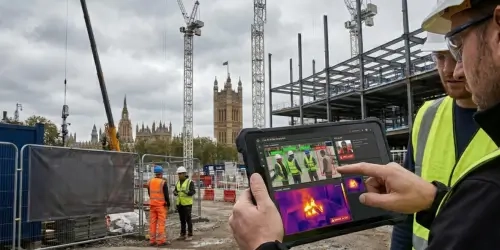
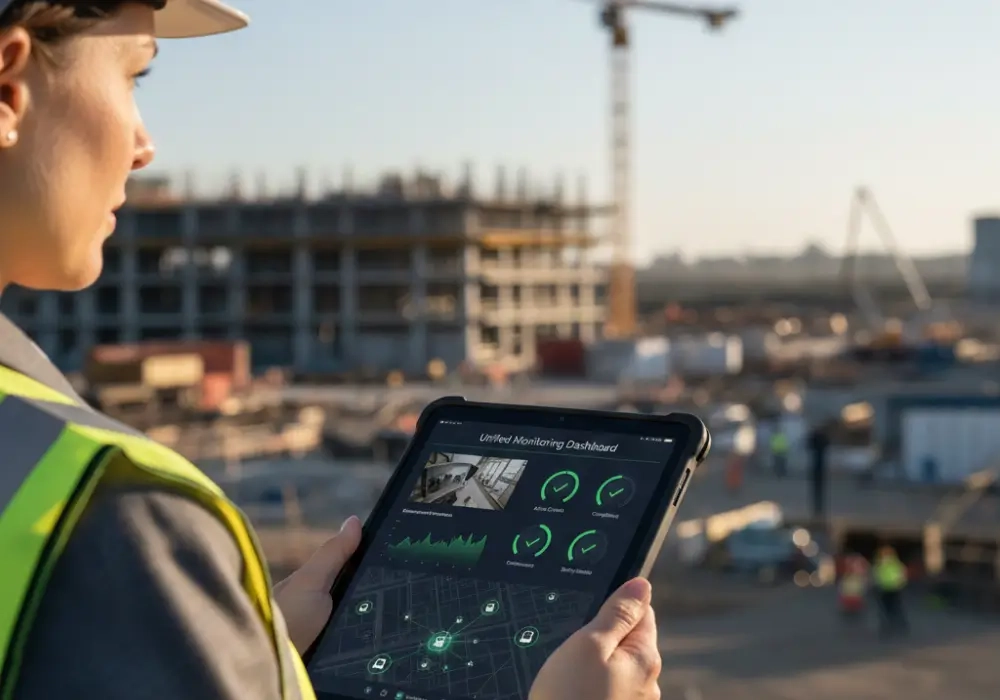
Centralised risk visibility: Unified platforms streamline operations by gathering all site data (CCTV, environment performance, access logs, PPE detection, etc.) into a single dashboard. Instead of logging into numerous vendor tools, IT and site teams have complete oversight at a quick glance via one interface.
-
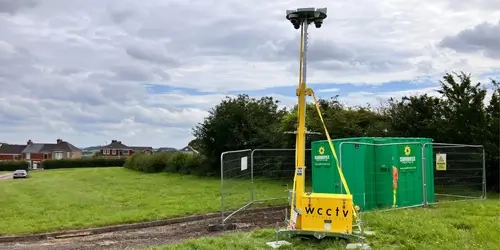
Continuous monitoring: Smart tools automate cross-system checks. When smoke detectors identify fire risks, integrated platforms automatically focus CCTV Tower cameras on affected areas, trigger instant alerts and timestamp every incident in real-time.
-
Cost savings: Unified monitoring simplifies IT management and reduces costs. One vendor relationship replaces 5-6 separate contracts. With fewer tools to manage and less operational overhead, project managers are significantly less stressed during audits.
-
Improved operational efficiency: Automation reduces manual administrative work, freeing teams to focus on higher-priority tasks instead.
-
Automatic compliance checks: Modern platforms automatically flag compliance violations in real-time. When noise levels near Section 61's 87 dB(A) threshold or workers aren't wearing the appropriate PPE, systems alert site teams immediately, store up to 180,000 timestamped records for trend analysis and compile reports without human intervention.
-
Stronger cybersecurity posture: Unified platforms apply consistent security protocols across all monitoring devices: end-to-end AES256 encryption, NDAA-compliant components and secure
-
data handling/storing of personal information (applicable to CCTV). Since all site data is accessible through a single login, cyberattacks are drastically reduced.
Read more:
5 Smart Consolidated Features Making a Difference in Construction
Modern systems that consolidate monitoring merge several technologies into a single platform, delivering capabilities that fragmented vendors simply can't match.
1. Remote monitoring with real-time alerts
24/7 remote monitoring and real-time alerts through NSI Gold Accredited monitoring centres reduce your reliance on manned guards/security vendors. When a threat is detected, trained security teams review live video footage and coordinate varied actions instantly, keeping sites safe and secure at all times. Some of these responses include:
-
Issuing live voice-down audio challenges
-
Dispatching mobile keyholding and alarm teams to investigate
-
Notification of emergency services where needed
What's more, site managers are also instantly notified when something happens on-site for complete peace of mind. Smart systems then consolidate incident footage and response actions with precise timestamps, creating a clear paper trail that ensures you're always audit-ready.
Read more: How IT Managers Can Support Hybrid and Remote Construction Safety Management
2. AI-powered systems and video analytics
Modern systems equipped with artificial intelligence (AI) and advanced software applications eliminate vendor sprawl almost entirely. Machine learning "teaches" cameras to analyse movement and behavioural patterns, not just basic motion. They can distinguish genuine risks from false alarms caused by moving debris or weather with near pinpoint accuracy.
This means AI-backed systems know exactly what to look for if a worker isn't wearing the required PPE in a predefined zone. They instantly alert site managers for corrective action, capture a video snapshot and timestamp the incident for compliance purposes. No manual reports or inspections needed.
Read more: How Artificial Intelligence is Revolutionising CCTV Tower Monitoring
3. IoT technology
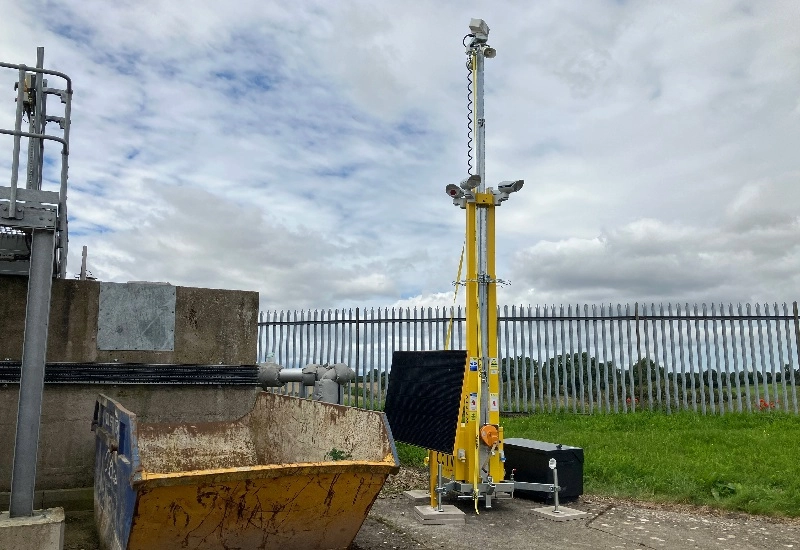
Internet of Things (IoT) devices collect and transmit data via secure 4G/5G networks without human intervention. They eliminate the need for multiple tools by providing continuous monitoring, predictive maintenance and consolidating compliance data as standard.
-
Air quality sensors track particulate matter (PM1, PM2.5, PM10), CO₂, VOCs, dust emissions and other harmful airborne pollutants for ESG reporting.
-
Noise monitoring sensors monitor and record a wide range of decibels (30-130 dB) and frequencies (20Hz to 12.5kHz) and send alerts the moment levels near 85 dB(A) thresholds as standard.
-
Weather monitoring systems track live atmospheric conditions such as temperature (-40°C to +60°C), windspeed (0-110mph), rainfall (hourly) and humidity (10-99%) automatically.
-
Smart detection systems covering PPE, smoke/fire detection and intruder alerts essentially do "3 jobs in 1". They identify missing safety gear, catch the earliest signs of fire hazards and constantly monitor sites for unauthorised access, without complex setup or human involvement.
-
Access control systems like Automatic Number Plate Recognition (ANPR) track vehicle movements, creating an automated timestamped log for every on-site entry and exit.
Read more: How IoT Devices Improve Both Safety and IT Overview on Construction Sites
4. Automated compliance
Unified platforms automatically generate compliance reports by pulling data from all connected monitoring devices. With the click of a button, you can export audit-ready documentation up to 5X faster than legacy systems. This streamlined approach frees teams from time-consuming data entry work while making compliance checks much simpler for IT leads.
Read more: Rethinking Construction Compliance Through Smart Monitoring Systems
5. Cloud-based dashboards
Stellifii, our cloud-based platform, receives data from all connected systems. This means contractors can review security, environmental, compliance and project management information from a single dashboard, without the need to switch between separate security solutions and different vendor tools.
For instance, IT managers in Manchester can monitor London building sites in real-time, review current and historical data trends and generate reports from afar. One vendor, but endless possibilities.
Read more: Unifying Security and Site Monitoring: The New Standard for UK Contractors
The Shift Toward Unified Systems
If you're looking to simplify your IT stack and reduce vendor sprawl with unified systems, here are 6 steps you can follow:
-
Audit your current vendor tools: Document your entire fragmented vendor landscape, including functions, contract terms and monitoring fees. This will help you spot overlapping capabilities, integration gaps and any pain points.
-
Define your priorities: Base decisions on contract renewal dates, security vulnerabilities, operational pain points and compliance requirements. These steps help you see where current vendors are falling short and what you need to prioritise for real value.
-
Evaluate consolidated capabilities: Assess potential consolidated platforms against your requirements: comprehensive monitoring, construction industry experience, cybersecurity credentials and UK support infrastructure. Knowing this ahead of time helps you understand what's needed for proper consolidation.
-
Plan your rollout: Implement unification gradually. Start by testing a monitoring system at one of your sites before rolling it across large-scale operations. This gives you time to test the equipment and see how it fits in with your day-to-day and reporting needs.
-
Team training: Teach your teams about unified dashboards, and how to interpret integrated data displays, respond to automated alerts and generate compliance documentation.
-
Measure ROI: Track consolidation outcomes: reduced vendor sprawl, faster compliance reporting, lower subscription costs and improved incident response times.
Simplify Your IT Stack with WCCTV
Managing vendor sprawl on your construction site might seem manageable, but it fast becomes a strategic liability that increases costs, complicates compliance and keeps teams in reactive firefighting mode.
Consolidated monitoring addresses all that with unified dashboards displaying all data via a single interface. This smarter approach to site monitoring reduces risks, cuts costs and strengthens your cybersecurity posture with virtually no human intervention.
With over 20-years expertise in unified monitoring, our fully-managed integrated systems simplify construction site management from day one. One platform; complete control.
Reach out to our team to discuss how we can help you eliminate vendor sprawl today.