The UK's construction industry operates within one of the most stringent regulatory frameworks globally, placing ongoing responsibilities on compliance management to demonstrate evidence-based oversight across all site operations.
One missed report or safety check, and things turn south quickly, putting the company's reputation and the managers' personal liability on the line.
The pressure when regulators arrive unannounced at your construction site is intense. The last thing a compliance management team needs is to scramble between fragmented platforms and hope last month's footage is still accessible. For many construction firms, that's exactly the reality when teams rely on outdated, legacy systems that weren't designed for the complexity of modern construction.
Maintaining compliance with Health and Safety Executive (HSE) and General Data Protection Regulations (GDPR) requirements is non-negotiable, and the repercussions when things slip through the cracks are serious. Fragmented systems and manual reporting don't just create admin headaches; they create audit gaps that regulators are quick to act on and enforce.
Real-time monitoring changes this dynamic by tracking site conditions as they happen and closing the compliance gaps that regulators look for.
This article covers everything you need to know about real-time monitoring for construction HSE and GDPR audits.
HSE and GDPR for UK Construction Sites: Explained
We'll focus on the two distinct regulatory frameworks that UK construction sites are subject to: HSE and GDPR. In a nutshell, the former covers general occupational health, safety and wellbeing of workers, while the latter covers data protection when "identifiable persons" are monitored.
Health and Safety Executive (HSE)
The HSE is Great Britain's primary regulator and enforcer for workplace safety. This means employers must take proactive steps to protect the health, safety and wellbeing of staff at all times.
Various "sub-regulations" are found within the HSE framework, each with its own set of rules and compliance obligations:
-
Health and Safety at Work Act (HASAWA) 1974: Employers must protect workers' health, safety and welfare "so far as it's reasonable practicable". This requires documented, ongoing evidence of risk management.
-
Construction (Design and Management) CDM Regulations 2015: Duty holders/principal contractors must plan, manage and monitor all construction phases, conduct thorough risk assessments and maintain a Health and Safety File throughout the project lifecycle.
-
RIDDOR 2013 (Reporting of Injuries, Diseases and Dangerous Occurrences Regulations): Serious injuries, dangerous occurrences and work-related illnesses/diseases must be reported within strict timeframes (immediately for fatalities; 24 hours for specified injuries).
-
Control of Substances Hazardous to Health Regulations (COSHH): Where Workplace Exposure Limits (WELs) may be exceeded, ongoing exposure monitoring records are required under Regulation 10. A one-off risk assessment doesn't satisfy this.
-
Control of Noise at Work Regulations 2005: Workers can't be exposed to sound levels above 85 dB(A) over 8 hours. Documented environmental monitoring and PPE provision are expected.
-
Working at Height Regulations 2005: Employers must ensure proper guardrails, barriers and safety harnesses are in place when teams work from heights, such as scaffoldings and ladders.
Smart technology directly supports these commitments. Rapid Deployment CCTV Towers, AI-video analytics and IoT-based environmental sensors all provide continuous monitoring and timestamped audit trails that UK regulatory bodies expect, with very little human input.
Read more: How HSE Regulations Are Evolving to Advance Construction Site Safety
General Data Protection Regulation (UK)
Data protection isn't only for IT departments because GDPR applies directly to construction operations.
Any system that captures footage or personal data from which individuals can be identified falls under UK data law. That includes CCTV surveillance, ANPR vehicle logs, PPE monitoring imagery and intrusion detection alerts. The way the data is stored, accessed, retained and shared must adhere to GDPR standards.
The core GDPR rules for construction monitoring include:
-
Use data fairly, lawfully (i.e., "lawful basis") and transparently
-
Use data for specified purposes (e.g., security reasons)
-
Limit the amount of data collected
-
Ensure data is accurate and up to date
-
Keep data for no longer than necessary
-
Keep data secure
"Lawful basis" refers to the legal requirement (Article 6) to identify and document at least one of 6 specific grounds (consent, contract, legal obligation, vital interests, public task, legitimate interests) before processing personal data, like CCTV surveillance or ANPR logs on construction sites. Without it, processing is illegal, risking ICO fines up to £17.5 million or 4% of annual global turnover.
On a cybersecurity note, any platform storing surveillance/monitoring data must use appropriate online security measures (AES256 encryption, NDAA-compliant components) to prevent unauthorised access. With 40% of construction companies experiencing cyberattacks in the last year alone, digital security must be a top priority. A single data breach can result in hefty ICO penalties and reputational damage.
Read more:
-
Does Your CCTV Comply with GDPR? A Complete Guide on UK Data Law
-
How Smart Security Systems Maintain Data Privacy for Construction Sites
Real-Time Monitoring vs Traditional Methods in UK Construction
The problem with traditional monitoring methods like physical walkabouts and clipboard compliance checks is that they only capture a moment in time. Conditions on building sites don't stay still, and changes between manual inspections often go unrecorded.
For instance, workers may start their day under safe weather conditions during a foreman's morning round, but by the afternoon, wind speeds may have exceeded safe thresholds. Without real-time data, this increased risk may go unnoticed until the next scheduled safety inspection, most likely the following day.
Fragmented systems make this problem worse. When health and safety records sit in one spreadsheet, GDPR logs in another and CCTV footage in a third vendor platform, the risk of non-compliance increases tenfold. Pulling site information for audits from multiple sources often takes days, time compliance teams don't often have.
Real-time monitoring, on the other hand, flags safety risks before they escalate. Using sophisticated software and advanced artificial intelligence (AI) algorithms, they track safety metrics, identify risks and provide proactive reporting for safety audits in a fraction of the time.
Here's a side-by-side comparison of traditional vs real-time monitoring in UK construction:
|
Feature |
Traditional monitoring |
Real-time monitoring |
|---|---|---|
|
24/7 monitoring |
[[NO]] |
[[YES]] |
|
Automated audit trails |
[[NO]] |
[[YES]] |
|
Timestamped activity logs |
[[NO]] |
[[YES]] |
|
Secure data storage |
[[NO]] |
[[YES]] |
|
Instant, real-time alerts |
[[NO]] |
[[YES]] |
|
Multiple site visibility |
[[NO]] |
[[YES]] |
Read more:
3 Ways Real-Time Monitoring Turns Site Activity into Compliant Data-Driven Insights
Real-time safety software doesn't just collect site data. It analyses, organises, stores and makes it easily retrievable in a way that satisfies both HSE and GDPR UK regulations.
For compliance managers facing resource strain and audit pressure, this efficiency streamlines audit preparation and improves safety performance all in one.
Here's how:
1. Real-time alerts
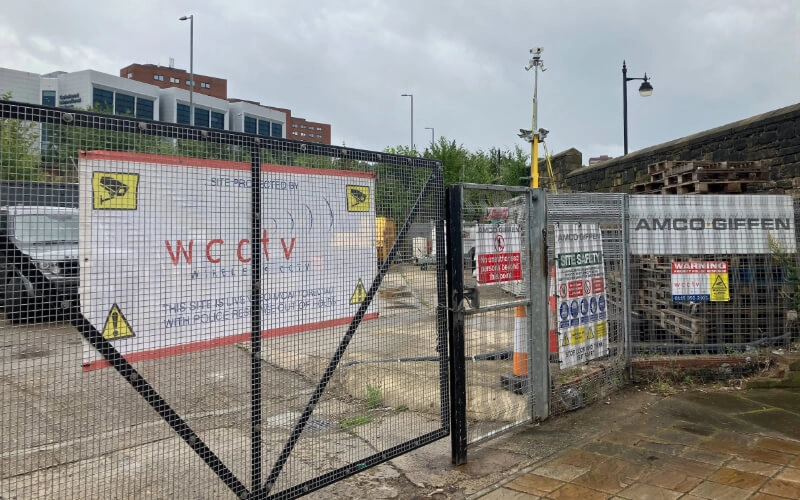
Fully-managed CCTV Towers and Temporary CCTV solutions with near-360° PTZ (Pan-Tilt-Zoom) cameras continually scan working zones, day and night, in all weather conditions.
When a potential hazard is detected, from a perimeter breach to a violation of safety protocols, automated alerts are instantly delivered to site managers and compliance officers, enabling rapid review and corrective action.
When remote monitoring is in place, trained operators at NSI Gold Accredited monitoring centres assess live footage as events unfold. Operating within clearly defined privacy and data-handling protocols, they can intervene within minutes by:
-
Issuing live audio voice-down challenges
-
Deploying mobile keyholding teams
-
Escalating safety issues to emergency services when needed
This targeted approach helps construction firms manage risk while supporting compliant data use.
Real-time alerts are also sent from smart add-on integrations/AI tools when potential risks are identified. These analytical insights help site managers make more informed decisions about business operations and the safety of their crews.
Powered by IoT technology, AI-video analytics and computer vision, smart detection systems and environmental sensors automatically notify relevant teams when employee safety is compromised or when site conditions approach regulatory thresholds:
-
Air quality sensors monitor CO₂, VOCs, particulate matter and other airborne contaminants, supporting compliance with HSE, COSHH and ESG
-
Noise monitoring sensors track occupational sound exposure and send instant alerts when levels approach the 85 dB(A) limit, helping to prevent long-term workplace injuries and reduce the risk of RIDDOR/HSE investigations.
-
Weather monitoring systems provide early warnings to compliance and project management teams when temperature, wind speed, humidity and rainfall create unsafe working environments.
-
PPE compliance is enforced through smart PPE monitoring systems that flag missing hard hats and other protective gear in real-time, allowing for swift corrective action.
-
Smoke and fire detection sensors identify the earliest signs of smoke or flames (heat signatures, colour changes, etc.), allowing for quick intervention before small issues escalate into project-stopping problems.
-
Intrusion detection systems enhance workplace safety by flagging unauthorised persons in restricted zones, with every incident timestamped to support audit and compliance requirements.
Read more: Using AI-Detection Data for Early Intervention on Construction Sites
2. Centralised data visibility
All activity data (site security feeds, environmental logs, ANPR access controls) feeds directly into centralised platforms like Stellifii via secure 4G/5G networks. From a single secure, NDAA-compliant cloud-based dashboard, everything is consolidated for easy reference with AES256 encryption built in as standard.
Compliance officers can access live and historical data across every project phase, so no more switching between vendor systems or chasing updates from safety teams who have already moved on to the next project.
This kind of digital safety management system is exactly what compliance managers need. Ongoing monitoring records are always available for HSE construction safety compliance. For GDPR purposes, it means data is stored centrally with robust encryption measures, meeting UK data safety practices without additional manual effort.
Read more: Construction Site Safety: The Importance of Data Visibility
3. Automated reporting
Every detection event, from workplace safety breaches to environmental spikes, is automatically logged with a location-specific timestamp and corresponding video footage.
Smart detection systems for PPE compliance, smoke/fire and intrusion detection all feed into Stellifii's single dashboard, meeting HSE and CDM requirements with ease. Environmental sensors store up to 180,000 timestamped logs for trend analysis and compliance reporting, providing the detailed exposure logs that COSHH Regulation 10 expects.
What's more, compliance reports are characterised by date, location and incident type. This means that if you're looking for a noise breach or PPE violation from weeks ago, searchable timeframes make it possible in just a few clicks. Systems generate audit-ready documentation up to 5X faster than fragmented systems.
For both HSE and GDPR compliance, centralising subject data makes a massive difference in operational efficiency with time-saving benefits. When HSE inspectors request verifiable evidence following a workplace injury, you don't need to jump between multiple legacy systems to retrieve the information, as records securely stored within Stellifii prove due diligence.
Read more: How Cloud-Based Tools Are Changing Construction Admin
7 Benefits of Real-Time Monitoring for the Construction Industry
Remote monitoring with real-time alerts offers a lot more than audit readiness:
-
Reduced compliance risk: Continuous, automated monitoring closes the gap between manual inspections, where incident reports could go undetected. Fewer gaps mean fewer enforcement actions under HSE.
-
Improved safety performance: Instant alerts cut incident rates by as much as 40%, preventing injuries, theft, fires and/or intrusions before escalation.
-
Lower personal liability exposure: Detailed records and secure access controls show that you took reasonable steps to mitigate risk in terms of both workers' safety and data protection. This is the epitome of what HSE and GDPR stand for.
-
Time and cost savings: Automated HSE reporting procedures reduce manual work by 30-40%, freeing managers to focus on higher-priority tasks. Remote monitoring can reduce security costs by up to 88% compared to manned guards. Lower insurance premiums can also be expected as insurers favour construction sites with proactive risk management and control.
-
Tender success: Compliant construction sites stand a higher chance of winning tenders as procurement teams increasingly scrutinise site safety measures and incident rates.
-
Stronger GDPR posture: In-built AES256 encryption means GDPR safety law requirements are met as standard, reducing the risk of data breaches and ICO fines.
-
Hassle-free audits: With all data consolidated in Stellifii, audit prep time is significantly reduced. Timestamped logs, video evidence and regulator-ready documentation are accessible on demand.
Read more: The ROI of Consolidating Site Monitoring Into a Unified Platform
Streamline HSE and GDPR Audits with WCCTV Today
Managing HSE and GDPR across multiple sites while relying on outdated legacy systems is how compliance gaps happen. Solving this problem means investing in the right innovative software and systems that generate verifiable evidence automatically when it's needed most.
With 6 regional hubs and over 2 decades of wireless monitoring expertise, we provide compliant monitoring solutions that give UK compliance teams the real-time, data-driven insights they need to handle HSE and GDPR audits, without the last-minute stress.
Don't wait for an inspection to discover where the gaps are. Contact our monitoring experts today to see how integrated, cloud-based systems can simplify your audit process from the ground up.