
Entering 2027, the UK construction industry faces supply chain and energy uncertainties, growing compliance pressures and rising materials and labour costs. In this environment, efficient controls, adaptable risk management and better information will be more critical as the industry continues to develop.
The contractors that perform best over the next few years will likely be those that connect operational efficiency, workforce safety, security, environmental management and evidence-based decision-making within a central management system.
This way, leaders can see the big picture and anticipate risks and opportunities, including the benefits of AI and automated reporting.
This article explores the key areas contractors should consider when developing their project strategies for next year, and examines how integrated monitoring can improve project oversight and profitable delivery.
7 Key Areas for Your 2027 Construction Project Strategy
These 7 areas highlight where better processes, connected monitoring and the right data can deliver improved project outcomes in 2027.
1. Build consistent standards across every site
One of the major project management challenges, especially in multi-site operations, is maintaining consistent standards across your portfolio.
Different supervisors, project teams and subcontractors tend to work slightly differently, leading to variations in the way sites are run and perform. This can create weaknesses in crucial areas like safety compliance, reporting/documentation, site security, environmental controls and quality standards.
When multiplied across several projects, inconsistencies undermine operations and introduce significant risks, including :
- Increased accident rates
- Theft and vandalism
- Project delays
- Disputes with stakeholders
- Rework and avoidable costs
- Difficulties proving regulatory compliance
For your 2027 planning, focus on creating uniform, measurable standards across the entire portfolio. Develop clear Standard Operating Procedures (SOPs) so that any new manager or subcontractor can consult the relevant SOP and quickly understand your operating requirements. CCTV monitoring solutions can help construction managers reinforce this structured approach throughout the company
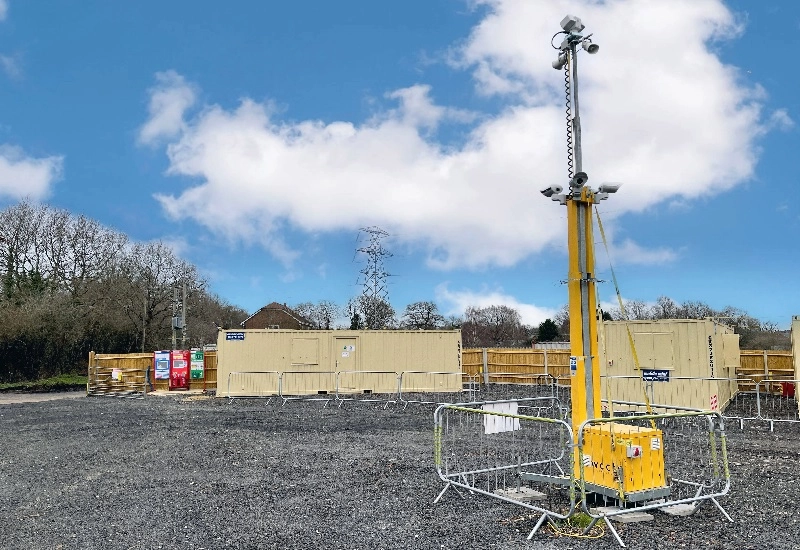
Mobile CCTV towers can be rapidly deployed wherever oversight is needed, capturing visual evidence that streams to a cloud platform and remote monitoring centre. System software lets you log in to the platform to view and export video and reports (via mobile or web).
With CCTV and platform visibility in place, you can add additional AI-enabled safety, compliance and environmental tools to help verify that every project aligns with your procedures. This smart centralised overview helps you quickly identify and correct deviations, reinforcing best practices and uniting teams around the shared strategy.
2. Improved workforce safety through greater visibility
With the construction industry recording more worker fatalities (25) than any other sector in 2025/26 in Great Britain, workforce safety will remain a top priority throughout 2027. A thorough risk assessment of safety issues at every site prior to starting work is the first step in implementing better practices.
Major challenges include mandated PPE non-compliance, falls from heights, poorly supervised subcontractors, vehicle and plant interactions and environmental hazards.
Best practices recommend regular project reviews for timely issue identification. The question is, how is this review conducted? Physical inspections and manual reports aren't enough to oversee large, complex environments. They offer only a snapshot of activity, and new risks may emerge hours, even minutes, after the project manager completes an inspection.
Integrated monitoring solutions help contractors mitigate risks and achieve more proactive safety management. Deployable CCTV towers with HD night-vision cameras provide the foundation to connect IoT sensors and AI-powered smart detection systems that identify specific events, including:
- Missing PPE: AI-driven PPE detection systems recognise when crews work without required equipment such as hard hats or high-visibility clothing. Real-time alerts to managers and audio warnings to crews ensure the issue is tackled promptly.
- Unauthorised access: Intrusion detection systems use AI to identify suspicious movements and behaviours and trigger near-immediate deterrents and responses from monitoring officers. The AI is trained to filter out common false alarms such as blowing materials, animals and authorised activities/vehicles.
- Environmental hazards: IoT Environmental monitoring sensors connected to CCTV towers help you protect workers and surrounding communities from noise and air pollutants. These systems can issue alerts when predefined limits are reached, prompting proactive, responsible management of eco hazards (discussed further in the environmental management section).
Smart systems retain timestamped records in one place, giving you reliable evidence to support investigations, regulatory audits, claims defences and safety reviews. With the right monitoring tools and skills training, contractors can foster a safety culture that actively prevents incidents rather than simply records them.
Read more:
3. Strengthen site security and asset protection
Security breaches on construction sites are an ongoing concern for project management teams. Both petty criminals and Organised Crime Groups (OCGs) target valuable equipment, materials, fuels and metals on worksites.
A security breach can delay works, increase costs, complicate insurance, disrupt subcontractor scheduling and harm your reputation with stakeholders. As your projects grow in value and complexity, treat security as part of overall project performance rather than a standalone function.
Integrated CCTV towers and AI-enabled risk detection play a vital role in securing construction projects today. These systems are designed for temporary work environments and can be easily relocated as risk priorities change (e.g., expensive materials and specialist equipment are received into on-site storage).
CCTV integrated with intrusion detection and remote monitoring services give you:
- 24/7 site oversight
- Automated threat detection and real-time alerts
- Recorded evidence to support investigations, insurance and injury claims
- Reduced security costs (our CCTV, central platform and live monitoring service can reduce security costs by up to 88% compared to manned guards)
- Visible deterrence (CCTV towers can stand up to 6 metres tall)
In 2027, asset protection is likely to become even more intelligence-driven, with AI detection supporting remote visibility and prompting real-time response with accurate identification and clear, automated incident reporting. Other systems that play a vital role here include:
- Fire and smoke detection systems catch early signs of smoke and flame, which is especially valuable around hot works, material storage and out-of-hours periods. Your monitoring team is alerted and can respond before a small incident becomes a major one.
- Automatic Number Plate Recognition (ANPR) tracks vehicles entering and leaving your site and restricted zones. ANPR lets you know who is on location and can check deliveries and subcontractor vehicles against schedules.
Read more:
- A Complete Guide to Construction Site Safety and Security
- How Integrated CCTV and ANPR Keep UK Sites Secure
4. Proactive environmental management
Environmental performance is becoming an essential part of modern project management. Construction sites must control noise under the Control of Pollution Act 1974 (including Section 61 consents and BS 5228), alongside worker protection rules such as the Control of Noise at Work Regulations 2005 and the Control of Substances Hazardous to Health (COSHH).
Violating noise and COSHH laws can cost thousands of pounds in fines (sometimes several million) and can lead to work stoppages and even criminal prosecution.
Beyond laws and ordinances, clients and the public expect contractors to be environmentally and socially responsible, minimising the impact of:
- Dust
- Noise pollution
- Poor air quality
- Machinery emissions
- Weather-related risks
- Chemical pollutants
Managing these responsibilities across multiple sites and complying consistently with regulations is nearly impossible if you rely on manual processes and spreadsheet records.
IoT-based environmental monitoring sensors connected to CCTV towers help you move from periodic monitoring to continuous oversight and accurate automated records:
- Noise monitoring sensors measure noise levels across work zones and alert when preset exposure thresholds are exceeded, helping you manage community impact, worker welfare and compliance.
- Air quality monitoring sensors track airborne hazards, dust, TVOCs, CO₂ and CO, notifying teams when preset thresholds are hit to support safer, more compliant workplaces.
- Weather monitoring sensors capture site-specific climate data, including temperature, wind and rainfall. This information supports contingency plans when conditions threaten work and provides evidence when weather disrupts project timelines.
Gathering consistent environmental data creates thousands of timestamped records you can use to drive not only better environmental outcomes but also greater project success.
Read more:
- The Uses For IoT in Construction
- Integrating Environmental Monitoring Sensors on Construction Sites
- Weather Monitoring Tools for Construction Sites
5. Stronger evidence collection, reporting and defensibility
Construction managers often have to produce evidence to defend the company's position in contractual disputes or liability claims. Project teams must routinely show evidence of compliance, safety protocols and environmental controls to Health and Safety Executive (HSE) inspectors, council inspectors and other stakeholders.
Without reliable records of these activities, management investigations are complicated, and compliance standards may be questioned. Disputes are also harder to resolve, and damage claims can become protracted and expensive.
For instance, a client may trigger a penalty because a project wasn't completed on time. Weather events may have materially contributed to the delay, but without accurate timestamped records to prove it, you can't defend the claim and must pay out, shrinking project profits.
Successful projects include evidence management as a crucial part of operations. Integrated CCTV monitoring through a central platform supports this by delivering:
- Recorded CCTV footage
- Timestamped incident logs and alerts
- Automated environmental records
- Access control information (ANPR logs)
- AI-driven safety and security reports
- Centralised document storage
Together, this data creates concrete evidence for investigations, compliance, insurance claims and stakeholder reporting. A digital audit trail of timestamped video footage/sensor data, alerts and reports is much harder to dispute than handwritten logs or memory.
Housing evidence in a central cloud-connected platform ensures teams can retrieve documentation in minutes, rather than spending hours searching across departments and systems.
6. Improved project efficiency through automation and AI
For many years, construction firms have employed project management software for procurement, materials management, scheduling and task tracking. Today, automation and AI tools can add value to nearly every stage of the construction process, with widely used applications including:
- PPE compliance monitoring
- Intrusion detection
- Access control and resource delivery monitoring
- Smoke and fire detection
- Automated alerts
Incorporating automation and AI into operations can significantly enhance project efficiencies. These solutions capture real-time data consistently without human involvement or error-prone manual recording.
Trained AI flags incidents such as fire hazards accurately and alerts project managers in real-time, enabling rapid responses to avert the danger. Every incident is logged, reported and stored to assist future efficiency reviews and complaint and claim handling. Automated reporting can also streamline progress tracking updates, budgeting and resource allocation.
The stronger your data records, the better you can leverage AI insights and trend analysis in 2027 and beyond. For example, sensor data analysis could reveal patterns in environmental exposures, making it easier to predict and manage this area in the future.
Read more:
7. Centralise project oversight
Modern construction management has shifted from standalone systems toward connected solutions that simplify and strengthen oversight in a central hub. A clearer big-picture overview improves risk management and decision-making, while AI insights can guide more effective strategic planning.
Cloud-based platforms provide this capability by bringing together:
- CCTV monitoring
- Security alerts
- Environmental sensors
- AI-powered detection systems
- Relevant project data
- Data-backed reports
Instead of managing information streams in 5 different tools, our dedicated cloud-based platform allows leaders to track multiple sites and up to 81 cameras in one central location.
This means safety, security, environmental monitoring and project progress information is available in secure, centralised dashboards for authorised users to view from any connected device.
When teams work from the same data, collaboration between sites, subcontractors and head office becomes easier. Communication processes are streamlined, improving project efficiency, productivity, safety and compliance.
Move to Smart Integrated Monitoring in 2027
Smarter construction delivery in 2027 relies on streamlined systems and connected oversight. By integrating security, safety, environmental compliance and operational data into central cloud dashboards, leaders gain the visibility to manage confidently in uncertain times.
Real-time alerts and automated reporting in our CCTV and cloud platform help you make informed decisions quickly, ensuring every project remains on track to success and profitability. Meanwhile, your teams are more productive because processes are consistent and admin is reduced by automation.
To make connected project oversight and best practices part of your 2027 strategy, contact our team today and let's discuss how we can support you.

