Today, highways authorities are expected both to deliver a safe, efficient public service and explain their decisions and actions. Residents, councillors and local media increasingly expect prompt updates on temporary traffic schemes and roadworks and full explanations for safety failures and environmental hazards.
This presents significant challenges, particularly when your team relies on physical site visits, delayed reports and inconsistent information to handle critical communications. Smarter monitoring, on the other hand, leads to better data quality and greater transparency, which improves public perception and trust.
A defensible traffic monitoring solution gives highways managers the objective evidence needed to show that projects are being managed responsibly. Through high-level oversight, proportionate deployment, audit-ready reporting and time-stamped evidence, leaders can answer difficult questions with confidence and integrity.
Our article explains how smart public sector monitoring with unified dashboards helps you manage stakeholder engagement with solid evidence and professional assurance.
Why Defensible Traffic Monitoring Matters More Than Ever
Managing modern public-sector roadworks and traffic schemes entails accounting to diverse stakeholders, as every group demands clear explanations for your operational and project decisions.
Residents and commuters expect prompt, transparent updates about roadworks disrupting their daily lives. Councillors need factual information about a delayed project to address their constituents' valid concerns. Contractors must be held accountable for safety and environmental performance at every workplace. Meanwhile, you and your team face continuous scrutiny to demonstrate that you are spending public funds wisely.
Data shows that UK roadworks have increased in recent years and in many instances have become more complex. Over 200 organisations can legally excavate roads, which introduces major co-ordination challenges.
Network projects, including temporary travel schemes, utility works, emergency repairs and infrastructure programmes, often overlap, creating greater disruption and more complaints. A concerning 81% of local authorities say poor co-ordination between companies working on our streets and highways is a major problem.
On any given day, highways managers may have to justify or investigate route delays, worksite noise, contractor compliance, unsafe working practices or asset theft. The only way to effectively stay on top of constantly emerging risks is by actively gathering evidence that shows exactly what happened, when it happened and how the situation was managed.
Successful leaders do this by implementing defensible monitoring strategies with specialised and often AI-driven systems designed to ensure the reliability, compliance and security of network infrastructure, public services and operational performance.
What Does Defensible Traffic Monitoring Look Like?
A defensible traffic and project monitoring solution provides decision-makers with 4 core benefits: Advanced visibility, proportionate deployment options, audit-ready reports and time-stamped evidence logs. Below, we explore these aspects in more detail.
1. Advanced project visibility for greater transparency
Smart remote monitoring provides high-level visibility into all your temporary works and traffic schemes. Strong visibility is crucial to understanding conditions on the ground and making the best decisions about events affecting your community.
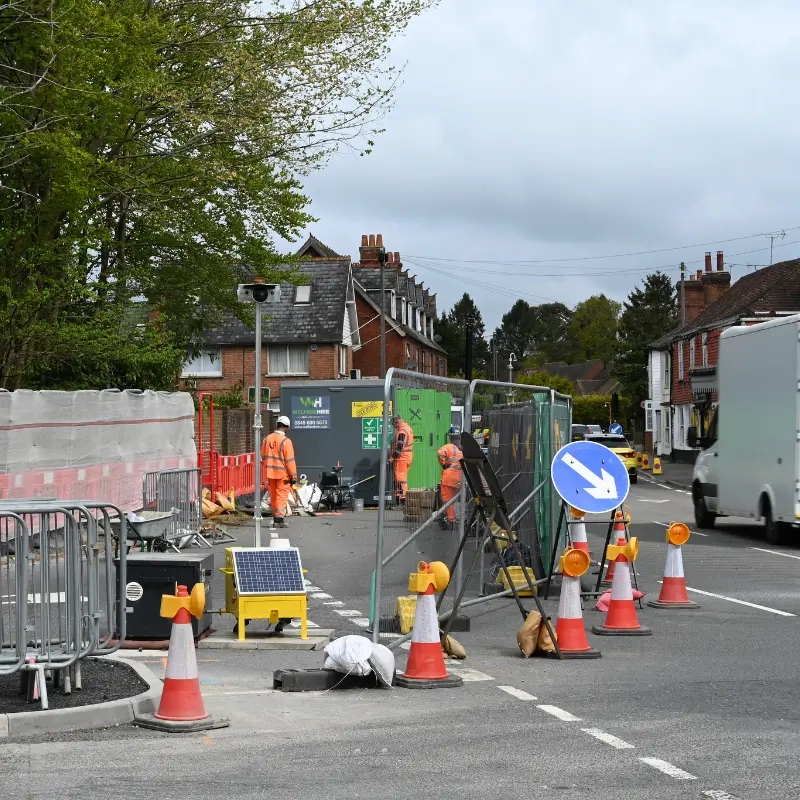
Deployable systems such as mobile CCTV towers can provide oversight of high-priority locations within 20 minutes (for basic setups). Our CCTV, Mini and Traffic Towers offer solar and fuel‑cell battery power and 4G/5G connectivity, so they operate independently of local power or network infrastructure.
Live and recorded footage from modern CCTV towers can be viewed on a single smart platform. A unified platform view shows you what's happening in each monitored zone, allowing you to assess safety and investigate incidents actively. With the ability to track developing events on a mobile or web app, you no longer need to conduct time-consuming site visits, saving you hundreds of working hours.
When your team and contractors are working from the same system, communication becomes clearer, which makes it easier to communicate transparently with residents and elected members.
Read more:
2. Proportionate deployment: Do the risks justify a monitoring solution?
Budget constraints, public pressure and good governance require you to direct resources to where they deliver the greatest value to stakeholders (road users, residents, local businesses, public transport, councillors, MPs and contractors).
Since it's expensive and impractical to install a fixed monitoring setup at a temporary project, deployable mobile platforms are the answer.
Traffic and highways teams can hire monitoring equipment to install where operational risk or public interest justifies it at the time. Once the project is complete or the risk is reduced and monitoring is no longer necessary, the equipment can then be packed away or moved to the next project.
This flexible approach ensures you always have coverage where you need it without sinking funds into costly, permanent infrastructure that offers limited long-term value. It shows stakeholders that public resources are being targeted appropriately, in response to genuine safety and security needs.
Deployable CCTV solutions are particularly well suited to:
-
Temporary traffic management schemes
-
Roadworks and maintenance projects
-
Major infrastructure works
-
Emergency road closures and detours
-
Remote or rural locations
-
High-risk traffic and crime hotspots
-
Public events affecting the network
Read more:
3. Audit-ready reporting for stronger accountability
Modern monitoring systems automatically record incidents, alerts, operator actions and interventions. This creates a comprehensive audit trail that is invaluable when projects face scrutiny.
Instead of piecing together information from email threads, contractor updates, spreadsheet logs and other scattered sources, you can quickly retrieve reliable reports supported by video and relevant sensor data. This evidence-backed documentation supports clear stakeholder feedback while simplifying reporting for internal reviews and regulatory compliance.
Rigorous audit trails and reporting show:
-
When incidents occurred
-
What risks were identified
-
What action was taken
-
Who responded
-
The full connected incident response
-
Whether contractors complied with requirements (based on sensor readings and CCTV footage)
Time-stamped evidence replaces assumptions with facts
Evidence-based decision-making in public policy allows local authority officials to move away from intuitive decision-making, leading to more effective public policies.
By combining CCTV footage with AI-generated alerts, smart detection tools and environmental monitoring data, traffic teams can quickly establish an accurate timeline of events. Instead of relying on conflicting accounts, managers can verify:
-
Are temporary traffic management measures in place?
-
Are work teams wearing the required PPE?
-
Was excessive dust or noise recorded?
-
Did weather conditions justify project delays?
-
When unauthorised access took place
-
How quickly corrective action was taken
The implementation of a comprehensive monitoring framework together with proper training closes risk and visibility gaps across all project zones. It empowers your team to respond confidently to complaints, armed with the necessary context and knowledge. It helps you demonstrate that your risk evaluations and policy goals are supported by high-quality data, rather than assumptions and intuition.
Defensible Monitoring Solutions That Provide Accountable Oversight
Our range of Traffic Management and CCTV Tower solutions helps highways teams establish high-definition PTZ surveillance at temporary worksites and locations without power or internet. This coverage can assist in managing security, safety, environmental monitoring and project oversight in one: Towers integrate these functions into a central platform to deliver comprehensive visibility across your sites.
Rapid installation and self-contained operation mean basic Tower setups can be commissioned within 20 minutes. These solar-powered, 4G/5G wireless-connected systems perform reliably in nearly every environment, including rugged rural networks. They can be easily relocated as work progresses, ensuring you never lose sight of active priority environments.
While all our systems are quick and easy to employ, a key benefit of our Mini Tower is that it can be installed by one person in minutes, with workers able to move it without the support of an engineer on-site. This makes it a widely-used option for emergency sites and locations where coverage needs shift quickly.
Our CCTV Towers are connected to a live monitoring service operated by an NSI Gold Accredited partner. Professional staff in a control room view your camera feeds, assess incidents and take immediate action when required, ensuring security and other threats are addressed promptly.
As mentioned, surveillance setups support customisable add-on solutions that help to further strengthen your management capabilities, including:
-
Intrusion Detection Systems with AI analytics monitor perimeters and restricted areas and alert designated contacts when unauthorised access is spotted. Analysing live video feeds 24/7, the system issues automatic warnings when it identifies suspicious behaviour or motion patterns.
-
PPE Detection and Monitoring flags and notifies safety managers if crews are not wearing the required protective gear. The smart detection tool can also issue direct reminders to non-compliant personnel. These swift interventions help to create safer, more compliant workplaces and overall project success.
-
Environmental Monitoring: Air quality, noise and weather monitoring tools can be integrated into our CCTV Towers to support sustainable work environments, ESG programmes and regulatory requirements. These IoT devices help protect workers and nearby communities, and they also provide essential data and analysis to guide constructive handling of concerns about pollution or environmental hazards.
-
Noise Monitoring Sensors measure work zone sound across a range of 30-130 dB and 20Hz to 12.5kHz, prompting managers before noise levels approach compliance limits or become unsafe.
-
Air Quality Sensors continuously monitor dust, fine particulate matter, CO₂, TVOCs and carbon monoxide. They help work teams control airborne pollutants during projects, protecting the health of crews and local communities, while limiting complaints regarding emissions.
-
Weather Monitoring Sensors deliver relevant updates on wind, rainfall, humidity, temperature and dew point. Sensors combined with night vision cameras provide reliable, current insights into weather events. Alerts are raised when variables approach preset thresholds (e.g., wind strength: 70 mph), enabling teams to plan and implement appropriate safeguards. The data gathered makes it easier to justify weather-related traffic disruptions or project delays to the public and other stakeholders.
-
-
Our Mobile Keyholding Service dispatches a specialist keyholder to investigate confirmed alerts, saving you the time and stress of responding yourself.
All of these tools can be configured to monitor specific areas where risks/public scrutiny are highest, and managed through our cloud-based platform software. This smart, dedicated platform brings together CCTV feeds from up to 81 cameras and AI-powered insights into centralised dashboards. By accessing dashboard reports via web or mobile, users can remotely oversee multiple locations from any connected device.
Instead of fragmented information, your teams gain a consolidated view of project activity and risk indicators, along with insights to guide appropriate interventions. For example, data and video of excessive dust might highlight the need to implement dust suppression measures or a change in work activities.
To ensure data security, our management platform is AES-256 end-to-end encrypted, and the supporting equipment is NDAA-compliant (making it suitable for local authority usage).
Read more:
Other available integrations
To achieve near-360° oversight of project safety risks, you can also integrate Fire Detection and Automatic Number Plate Recognition:
-
Advanced Smoke and Fire Detection alerts you to early signs of smoke and fire. Quick, accurate detection enables a rapid response to protect infrastructure and assets from danger. These systems perform very well in the open, outdoor environments associated with larger roadworks where traditional fire alarms can't be relied on.
-
Automatic Number Plate Recognition (ANPR) Systems let you to track vehicle movements through roadworks zones and high-risk locations. ANPR identifies unsafe driving patterns, traffic incursions and unauthorised vehicles. Stored logs (containing plate, make, model, colour and speed details) assist investigations and complaint handling.
Read more:
- AI-Powered Risk Detection: Smoke, Fire and PPE Compliance
- How Integrated CCTV and ANPR Keep UK Sites Secure
Build Public Trust Through Defensible Traffic and Project Monitoring
For highways managers overseeing temporary traffic and work projects, a defensible monitoring solution is a vital performance and reporting asset.
Smart monitoring solutions supported by unified cloud platforms provide the intelligence you need to address public concerns with factual, time-stamped documentation that stands up to challenge.
Rather than relying on second-hand reports or best guesses, managers can draw on actual footage, incident histories, environmental readings, confirmed contractor activity and lessons learned to provide a full, considered response.
The result is stronger complaint handling, improved transparency and greater confidence from councillors, residents and project stakeholders.
Contact our team to discuss how flexible traffic monitoring solutions can deliver the oversight you need to stay a step ahead of public pressure.