UK data privacy laws, particularly GDPR, demand strict protocols for how site data is collected, handled and stored. One breach and construction companies could face penalties of up to £17.5 million or 4% of annual turnover for ICO violations.
Did you know that the UK construction sector is the third most financially impacted industry by cyber threats, with small construction firms losing nearly £120 million in damages each year? These statistics paint a grim reality, and the problem often originates from something easily overlooked: legacy systems.
Legacy systems and on-premise software lack the robust security protocols modern construction calls for. Outdated software, weak access control and default passwords create easy entry points that hackers can exploit. This puts sensitive data and personal employee information at risk.
But smart security systems are changing the game. AI-powered platforms built with AES256 encryption, automated audit trails and strict access management as standard address data privacy concerns while delivering real-time oversight. This article covers everything you need to know about it.
5 Reasons Why Data Privacy Matters in Construction Security
Sensitive data is collected on every construction project: blueprints, financial records, employee information and health and safety records, to name a few. The purpose of data privacy is to protect this information from falling into the wrong hands and protect the company from reputational damage.
Strong data privacy controls also help construction companies comply with the General Data Protection Regulation (GDPR), regulatory compliance standards, avoid fines and maintain trust with stakeholders, clients and the workforce at large.
-
Protect sensitive project data: Construction projects involve confidential information like blueprints, architectural designs, bid documents and client contracts. When security systems lack encryption and access controls, this commercial data becomes vulnerable to cybercrime, theft and/or unauthorised access that could benefit competitors.
-
Prevent intellectual property theft: Cyber threats such as ransomware attacks, phishing and Business Email Compromise (BEC) scams use social engineering to infiltrate construction databases. Cybercriminals particularly target the construction sector to steal valuable data for extortion or resale to competitors.
-
Secure personal employee information: CCTV footage, access control logs and sensor data all capture identifiable persons (i.e., the “data subject”), which are subject to GDPR Security solutions lacking robust security measures and secure footage are at risk of non-compliance with UK laws.
-
Detailed record-keeping: All construction sites are required to keep documentation for insurance claims, legal proceedings, ESG reporting and HSE Smart security and monitoring systems do this automatically, reducing the risk of violations.
-
Prevent compliance breaches and legal action: GDPR violations trigger ICO penalties that can reach up to £17.5 million or 4% annual turnover. These penalties also come with legal claims from affected persons and reputational damage to the construction company. For IT construction managers, security systems need built-in privacy-by-design principles to demonstrate due diligence and protect the business against regulatory risk.
Related Article: GDPR, ESG and Construction: What Every Leader Needs To Know
Risks of non-compliance
| Risk | Impact |
| Cybersecurity attacks | Ransomware, data loss, operational downtime |
| Regulatory fines | Up to 4% of annual turnover |
| Reputational damage | Loss of trust, failed bids |
| Legal action | Claims from affected persons (employees, clients, etc.) |
| Insurance implications | Increased cybersecurity insurance premiums; some insurers may refuse cover |
Real-life example: In 2020, Interserve, a Berkshire-based construction company, suffered a data breach exposing the personal data of over 100,000 employees. The attack compromised 16 accounts and 283 systems after a phishing email scam spread throughout the company. ICO found that the company violated numerous data protection policies and imposed a £4.4 million fine.
Read more: Rethinking Construction Compliance Through Smart Monitoring Systems
Which UK Data Privacy Laws Apply to Construction Site Security Systems?
UK construction GDPR governs how organisations process, store and handle the personal data of UK residents. It's a law that's been in effect since January 2021 and applies to all construction sites that process personal data (i.e. where CCTV surveillance is in place).
Below, we outline these rules and regulations:
| Regulation | Purpose | Compliance requirements |
| UK GDPR(the UK's equivalent to EU GDPR) | Protects personal data rights |
|
| UK Data Protection Act 2018 | Additional UK-specific law under GDPR |
|
| Privacy and Electronic Communications Regulations (PECR) | Governs electronic marketing and the use of cookies/trackers on construction websites |
|
Under GDPR Article 33, businesses must report data breaches to the ICO within 72 hours of becoming aware if the breach risks individuals' rights. This tight timeframe means construction firms need security systems that automatically detect breaches, generate immediate alerts and provide detailed audit logs. Legacy systems without this automation make meeting this requirement nearly impossible.
Read more:
-
Rethinking Construction Compliance Through Smart Monitoring Systems
-
The Growing Expectation of Tech-Enabled Compliance in Construction
How Smart Security Systems Protect Data Privacy in Construction
Smart security systems maintain data privacy on construction sites by encrypting data, restricting system access, minimising personal data collection and automatically logging all activity for GDPR compliance. These systems use AI-powered monitoring, secure cloud platforms and real-time audit trails to protect sensitive project and worker information.
Smart surveillance and access control
AI-powered CCTV and smart access control systems protect both physical security and digital assets:
-
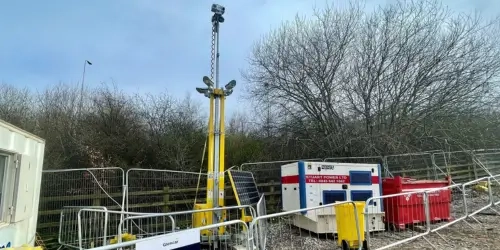
CCTV Towers with privacy-first design: Rapid Deployment CCTV Towers and Temporary CCTV systems featuring PTZ (Pan-Tilt-Zoom) cameras with near-360° visibility have data minimisation principles built in as standard (i.e., only capturing relevant information). Cameras stream to secure cloud storage with AES256 encryption rather than local servers/drives.
-
AI-video analytics reduce false alarms: AI-powered cameras use machine learning to improve identification of people, objects and behaviours, helping security teams accurately distinguish real threats (intrusions, safety violations, etc.) from routine activity. By filtering false alarms, artificial intelligence (AI) and machine learning reduce the total amount of security alerts and data collected.
-
ANPR access control: Automatic Number Plate Recognition (ANPR) systems log vehicle movements and monitor unauthorised access in gated sites or controlled zones. Systems securely store that data to reduce the likelihood of a breach. Redeployable CCTV and CCTV Tower units can be equipped with ANPR functionality to capture vehicle movement in areas without fixed infrastructure.
-
Scalability: Rapid deployment surveillance cameras transmit data via secure, AES256 encrypted 4G/5G networks, making it easier to scale across multiple sites.
Read more:
-
How Integrated CCTV and ANPR Keep UK Sites Secure and Compliant
-
How IT Simplifies Security with Intrusion Detection and ANPR in One Platform

4G/5G networks and cloud cybersecurity
Modern UK construction sites are increasingly turning to cloud platforms and IoT-based environmental solutions to keep sites secure. Smart security systems protect data through:
-
Secure 4G/5G data transmission: All site data transfers over encrypted cellular networks (4G/5G) with AES256 encryption, eliminating risks from unsecured Wi-Fi (which could have weak entry points that hackers exploit). This also means there's no need for local on-premise software or managing multiple vendors to collect data that construction projects rely on.
-
Cloud storage: Stellifii, our cloud-based platform, is built on industry-approved cloud infrastructure with AES256 encryption and fully NDAA-compliant components. No DVRs, no manual retrieval. Just smarter security software and built-in cybersecurity at your fingertips.
-
Unified access management: Stellifii's unified platform allows IT and building managers to oversee all security devices (surveillance, IoT sensors, access control) through secure role-based access controls, eliminating vulnerabilities caused by disjointed, multi-vendor systems.
Read more:
-
Why Construction Site Cybersecurity and Safety Monitoring Go Hand in Hand
-
Unifying Security and Site Monitoring: The New Standard for UK Contractors
Privacy controls
-
Remote access with secure logging: Fully-managed security systems with remote monitoring enable faster access to site footage while maintaining clear audit trails. Every system access is logged with user credentials, timestamps and actions performed.
-
Secure-by-design infrastructure: NDAA-compliant components ensure site security systems meet strict security standards. Stellifii minimises personal data collection and enforces lawful access logging and retention policies aligned with UK ICO guidance.
-
Real-time diagnostics: Check connection status, signal strength and system health remotely. Continuous monitoring detects unauthorised changes or tampering attempts, triggering instant alerts.
Smart integrations
-
Seamless integration with IoT devices: Environmental sensors (air quality, noise, weather) provide analytical insights without collecting personal data. They detect safety hazards through environmental measurements (wind speed, decibel levels, CO₂ readings) rather than individual tracking.
-
Smart detection systems: Combining intrusions, PPE violations and smoke/fire hazards into a single platform, Stellifii eliminates the need for multiple vendors and the data/security risks associated with numerous logins.
Read more: How IoT Devices Improve Both Safety and IT Overview on Construction Sites
Compliance automation systems
-
Automatic compliance reports: Every security and access event is logged in real-time, timestamped and linked to specific user credentials, providing audit-ready documentation that complies with UK data laws as well as other regulatory industry standards (ESG, HSE, CDM).
-
Remote monitoring and reporting: Continuous site monitoring via NSI Gold Accredited monitoring centres enables trained security personnel to review footage in real-time. When potential threats or unauthorised access occur, instant alerts are sent to site teams while audit trails and documentation happen automatically.
Read more: The Importance of IT and HSE Collaboration in Construction
Maintain Data Privacy the Smart Way
Smart security systems have become vital for modern construction sites. They do more than just protect assets; they also protect the sensitive data that keeps projects compliant and operational.
By replacing outdated legacy systems with AI-driven cloud platforms featuring AES256 encryption and automated compliance, construction sites can reduce cyber threats, meet GDPR obligations and maintain full visibility without compromising the privacy of the data they collect.
With 6 regional hubs and over 2 decades of experience in cloud-based monitoring, we understand the importance of staying compliant with UK data laws.
If you’d like to learn more about how Stellifii and our smart security systems help maintain data privacy on construction sites, speak to our team today.