
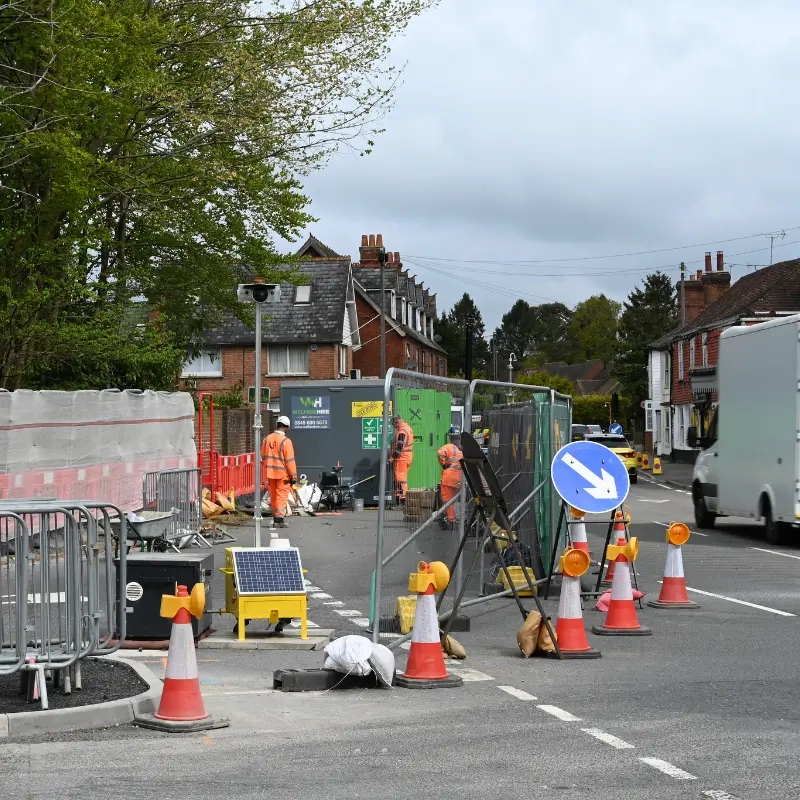
Temporary roadworks create unique monitoring challenges for highways managers and their teams. Whether it's an 8-week lane closure, urban road widening, a resurfacing project or emergency repairs, installing fixed surveillance at the site is hard to justify.
Yet to maintain proper control over the project, highways authorities need visibility into workplace conditions and activities. It's the only way to effectively drive safety and traffic compliance while safeguarding assets and infrastructure.
Mobile CCTV solutions that can be swiftly deployed wherever needed have become the go-to solution for supporting temporary roadworks monitoring. These versatile modern systems use solar power, battery storage and wireless connectivity, making them fully autonomous and suitable for virtually any environment.
In this article, we explore how deployable monitoring solutions provide reliable oversight for temporary roadworks without the cost and complexity of permanent infrastructure. We look at how these flexible systems improve worker safety, traffic management, asset protection, incident reporting and environmental conditions during essential roadworks.
Why Permanent Monitoring Infrastructure is not the Solution for Temporary Roadworks
Put simply, a permanent installation is usually not the best solution for a temporary need.
Let's briefly explore this mismatch and other challenges around fixed surveillance:
-
Lack of mobility: Once fixed surveillance or CCTV is installed, it's difficult and expensive to reposition. If the roadworks move down a 2-mile stretch of highway, the fixed system can't simply be packed up and moved with the contractor's team. This means the active work zone and emerging risks go unmonitored. Once the project is complete (say after 8 weeks), there may no longer be a need for monitoring at the location, making the asset redundant.
-
Unjustified costs: The upfront capital investment for hardware, trenching, cabling, grid and fibre connection is steep. Spending tens of thousands of pounds on a permanent structure to monitor short-duration works is typically a waste of taxpayer money.
-
Lead times and red tape: Obtaining budget authorisations and council permissions, coordinating with utility companies and managing the civil works to install fixed CCTV cameras can take months, sometimes years. This is clearly not practical when your goal is to complete the roadworks in weeks.
-
Lack of local infrastructure: Permanent monitoring systems often require reliable power and fibre broadband connectivity. Many locations, including underserved rural communities, lack these utilities, making traditional setups impractical and/or expensive.
Read more:
Why Deployable CCTV Solutions are a Practical Solution for Monitoring Roadworks Cost-Effectively
Rapidly deployable CCTV platforms, available on affordable rental plans, have become the preferred solution for highways teams overseeing active roadworks and other temporary sites.
Mobile CCTV Towers offer comprehensive visibility into priority areas without requiring complex, fixed infrastructure. These versatile systems let you quickly set up full coverage where it’s needed, when it’s needed (paying only for the required period). Basic setups can be operational in 20 minutes without disrupting ongoing work.
These smart CCTV systems typically feature:
-
Solar power (with fuel cell battery backup), eliminating the need for mains electricity.
-
4G/5G connectivity for reliable video and communications without needing permanent internet.
-
High-definition, infrared PTZ (Pan-Tilt-Zoom) cameras that provide the detail and coverage required to manage evolving sites day and night.
-
Remote platform access allows you to check in and view alerts, video footage and incident reports from anywhere on your phone or laptop.
-
Advanced systems can integrate specific monitoring tools, allowing you to manage functions such as safety compliance, environmental monitoring and number plate recognition in smart central dashboards.
Read more:
The Benefits of Deployable CCTV for Roadworks Monitoring
Strategic deployment of mobile CCTV surveillance allows traffic leaders to actively manage multiple work zones across their networks. When stakeholders (residents, councillors, contractors, local businesses) see the following benefits, they are assured that the project is well run and professionally managed.
Improved workforce and public safety
Live and recorded video of workplace conditions allows your team to remotely monitor compliance with health and safety protocols (e.g., PPE compliance, dust controls). With advanced visibility, teams verify agreed safety protocols such as barriers to prevent incursions and proper temporary road markings.
Evidence-backed accountability
If a community member complains about dust, road closures or unsafe working practices, you can review the footage/data and check the facts. Armed with the evidence and full context, you can address community concerns transparently and confidently.
Incident reporting and asset security
Machinery and equipment left unattended on worksites overnight become targets for theft or vandalism. Deployable towers act as a visual deterrent and, when connected to live monitoring centres, actively prevent theft. A control room is instantly alerted to suspicious activity, and operators take swift action to deter intruders.
Having this level of security surveillance also flags suspicious or unauthorised vehicles in restricted areas and prompts intervention.
Temporary traffic management
Traffic teams can view live and recorded footage to gain a better understanding of traffic flows through construction zones. With deep visibility, they're able to support traffic officers in reducing congestion and safety hazards.
For example, they can verify the proper use of temporary traffic controls such as cones, barriers, 'stop-go' controls, detour signs and reduced speed limit signs to guide road users safely.
Advanced systems with AI analytics and incursion alerts are deployed along worksites to monitor traffic. Alerts provide extra seconds for workers to escape in the event of a site breach, improving safety in high-risk areas.
Fewer site visits
Verifying project progress and compliance remotely saves hundreds of hours of travel time and reduces vehicle running costs and carbon emissions. When teams use the saved time to focus on higher-value tasks, productivity and service delivery inevitably rise.
Improved contractor accountability
Contractors tend to follow safety and environmental rules more diligently when they know the workplace is monitored and compliance is visibly and constructively enforced.
Temporary Roadworks Monitoring Solutions that Improve Risk Management
WCCTV offers a suite of integrated solutions that help highways authorities manage roadworks and other high-priority environments from a secure cloud platform. Connecting several solutions (including security, safety compliance and environmental monitoring) into a single control hub enables smart management of multiple responsibilities, strengthening project oversight and reducing disruption.
Let's take a closer look at monitoring solutions that can be quickly deployed at temporary work zones to help leaders manage with confidence, vision and accountability. Selected tools can be seamlessly integrated together into our cloud management platform, depending on your specific needs.
1. Security services to safeguard roadwork zones
To guard perimeters against unauthorised access, our rapidly deployed CCTV Towers and Mini Towers can be set up in 20 minutes, providing surveillance wherever it's required. By their presence alone, 6-metre-tall, live-monitored Traffic Management Towers are an immediate deterrent to crime, trespassing and vandalism.
As another security layer, integrated Intrusion Detection Systems use AI analytics to spot breach attempts and raise near-instant alerts. Snapshots and video clips are sent to the management platform, where they can be escalated or exported as the situation demands.
This fully-managed security solution is supported by NSI Gold-Accredited remote monitoring centres, where professional operators verify threats and issue live audio warnings, deterring up to 90% of intruders. For additional intervention, you can opt for Mobile Keyholding Response, where a security professional investigates physically when they receive a verified threat alert.
For access control, surveillance supported by Automatic Number Plate Recognition (ANPR) flags and logs vehicle incursions and unauthorised traffic entering the work area.
These systems not only protect assets and equipment but also limit crime-related disruptions and retain digital records and video evidence to enhance security and assist investigations.
Read more:
- What Are Rapid Deployment CCTV Towers?
- How Artificial Intelligence is Revolutionising CCTV Tower Monitoring
2. Safety management to protect crews and road users
Advanced CCTV visibility lets your team remotely review video to ensure safety protocols are properly practised on-site. This is especially relevant for roadworks near risky locations or involving contractors you don't have an established relationship with.
Our solutions offer AI-powered Smart Detection Systems that integrate into our Towers to quickly highlight safety risks such as missing PPE and fire dangers (and Intrusion Detection as discussed above):
-
PPE Monitoring and Detection Systems spot and flag when crews are not using appropriate PPE as required by HSE Alerts help contractors reinforce compliance in highly-regulated, working environments where the chance of injury increases when safety gear is neglected. PPE Detection can be added to both our CCTV Towers and compact Mini Towers (which are deployable by one person).
-
Smoke and Fire Detection Systems generate alerts at the early indicators of smoke and fire. AI video detection generally triggers warnings more quickly than standard fire alarms, which struggle or are unable to work in large, outdoor areas. Quick notifications prompt a rapid reaction to prevent the fire/smoke from spreading and endangering people and assets.
Safety detection systems strengthen PPE adherence, fire control and incident reporting. They also collate time-documented data and visual evidence for investigations and help build a stronger safety culture.
3. Environmental and weather monitoring
Advanced IoT-enabled sensors let you and contractors monitor environmental conditions on worksites to manage risks and also capture vital data to guide faster, better decision-making.
Environmental Monitoring Sensors, deployed on our CCTV Towers, measure noise and airborne pollutants against allowable limits. They also accurately monitor weather variables that could impact workflows.
-
Noise Monitoring Sensors record ambient sound over ranges of 30-130 dB and 20Hz to 12.5kHz. The system notifies project managers before noise levels violate local ordinances or become harmful to workers and/or attract community complaints.
-
Air Quality Sensors continuously monitor dust, fine particulate matter, TVOCs, CO and CO₂. This data helps managers control airborne hazards from roadworks and supports reporting obligations under the Control of Substances Hazardous to Health Regulations (COSHH).
-
Weather Monitoring Sensors deliver precise wind, rainfall, humidity and temperature updates. This location-specific data enables managers to modify schedules and plan emergency responses to minimise weather disruptions, costly damage and worker harm.
By effectively employing environmental monitoring to control climate risks and eco-hazards, you create healthier, more compliant and sustainable workplaces. You also gather valuable data to justify schedule changes, answer stakeholder queries about environmental impacts and manage expectations around possible delays due to weather etc.
4. A platform for complete project oversight
Our dedicated cloud-based platform pulls together all the insights from the above tools into one place. Specially designed software and dashboards provide a unified, up-to-the-minute view of safety/security conditions, incident alerts and environmental variables from every location you're monitoring.
Cloud connectivity lets you review relevant events on your phone or laptop at any time, anywhere. This capability reduces the need for site visits and eases admin and stress burdens.
Dashboards transform unhelpful siloed information into "big-picture" intelligence and actionable insights to guide confident, evidence-based decisions. A centralised overview of all operations helps you handle complaints, compliance, investigations and project performance from a position of knowledge and authority.
To protect your footage and data against the growing threat of cyberattacks (50% of UK businesses have experienced a cyber breach in recent times), our cloud-based platform is secured by robust AES-256 end-to-end encryption.
Other Environments that Benefit from Temporary Roadworks Monitoring
Besides everyday roadworks activities (utility company excavations, street resurfacing, bridge maintenance, emergency repairs, traffic signal upgrades, etc.), other common events that benefit from deployable oversight include:
-
Major infrastructure projects: For long-term, expensive infrastructure works (e.g., dual carriageway expansions), smart mobile surveillance and risk monitoring keep you constantly updated on project progress and health and safety compliance. It also helps contractors actively mitigate disruptions from weather, environmental factors and regulatory actions. As with all the scenarios below, an advanced monitoring system collects valuable project/event data to assist complaint handling, investigations and future traffic management proposals.
-
Locations without traditional infrastructure: In remote rural areas and other underserved locations, solar-powered solutions with wireless connectivity ensure you can maintain oversight without needing mains power or broadband.
-
Shifting risk hotspots: In regions where crime or risk patterns shift regularly, the ability to rapidly reposition coverage ensures your surveillance is always targeted at the most urgent hotspots.
-
Special events: During public events such as races, parades and festivals, rapid deployment allows you to support temporary traffic arrangements. Advanced visibility also helps improve safety, control noise levels and limit collisions between vehicle drivers and pedestrians or cyclists.
-
Temporary traffic management schemes: Live and recorded footage help support traffic teams to pinpoint bottlenecks, assess scheme performance and make evidence-based operational decisions.
Deploy Smart Mobile Monitoring on Your Next Roadworks Projects
Portable CCTV towers and mini units powered by solar or battery can now be deployed at worksites in 20 minutes (for basic setups), delivering high-definition footage, simple control and AI-powered risk detection.
Our field-ready monitoring tools offer affordability and adaptability and can be deployed and managed without large teams or reliance on your IT department. The technology is easily scalable and provides advanced insights that successful highways professionals use to maintain control of their network, even when overseeing multiple complex, high-stakes projects.
To manage security, safety, and environmental risks at roadworks more smartly, contact our team today. Let's find the right solutions to give you confident oversight over your next temporary project,
