The UK construction industry employs over 2.3 million people and plays a major role in the national economy. It's also the country's most dangerous sector, with workers facing daily risks such as falls from heights and exposure to hazardous substances.
According to the Health and Safety Executive (HSE), nearly 80,000 workers have experienced work-related ill health over the past 3 years (2023-2025), and in 2024/25, falls from heights accounted for 53% of the 35 fatal injuries recorded. It's also concerning that roughly 5,000 workers currently live with work-related breathing or lung conditions caused by occupational exposure to dust and fumes.
For too long, IT and HSE teams have operated in separate silos, and the above figures show clearly that this outdated approach no longer works. HSE focuses on worker safety, incident prevention and regulatory compliance, while IT manages systems and technology infrastructure. When these departments don't collaborate, critical risks slip through the gaps, sometimes with fatal consequences.
If you're a construction IT manager looking to demonstrate strategic value rather than simply keeping systems running, partnering with HSE through connected monitoring platforms offers one of the most effective ways to achieve that. This guide explains exactly how to make it happen.
8 Reasons Why IT and HSE Collaboration Matters in the Construction Industry
Construction is consistently ranked as the UK's most dangerous sector, where a single decision can be the difference between a safe shift and a serious incident. When IT and HSE teams collaborate, technology becomes a proactive safety tool rather than a reactive one, helping to identify risks before someone gets hurt.
Here are 8 reasons why IT and HSE collaboration matters:
-
Real-time visibility: Cloud-based monitoring platforms give health and safety teams 24/7 oversight of site conditions. Rather than waiting for weekly reports, project teams see PPE violations, environmental hazards and security risks as they occur, enabling quick corrective action.
-
Proactive risk management: Smart monitoring systems identify potential safety issues before they escalate. Environmental sensors detect poor air quality before workers are exposed, and AI-video analytics flag missing PPE before HSE inspectors arrive. This proactive approach supports HSE's mission of preventing harm rather than just responding to it.
-
Fewer project delays: When safety issues force work stoppages or HSE inspections, project delays and running costs inherently increase. IT-enabled monitoring prevents disruptions by detecting compliance gaps and safety concerns in real-time.
-
Simpler regulatory compliance: HSE compliance requires extensive documentation. When IT provides automated reporting systems through integrated platforms, this task becomes easier and eliminates hours of manual reporting work.
-
Operational efficiency: Admin time is cut by up to 37% when IT streamlines reporting and logistics via digital technologies and unified dashboards. Real-time data provides site managers with a "bird's eye view" of everything happening on-site, helping them to address incidents and near-misses quickly before they impact project timelines.
-
Reduced legal risk: When incidents occur, construction companies may face HSE penalties, higher insurance premiums and civil claims. Having real-time monitoring systems in place provides timestamped evidence of proactive risk management and corrective actions taken to protect firms during investigations.
-
Demonstrates strategic value: When IT delivers systems that provide measurable ROI, prevent incidents and automate compliance, stakeholders see technology as a competitive advantage rather than an operational cost.
-
Cost-effective solution: Integrated monitoring provides far superior safety outcomes, keeps human error to a minimum and costs up to 88% less than manned guards. Automated compliance reporting saves hours of manual work, and early detection prevents costly project delays and HSE fines.
Read more: A Complete Guide to Construction Site Safety and Security
HSE's Role in Construction and the Regulations Every Contractor Should Know
HSE is the UK's national regulator for workplace health and safety, placing a strong emphasis on proactive risk management rather than reactive response. For construction professionals, this means preventing incidents, not simply responding after something has gone wrong.
HSE inspectors also assess whether construction sites have "suitable and sufficient" control measures in place to identify and minimise risks. This includes completing a thorough risk assessment and ensuring these controls are monitored and maintained over time. Failure to do so can result in enforcement action, HSE violations, project delays and serious reputational damage.
Here's a closer look at HSE's role in the construction sector and the expectations on construction health and safety leaders to maintain safer working environments:
| HSE's role | Health and safety leadership expectations |
| Establish and enforce UK safety standards | Conduct and document risk assessments before construction begins |
| Conduct random compliance spot checks | Ensure "suitable and sufficient" controls for identified risks, including proper signage |
| Provide guidance and industry-approved best practices | Provide employee safety training |
| Prosecute serious breaches for non-compliance/repeated offences |
|
HSE's 6 Management Standards
These HSE Management Standards help construction companies create safer, more supportive working environments:
-
Demands: Are workloads and working environments manageable?
-
Control: Do employees have input in how they do their work?
-
Support: Are workers given the training and resources they need for the job?
-
Relationships: Are professional relationships positive and mutually respectful?
-
Role: Do employees understand what's expected of their job role?
-
Change: Is organisational change managed and communicated well?
Key HSE regulations in the UK
| Regulation | Purpose | Compliance requirements |
| Construction (Design and Management) CDM Regulations 2015 | Regulation governing safety across all phases of construction |
|
| Health and Safety at Work Act (HASAWA) 1974 | Legal workplace framework in the UK |
|
| Working at Height Regulations 2005 | Legislation where falling is a risk |
|
| Control of Substances Hazardous to Health Regulations (COSHH) | Protect workers from hazardous substance exposure |
|
| Personal Protective Equipment at Work Regulations (PPER) 1992 | Requires formal PPE risk assessments |
|
| RIDDOR 2013 (Reporting of Injuries, Diseases and Dangerous Occurrences Regulations) | Requires formal reporting of all occupational incidents (injuries, deaths, illnesses) |
|
The risk of non-compliance
-
Financial penalties: Unlimited business fines, fire safety violations exceeding £160,000 and CDM 2015/HSE violations ranging between £80,000 and £900,000.
-
Project delays: Work stoppages during investigations or complete business suspension.
-
Legal action: HSE prosecutions, legal liability and civil/compensation claims.
-
Jail time: Custodial sentences of up to 2 years and imprisonment for gross negligence.
Read more: The Modern HSE Playbook for UK Safety Leaders
How IT Can Support Health and Safety in Construction
IT can support health and safety through integrated construction technology that provides real-time visibility, compliance automation and data-driven collaboration. Here's how it works in practice:
Real-time monitoring
IT-enabled monitoring systems give project teams 24/7 visibility across sites so they know everything happening the moment it occurs. Using artificial intelligence (AI) and machine learning, real-time visibility helps prevent minor issues from escalating into project-stopping problems.
For instance, when environmental sensors detect poor air quality, team leads can adjust schedules to ensure worker safety. Pausing crane operations due to live weather monitoring data is another way to make more informed health and safety decisions.
Cloud-based platforms also allow construction safety teams to track current and historical site data from any device, eliminating physical site visits to gather information that supports better decision-making.
Read more: How Smart Monitoring Systems Enhance Construction Site Safety
Compliance automation
Instead of manually compiling reports, systems generate audit-ready documentation up to 5X faster than traditional methods/legacy systems, satisfying UK regulators (HSE, ESG, CDM) at the click of a button.
Every safety incident, fire hazard and PPE violation is logged, timestamped and stored in a single, AES256-encrypted cloud-based dashboard, making retrieval for HSE inspections quick and effortless.
Read more: Rethinking Construction Compliance Through Smart Monitoring Systems
AI-powered analytics
Advanced AI-video analytics turns standard monitoring data into action. Powered by state-of-the-art software and artificial intelligence, systems identify patterns and flag unsafe behaviour with near-pinpoint accuracy.
Environmental monitoring data (air quality, noise, weather conditions) highlights which construction activities generate the most dust or noise, smart detection systems identify missing safety equipment and modern fire alarms identify smoke/fire hazards early and alert project teams instantly.
Read more: Smart Analytics Insights in Construction
6 Construction technologies making a real difference
-
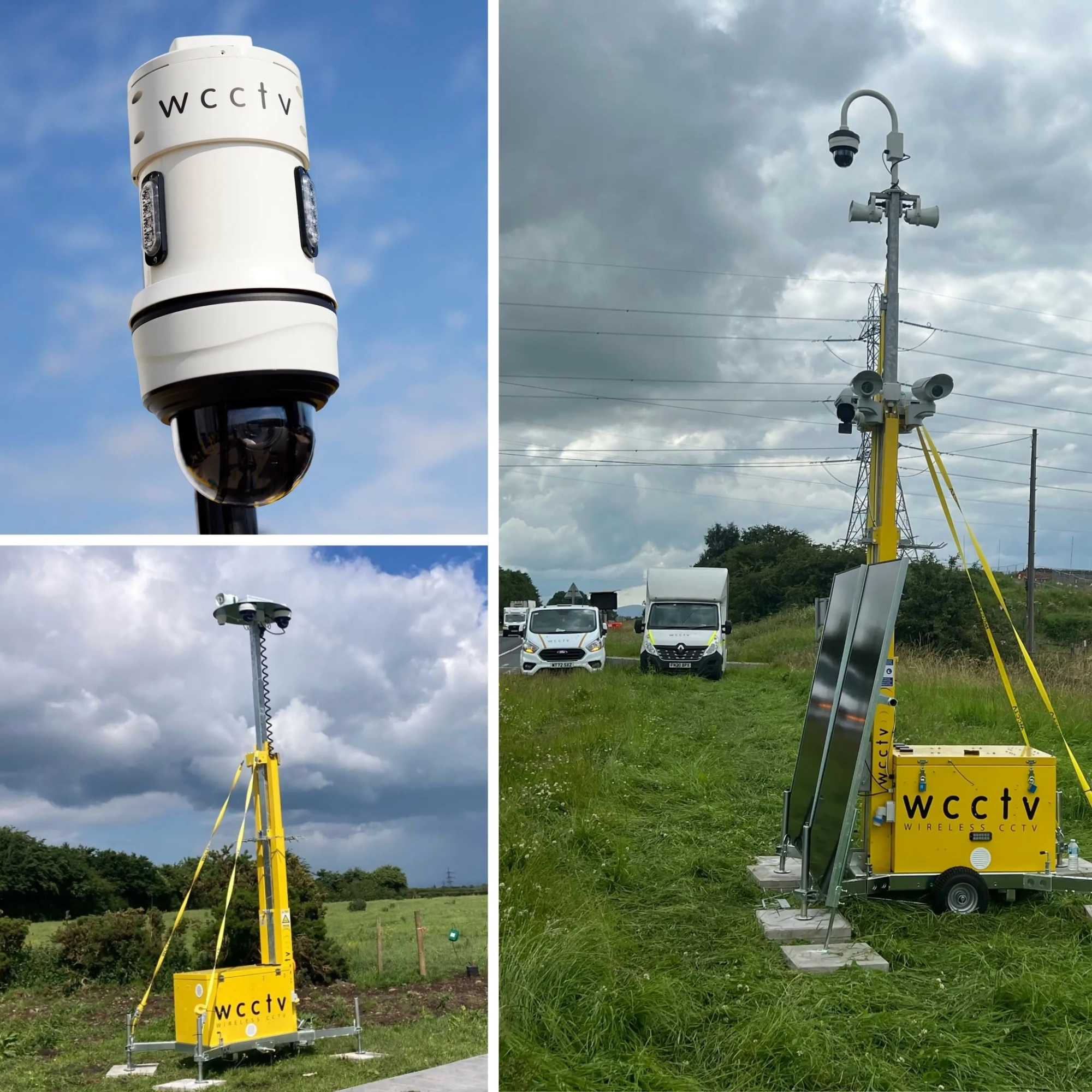
Advanced CCTV surveillance: Redeployable Cameras and Rapid Deployment CCTV Towers, standing up to 6 metres tall with a near-360° field of view, protect assets and ensure workplace safety both day and night.
-
Smart detection systems: PPE monitoring, intruder and smoke/fire detection enable quick responses that prevent minor safety issues from escalating, keeping everyone safe on-site.
-
IoT environment monitoring sensors: Air Quality Sensors track particulate matter (PM1, PM2.5, PM10), CO₂ and other harmful gases in real-time. Noise Monitoring Solutions alert teams when sound levels reach Section 61 thresholds. Weather Monitoring Sensors continuously observe temperature, wind speed, rainfall and humidity. Together, these IoT-based systems support better decision-making across construction projects that improve workforce safety.
-
Remote Monitoring Services: Fully-managed system integrations enable remote monitoring from any device. When threats are detected, mobile keyholding teams are dispatched from NSI Gold Accredited monitoring centres to investigate, both during work and out-of-office hours.
-
Automatic Number Plate Recognition (ANPR): Logs every vehicle entering/exiting your construction site, preventing unauthorised access while maintaining timestamped audit trails.
-
Stellifii: Our secure, AES256-encrypted cloud-based platform consolidates all site data into a single dashboard, accessible from any device. With Stellifii, IT and safety teams can access incident reports, PPE monitoring stats and compliance documentation in just a few clicks.
Read more:
-
The Role of Environmental Monitoring in Meeting CDM 2015 Requirements
-
AI-Powered Risk Detection: Smoke, Fire and PPE Compliance in Construction
IT and HSE Collaboration Done Right
IT and HSE must collaborate to keep construction workers safe and help contractors meet regulatory compliance obligations. When technology and safety work together, risks are identified earlier and compliance becomes easier to manage.
For IT managers, supporting HSE through integrated monitoring platforms is one of the highest-impact contributions you can make. Real-time visibility helps prevent incidents, cloud-based dashboards make compliance easy and AI-video analytics deliver data-driven insights, all without putting additional strain on IT or construction teams.
With over 20-years of experience in wireless monitoring, we provide fully-managed monitoring solutions designed to support IT and HSE collaboration in construction.
Contact our team today to discuss how our remote monitoring services and Stellifii platform can help you reduce operational complexity and improve safety outcomes.