UK construction companies can adapt to digital transformation by integrating digital solutions like Internet of Things (IoT) devices, real-time monitoring, artificial intelligence (AI) and modern project management software like BIM into daily workflows.
But digital transformation isn't just software upgrades; it's now an industry expectation. Clients want live visibility, regulators demand continuous monitoring, insurers expect timestamped evidence and boards want proof that IT spend delivers measurable ROI.
Yet many construction IT managers find adoption hard. Legacy systems consume 60-80% of budgets, vendor sprawl complicates integration, cybersecurity is a concern and talent shortages leave teams stretched thin.
The result? Digital transformation stalls, and IT remains stuck in the in-between, firefighting issues instead of driving strategic value.
This guide explains how construction sites can adapt to digital transformation without increasing risk or cost. It covers what's holding the sector back, what modern digital technologies actually look like and how IT leaders can justify investment and prove their value to the board.
6 Reasons Digital Transformation Stalls on UK Construction Sites
While other major industries like retail and manufacturing have already embraced digital transformation, construction firms still heavily rely on outdated processes and reactive security.
Understanding what's holding the industry back is the first step toward overcoming it:
-
Budget pressures: IT managers are asked to innovate, all while justifying expenses to CFOs for every pound spent. With UK construction profit margins averaging under 2% and 2026 inflation costs estimated at 3.5%, there's little more for "extra" investments.
-
Cybersecurity threats: Ransomware attacks, phishing scams and data theft are common threats in the construction industry. Weak online security and fragmented systems create vulnerabilities that attackers exploit. In 2022, the Interserve Group was fined £4.4M by the Information Commissioner's Office (ICO) when it found the company failed to put in place appropriate security measures to prevent a data breach of workers' personal information.
-
Talent shortages: Finding and retaining skilled workers is difficult, with talent shortages affecting over 70% of employers. That pressure often pushes up salaries or leads to costly outsourcing contracts just to keep IT covered across multiple sites and regions.
-
Legacy systems: Many construction companies still use outdated on-premise tech installed years ago. These systems technically function but need ongoing maintenance that further eats into IT budgets, leaving minimal cash flow for modernisation.
-
Vendor sprawl: Those in the construction sector often use multiple vendor platforms to understand what's happening on-site. One platform for CCTV, one for environmental impact and another for access control. The problem? Most of these systems work in isolation without syncing project data between them. Tool sprawl is also costly: multiple subscriptions, duplicate data entry and hours spent correlating information manually.
-
Workforce resistance: Digital solutions only work if site teams actually use them. Older workers often have the most resistance toward new technologies. This is because they've operated in the same way for decades and find new tools to be invasive and disruptive.
Read more:
-
The Hidden Costs of Legacy Systems on Modern Construction Projects
-
Managing Vendor Sprawl in Construction: Why Consolidated Monitoring Matters
-
Budget Pressures in IT: How Smart Monitoring Saves Construction Sites Money
The downside of lagging behind
-
Missed tender opportunities: Public procurement wants digital construction management and compliance. Manual processes simply can't keep pace.
-
Higher insurance premiums: Insurers reward continuous monitoring and timestamped evidence records. Legacy systems can't provide this.
-
Increased cyber risks: Ransomware, phishing scams and data theft from fragmented, unpatched systems are easy targets. Unsecure construction technology creates gaps that hackers exploit.
-
Reduced productivity: Digital-first construction companies deliver projects faster at lower costs. Firms using outdated tech and manual processes struggle to meet project timelines within budget.
-
Carbon reporting gaps: Vehicle patrols and manual site inspection increase operational costs and undermine sustainability goals. Modern technology (remote monitoring, automated compliance) reduces carbon emissions because it supports ESG and Net Zero.
Why Construction Digital Transformation Matters
The UK's construction sector needs to modernise through digital transformation to remain competitive today. Digital tools solve real operational problems, reduce risk, simplify infrastructure and prove compliance in a highly regulated market.
A 2023 McKinsey Global Institute report found that construction companies adopting digital transformation see a 15% increase in productivity and a 6% reduction in costs. It's also noted that AI-driven predictive analytics reduces delays by up to 30%. For an industry plagued with project delays and cost overruns while operating on razor-thin margins, these gains are substantial.
The shift is also regulatory, as the UK construction industry operates under some of the most stringent regulations. CDM 2015, HSE, ESG and GDPR reporting all require documented evidence that manual processes struggle to supply. Clients and insurers want real-time data over end-of-the-week summaries compiled from handwritten reports.
Sustainability adds another level of urgency. As the nation moves towards Net Zero carbon emissions by 2050, construction companies must reduce Scope 1, 2 and 3 emissions while keeping accurate ESG reporting records. This again is where traditional methods fall short, and where IT departments can make a big difference.
Read more: The Importance of IT and HSE Collaboration in Construction
What Digital Transformation in Construction Looks Like in Action
Successful digital transformation means moving from fragmented reactive systems toward integrated proactive platforms, while maintaining uptime, security and compliance throughout the transition.
Here's how traditional methods and digitally integrated sites compare:
| Feature | Traditional construction sites | Digitally integrated sites |
| Security | Manned guards, standalone CCTV, paper reports | AI-powered surveillance, real-time alerts, automated incident logging |
| Compliance | Manual documentation, isolated spreadsheets, stressful audits | Automated reporting, timestamped evidence, audit-ready real-time data |
| Monitoring | Periodic and reactive | Continuous and preventative with instant alerts |
| Data access | Multiple vendor logins | Single cloud-based dashboard |
| Vendor management | 5+ providers (vendor sprawl) | Single, consolidated vendor relationship |
| Incident response | Delayed | Near-instant |
| Scalability | Expensive and extensive | Rapid deployment |
| Cybersecurity | Minimal | AES256 end-to-end encryption |
Key technologies
-
Building Information Modelling (BIM): Smart project management software that improves planning and resource allocation, and enables better decision-making throughout project lifecycles.
-
Augmented (AR) and Virtual Reality (VR): 3D visuals for design, safety training and remote collaboration reduce travel time and improve stakeholder engagement.
-
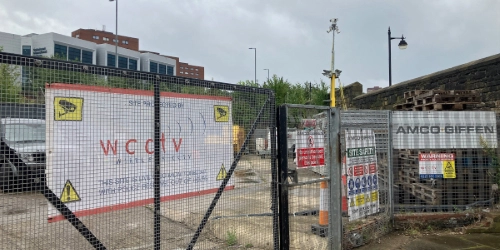
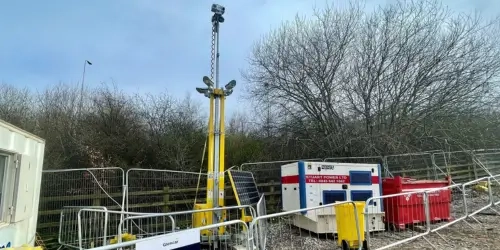
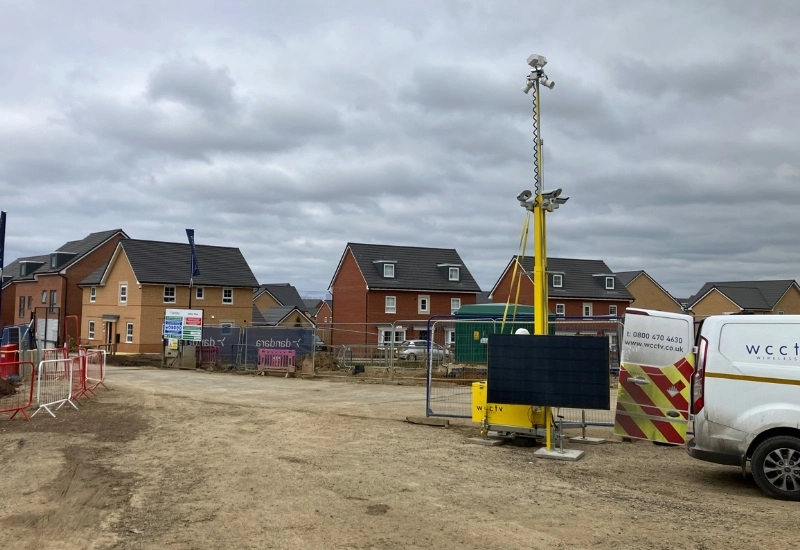
Smart surveillance: Rapid Deployment CCTV Towers and Temporary CCTV solutions with hi-tech PTZ cameras provide near-360° coverage across all working areas, both day and night. Redeployable CCTV Cameras extend visibility into hard-to-reach areas and can easily be relocated as projects progress.
-
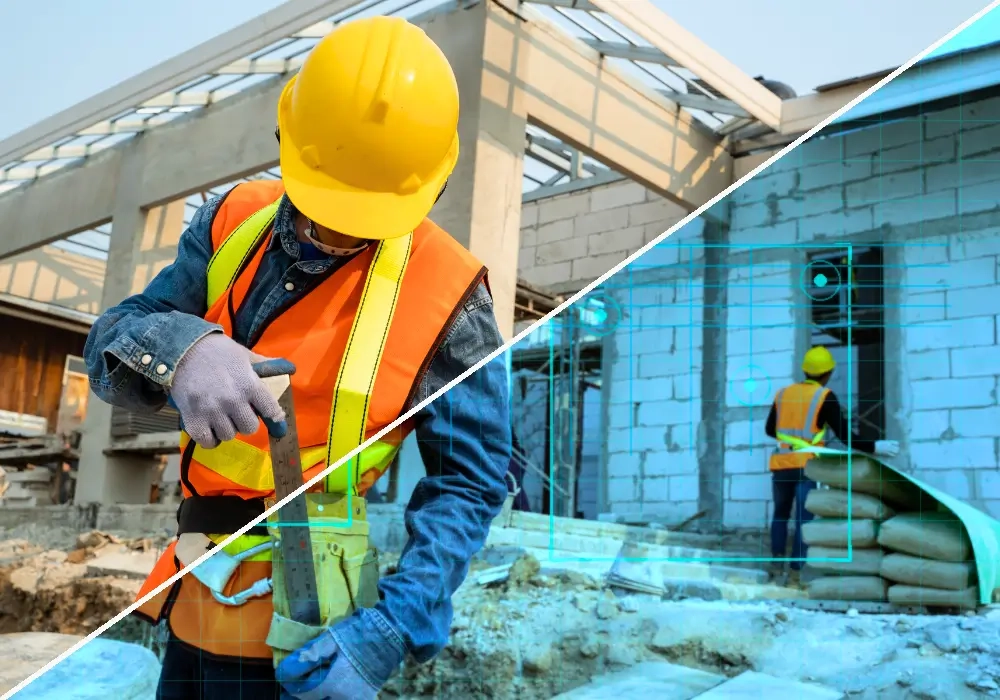
Smart Detection Systems: AI-video analytics, intelligent software, machine learning and pattern recognition identify real threats (PPE violations, intrusions and smoke/fire hazards) while filtering false alarms from dust or weather.
-
IoT technology: Advanced environmental monitoring sensors use IoT tech for tracking live air quality (particulate matter, VOCs, CO₂), noise (30-130 dB) and weather (temperature, humidity, rainfall, wind speed). This provides the real-time data ESG and regulatory compliance expect.
-
Real-time monitoring: Professional remote CCTV monitoring at NSI Gold Accredited centres verifies alerts and initiates various actions to deter threats: voice-down audio challenges, mobile keyholding team dispatch and/or emergency service contact.
-
Advanced access control: Automatic Number Plate Recognition (ANPR) logs all vehicle movement in and around building sites, timestamping entry/exit times for accountability.
-
Cloud consolidation: Stellifii, our cloud-based platform, brings surveillance, site monitoring and smart detection into a single view. This allows project managers and IT leads to retrieve live data analytics in just a few clicks. One platform; endless possibilities.
Read more:
-
How Smart Monitoring Systems Enhance Construction Site Safety
-
The Role of Environmental Monitoring in Meeting CDM 2015 Requirements
-
How IoT Devices Improve Both Safety and IT Overview on Construction Sites
-
AI-Powered Risk Detection: Smoke, Fire and PPE Compliance in Construction
How do construction firms benchmark where they are today?
A simple maturity model helps IT managers see where they are, and how far they still need to go in adopting digital technologies:
-
Level 1: Paper-heavy, reactive responses, no real-time visibility
-
Level 2: Some digital tools adopted, multiple vendors, disconnected systems
-
Level 3: Digital adoption emerging, single dashboard, automated alerts, faster reporting
-
Level 4: Predictive, data-driven decisions, AI analytics, measurable ROI
Most UK construction businesses sit somewhere between Level 1 and 2. The goal of digital transformation in construction projects is to aim for Level 3 and 4, where IT delivers strategic value.
Staying Compliant while Scaling Digital Tools: Stellifii
In the UK, construction professionals must comply with numerous compliance regulations, some of which include:
-
The Health and Safety Executive (HSE): Risk management, incident reporting, PPE provision
-
Construction (Design and Management) CDM Regulations 2015: Construction phase planning, safety documentation, continuous monitoring
-
UK General Data Protection Regulation (UK GDPR): Data protection for CCTV footage/personal data
-
Environmental laws: Noise limits, ESG reporting, Net Zero targets, Clean Air Act 1993, etc.
For IT construction managers scaling digital tools, choosing platforms with built-in security and compliance is key.
Stellifii addresses these requirements directly:
-
AES256 encryption: Industry-standard protection for all stored site and project data.
-
NDAA-compliant components: Meeting growing government security expectations.
-
GDPR-aligned data handling: Clear retention policies, secure access control and audit trails.
-
Role-based access: Only authorised personnel view sensitive footage.
-
Automated reporting: Generate audit-ready documentation up to 5X faster than legacy systems.
For IT managers, this means site data is secure, access is controlled and compliance is verifiable, all from a single dashboard that reduces complexity instead of adding to it.
Read more:
Justifying IT Spend to Construction Boards: Key Benefits
Adopting digital technologies requires investment. But unlike legacy systems that drain 60-80% of IT budgets without visible return, smart monitoring delivers measurable ROI (and other benefits) in just a few months.
Here's how IT managers can frame business value to stakeholders and board members:
Increased productivity
Automated monitoring replaces manual processes. Teams spend less time on repetitive tasks (logging into multiple vendor platforms, compiling reports, correlating data) and more time on strategic work.
Cost savings
Consolidating 5+ vendor systems into a single platform eliminates costly subscriptions and integration costs. Fully-managed monitoring can cost up to 88% less than traditional manned security while providing better coverage.
Reduced rework and project delays
Real-time monitoring catches issues before they escalate. AI detection identifies safety hazards, equipment problems and environmental risks early, preventing incidents that cause delays and rework.
Lower insurance
Insurance companies are more likely to lower premiums and offer favourable terms to sites that prioritise continuous monitoring and timestamped video evidence.
Enhance site safety
AI-powered detection systems identify PPE violations, intrusions and fire hazards in real-time. Faster detection means faster response and fewer injuries.
Automated compliance
All construction project data, from surveillance logs to environmental impact, is timestamped with corresponding footage. This automated digital trail makes audit preparation much more streamlined and straightforward.
Sustainability alignment
IoT-based environmental sensors collect data on air quality, noise and weather that support ESG and Net Zero goals. Solar-powered CCTV surveillance reduces commercial carbon footprints further.
Read more: The ROI of Consolidating Site Monitoring Into a Unified Platform
Getting Digital Transformation Buy-In from Construction Teams
Smart construction technology only delivers real value if people use it. Workforce resistance is one of the biggest barriers to successful digital transformation in construction.
The solution is better communication. Workers need clarity about what digital tools actually do. If remote monitoring, AI data analytics or digital reporting systems are introduced without explanation, it could be perceived as "personal surveillance" rather than support. IT managers need to be clear about what data is collected, who has access to it and how digital solutions protect both workers and the business.
When workers understand that the technology is there to reduce risk and support safer working, rather than to replace jobs or track their every move, adoption becomes much easier.
On top of this, construction companies with a stronger safety culture typically see the most buy-in from construction teams. This is because digital transformation and safety priorities are closely aligned. Where safety is embedded into everyday operation, digital tools are seen as natural extensions of existing safety measures.
Read more:
6 Step Digital Integration Roadmap for UK Construction
Digital transformation doesn't happen overnight. It requires a phased approach to reduce risk while building momentum.
-
Assess current state: Audit existing monitoring systems, vendors and procedures. Identify pain points such as disjointed integration and compliance gaps, and check which manual tasks consume the most time.
-
Define priorities: Focus on high-impact areas first, such as cost overruns, project delays and risk management. Security and compliance often offer the strongest business value through visible ROI, reduced risk and regulatory compliance.
-
Opt for unified platforms: Choose digital solutions/cloud-based platforms for UK-based providers that consolidate multiple functions. A single vendor for surveillance, site monitoring and compliance reduces complexity and cost.
-
Start small: Pilot construction technology on one building site first to test integration and train teams. Keep detailed records on integration and metrics.
-
Measure ROI: Track metrics such as prevented incidents, hours saved and audit readiness. Show these results (cost savings, risk reduction, improved operational efficiency) to board members to demonstrate IT's strategic value.
-
Scale: With proven ROI and refined processes, expand digital technologies to additional construction sites. Cloud-based platforms like Stellifii make scaling easy, as multiple sites can be managed from a single interface.
Common roadblocks
-
Budget approval delays: Counter this with clear ROI projections and pilot results.
-
Cultural resistance: Invest in communication and training, and bring teams on early.
-
Cybersecurity concerns: Choose service providers with strong cyber credentials (AES256 encryption, NDAA-compliant)
-
Data management: Prioritise platforms that consolidate site data in real-time.
Read more:
-
Choosing a Monitoring Partner That Understands UK Construction
-
Integrating Environmental Monitoring Sensors on Construction Sites
-
Unifying Security and Site Monitoring: The New Standard for UK Contractors
Build a Digital Tomorrow, Today
With the growing expectation of tech-enabled compliance in construction, the industry can't afford to wait.
Companies embracing digital transformation already see the difference. Integrated platforms are helping them win tenders and complete construction projects faster, all while improving their bottom line.
With more than 20-years of wireless monitoring expertise, WCCTV is the UK's leading supplier of temporary CCTV systems that make adopting digital technologies easy.
How long will you wait to modernise your construction site? Contact our experts to discuss how we can make that happen today.