
Construction has always been one of the UK's most heavily regulated industries, and for good reason, given the inherent dangers that come with the work. But the compliance obligations facing today's site security and compliance teams look very different from a few years back, especially since site security has become a critical compliance factor, not just an operational concern.
With the growing expectation of tech-enabled compliance and more personal accountability for those responsible for mitigating risk, getting compliance right from the get-go is non-negotiable. The problem is that manual processes were never designed to meet the demands of modern construction sites.
While legacy systems do collect data, the information is often fragmented and scattered across multiple vendor platforms. When managers need to produce clear, evidence-backed reports for HSE, CDM 2015, RIDDOR, ESG and GDPR compliance, outdated methods create more gaps than most would like to admit.
Smart construction site security and monitoring systems are changing all of this. Through remote monitoring, rapid response and automated reporting, integrated systems are moving more construction companies from reactive audit preparation to proactive, continuous control. This article covers everything UK compliance managers in construction need to know.
Compliance: What UK Construction Sites Are Up Against
Construction compliance covers a comprehensive range of rules and regulations in the UK. This includes health and safety, data privacy, access control and environmental commitments, to name a few.
Each regulation has its own set of requirements and enforcement consequences, and evolving Health and Safety Executive (HSE) requirements make staying on top of everything even more stressful. For compliance managers responsible for reducing regulatory risk and personal liability exposure, the pressure is constant and the margin for error is slim.
|
Regulation |
Compliance requirements |
Consequence of non-compliance |
|
Health and Safety at Work Act (HASAWA) 1974 Covers: General health, safety and welfare of construction workers. |
Documented, ongoing risk management "so far as reasonably practicable". |
Custodial sentences Civil and compensation claims Reputational damage Prosecution (for gross negligence) |
|
Construction (Design and Management) CDM Regulations 2015 Covers: Planning, managing and monitoring all construction project phases. |
Duty holders must conduct pre-construction risk assessments, continuously monitor working zones and maintain a Health and Safety File. |
HSE enforcement action Site shutdowns Lost tenders Personal liability for principal contractors |
|
RIDDOR 2013 (Reporting of Injuries, Diseases and Dangerous Occurrences Regulations) Covers: Reporting of workplace injuries, illnesses, dangerous occurrences and diseases. |
Report occupational incidents to HSE within stipulated timeframes. |
Penalties Civil claims HSE investigations Project delays Jail time (for gross negligence) |
|
Control of Substances Hazardous to Health Regulations (COSHH) Covers: Control of substances hazardous to workers' health. |
Ongoing exposure monitoring records are required under Regulation 10 where Workplace Exposure Limits (WELs) may be exceeded. Record-keeping expected (up to 40 years for silica dust). |
Site shutdowns/stop notices Unlimited penalties Enforcement action Compensation claims Reputational damage |
|
Control of Noise at Work Regulations 2005 Covers: Occupational noise exposure. |
Documented monitoring, PPE provision and corrective action where exposure exceeds 85 dB(A) over 8 hours. |
HSE enforcement Civil lawsuits Compensation claims Noise Abatement Notices Community complaints |
|
(Applicable to England) Covers: Governs safety on high-rise buildings of 18 metres or 7 storeys tall. |
Keep site safety and standards of higher-risk buildings, and establish and operate a "voluntary occurrence reporting system". |
Fines Enforcement action Civil claims Reputational damage Site shutdowns |
|
Personal Protective Equipment at Work Regulations (PPER) 1992 Covers: The correct usage and provision of personal protective equipment (PPE) for high-risk tasks. |
Employers must provide free PPE and sufficient worker training throughout all project phases. |
Penalties Compensation claims Personal liability |
|
UK General Data Protection Regulation (UK GDPR)/Data Protection Act 2018 Covers: Monitoring, processing and storing of personal data, including CCTV footage, ANPR logs and other site security solutions whereby individuals can be identified. |
"Lawful basis" documentation, Data Protection Impact Assessment (DPIA) completed before large-scale monitoring and ICO notification of breaches (within 72 hours under Article 33). |
Major ICO fines (up to £17.5 million or 4% annual global turnover) Project suspension Reputational damage |
|
ESG and Net Zero obligations Covers: Framework for nationwide sustainability goals and environmental responsibility. |
Continuous monitoring of environmental conditions (air quality, weather, etc.). Reduce Scope 1, 2 and 3 carbon emissions to align with sustainability targets. |
Fines HSE investigations Stop notices Lost tenders |
Read more:
- How HSE Regulations Are Evolving to Advance Construction Site Safety
- Does Your CCTV Comply with GDPR? A Complete Guide on UK Data Law
- GDPR, ESG and Construction: What Every Leader Needs To Know
- Rethinking Construction Compliance Through Smart Monitoring Systems
- 7 Compliance Pitfalls Costing Construction Firm Millions
What Smart Construction Site Security Actually Means
Smart security refers to a network of interconnected systems that combine physical security, AI-powered detection, environmental monitoring and cloud-based data management into a single, integrated platform. Designed specifically for busy construction sites, these systems continuously monitor conditions and site activity with minimal human input.
While traditional site security measures, such as periodic walkabouts and spreadsheets, do gather information, they rely heavily on on-site security personnel to interpret data and compile reports. Basic CCTV surveillance captures security incidents after the fact, doing little to prevent risks from escalating and before valuable assets are compromised and workers are harmed. This approach is outdated, expensive and very time-consuming.
By contrast, smart security solutions use intelligent software, AI-video analytics, real-time tracking and machine learning to monitor building sites 24/7 and anticipate when things could go wrong. Capturing high-quality images via PTZ (Pan-Tilt-Zoom) security cameras and timestamping every detection alert, they give compliance construction managers complete visibility and control.
The level of security these systems bring to the UK's construction sector is day and night compared to legacy systems. Fully-managed CCTV Towers, instant alerts, innovative technology and cloud-based evidence collection are exactly what regulators, insurers and stakeholders expect to see, and where manual processes consistently fall short.
Read more:
Traditional Security vs Smart Construction Site Security
The main problem with legacy systems is that they only capture a moment in time. Site conditions change by the hour, and it's difficult to see what happens in between manual inspections.
Smart site security solutions address this issue head-on.
Let's take a closer look at how traditional site security methods measure up against newer, more modern security systems for UK construction:
|
Feature
|
Traditional monitoring
|
Smart monitoring
|
|
Ongoing, 24/7 monitoring
|
[[NO]]
|
[[YES]]
|
|
Work autonomously
|
[[NO]]
|
[[YES]]
|
|
Remote monitoring with real-time alerts
|
[[NO]]
|
[[YES]]
|
|
AI-video analytics
|
[[NO]]
|
[[YES]]
|
|
Smart detection and integration support
|
[[NO]]
|
[[YES]]
|
|
IoT technology
|
[[NO]]
|
[[YES]]
|
|
Automated compliance reporting
|
[[NO]]
|
[[YES]]
|
|
Timestamped evidence collection
|
[[NO]]
|
[[YES]]
|
What compounds this issue is that many construction companies manage 5+ separate security vendors. One for CCTV surveillance, another for environmental monitoring and a third for vehicle tracking. Data is siloed, and pulling evidence from multiple disconnected systems for an audit becomes 10X harder.
Read more:
6 Integrated Technologies Reshaping Construction Site Security in the UK
Here are the key features of the smart technology reshaping the UK's construction sector:
1. Smart surveillance
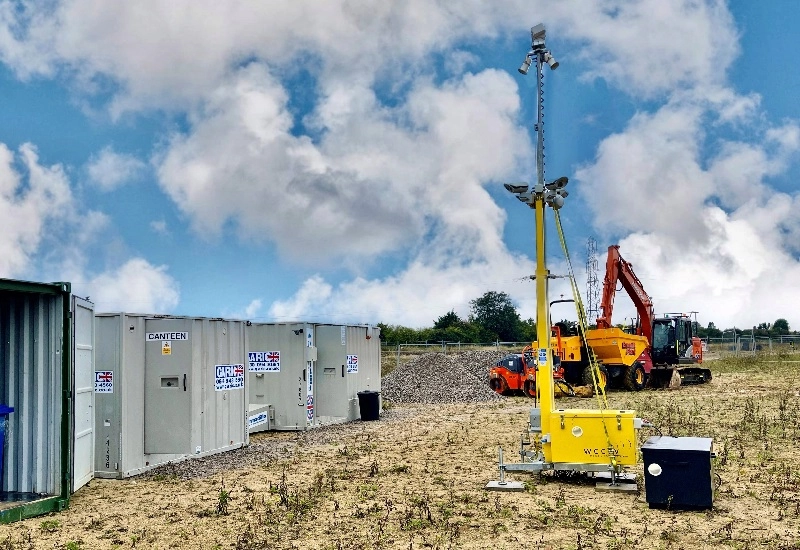
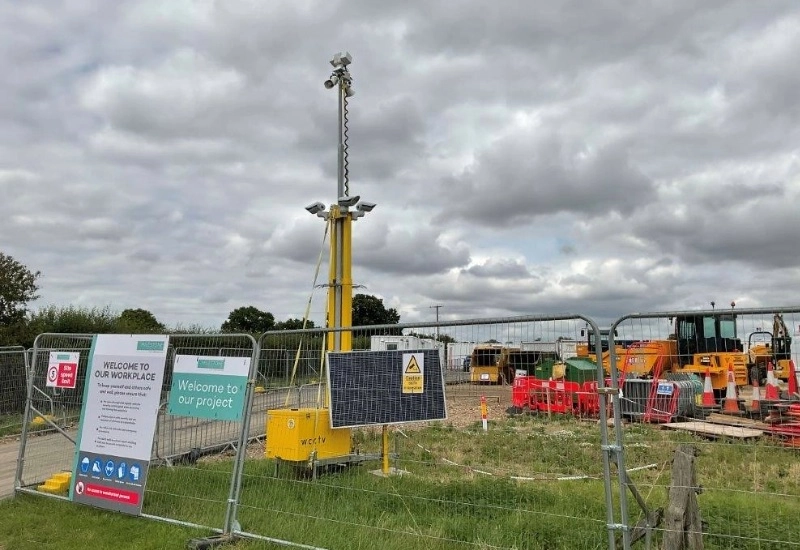
Rapid Deployment CCTV Towers and Temporary CCTV solutions form the foundation of smart site security. Standing up to 6 metres tall, with near-360° PTZ cameras (40X optical zoom and night vision), they monitor building sites 24/7 for signs of security risks such as unauthorised access or violations of safety protocols in real-time.
Systems also operate autonomously and transmit data via secure 4G/5G networks. Solar power and fuel cell batteries make them deployable, even in the most isolated locations.
The value for compliance managers? Modern CCTV Towers generate continuous, high-quality visual evidence of everything that happens on-site. By providing clear, timestamped records in all weather conditions, managers see the "full picture" of site activity as it unfolds.
Read more: The Best Options for Construction Site CCTV
2. Remote monitoring
Remote CCTV monitoring connects security cameras to NSI Gold Accredited monitoring centres, where trained operators review live footage. When a threat is detected, response time is near-immediate as they initiate various responses before standard security systems even react. This can include:
- Issuing live audio voice-down challenges
- Dispatching mobile keyholding teams
- Contacting emergency services if/when needed
Every security incident is automatically logged with a timestamp, contributing directly to CDM and RIDDOR audit trails without any manual effort from site teams. Remote monitoring is also significantly cheaper than manned guarding, saving up to 88% on security costs.
Read more:
3. AI-video analytics
Artificial intelligence (AI)-powered systems take site security to the next level. AI-video analytics uses machine learning and computer vision to distinguish genuine threats from routine site activity, filtering false alarms and only focusing on real risks that require immediate attention. This in itself saves compliance managers hours per week when trying to piece together what has happened.
In a nutshell, basic CCTV systems record activity but flag nothing. Managers often have to manually review footage to see what triggered an alert, whereas AI systems identify specific behaviours in real-time and anticipate problems before damage is caused.
With security incidents timestamped and backed by corresponding video evidence showing exactly what happened, compliance managers have the data-backed insights they need to meet regulatory obligations.
Read more: How Artificial Intelligence is Revolutionising CCTV Tower Monitoring
4. Smart detection
As add-on features to our CCTV Towers, smart detection systems bring together many critical functions that help compliance managers do their job more effectively:
PPE monitoring and detection instantly identify missing personal protective gear. This means if construction workers aren't using hard hats, safety goggles or respiratory equipment during high-risk tasks, compliance managers can take corrective action long before injuries occur.
Smoke and fire detection pinpoint the earliest signs of fire hazards and visual smoke indicators faster than conventional fire detectors. This allows for early intervention before small incidents escalate.
Intrusion detection flags unauthorised entry in restricted areas with instant alerts and timestamped footage, supporting both HSE access control obligations and GDPR incident logging.
Adding an extra security layer to your site monitoring strategy also involves using other smart integrations, such as:
-
Automatic Number Plate Recognition (ANPR): For access control evidence
-
Wearable devices (e.g. Body Cameras): For close proximity monitoring
-
Time Lapse Video: For project progress documentation
Read more:
5. Internet of Things (IoT) tech
IoT-based sensors monitor vibrations, movement and environmental hazards in construction environments, extending smart security beyond physical surveillance. They monitor "invisible risks" and support environmental compliance obligations that security cameras can't address:
|
Type of environmental sensor |
Function |
Compliance support |
|
Monitors particulate matter (PM1, PM2.5, PM10), VOCS, CO₂ and harmful airbourne toxins Analyses readings against predefined or WELs thresholds and sends instant alerts Stores up to 180,000 timestamped logs |
ESG/Net Zero COSHH Air Quality Standards Regulations (AQSR) 2010 |
|
|
Ongoing tracking of construction-related sound (30-130 dB) and frequency (20Hz to 12.5kHz) levels Triggers alerts before safe thresholds are breached |
HASAWA PPER Control of Noise at Work Regulations 2005 Considerate Constructors Scheme (voluntary membership) |
|
|
Continuous monitoring of temperature (-40°C to +60°C), windspeed (0-100 mph), humidity (10-99%) and rainfall (hourly) Signals early intervention when conditions change and/or become unsafe |
HASAWA CDM 2015 |
Read more:
6. Cloud consolidation
Our cloud-based platform brings all of the above together in one place. This means everything from camera surveillance and environmental logs to ANPR records and incident reports is stored in a single dashboard, making audit prep smoother and hassle-free for compliance managers.
Advanced software with end-to-end AES256 encryption and role-based access controls satisfies GDPR data security laws and prevents cybersecurity risk.
Every system plays its part by timestamping every event (with location data) in real-time. This information feeds into our cloud-based platform, and compliance reports can be generated in minutes; in fact, up to 5X faster than legacy systems. When an HSE inspector arrives unannounced and requests records of ongoing monitoring or wants to verify a security breach, the evidence is ready in just a few clicks.
Read more: How Cloud-Based Tools Are Changing Construction Admin
UK Construction: From Reactive Fragmentation To Proactive Compliance Assurance
Unified security is fast becoming the baseline expectation from regulators, insurers and major clients across the UK. Construction sites that don't adopt the digital transformation risk falling behind on audits and losing tenders to competitors already using the technology.
But making the transition doesn't have to be complicated. Here are a few tips:
Audit your current system: Identify where security and compliance gaps occur the most. Usually, the biggest gaps aren't in safety procedures, but rather in documentation.
Consolidate vendors: Move from multiple, disconnected vendor tools to a single integrated system. This eliminates vendor sprawl, reduces the risk of non-compliance and makes audit prep much easier.
Deploy the right systems: Find UK monitoring security providers that specialise in construction. Match technology to what you want to achieve: faster response times, automated audit trails or environmental sensors for COSHH compliance.
Automate reporting: Configure dashboards and alert thresholds so evidence is generated continuously rather than assembled under pressure.
Review and refine: Pilot systems on one building site before deploying across multiple sites, and use analytical insight data to track metrics and ROI. Measurable outcomes include reduced incident rates and fewer insurance claims. Adopt a "continuous improvement" mindset and adjust systems accordingly.
Read more:
5 Key Benefits of Modernised Site Security in Construction
For compliance leaders responsible for reducing regulatory risk and personal liability exposure, modernised site security delivers strategic advantages that go far beyond crime prevention.
Reduced manual workload: Automated reporting cuts manual admin time by 30-40%, freeing compliance managers from paperwork and giving them time to focus on actual risk management tasks that will move the needle.
Stronger audit trails: Timestamped, location-specific cloud-stored evidence across every monitoring system means audit preparation takes hours, not days or weeks.
Measurable risk reduction: Incident rates fall with real-time detection and early intervention. Proactive safety management returns £3-£5 for every £1 invested.
Improved board confidence: Consolidated dashboards (with measurable ROI) give managers the boardroom confidence to show executive teams the value of compliance.
Enhanced stakeholder trust: Clients, insurers and procurement teams increasingly scrutinise site safety management before awarding contracts. Firms with automated compliance records and proactive risk management systems in place present a stronger case.
Read more: The ROI of Consolidating Site Monitoring Into a Unified Platform
Smart Construction Security Starts Here
The construction sector is inherently high risk, and as HSE compliance requirements continue to evolve, compliance managers need smarter ways to stay ahead of security and regulatory pressures. Smart construction site security systems provide the visibility, control and evidence needed to manage risk proactively rather than reactively.
By using sophisticated software, AI-video analytics and remote monitoring, compliance teams gain a clear, bird's-eye view of everything happening on-site in real-time. Risks are identified earlier, responses are faster and audit prep is no longer a stressful process.
With over 20-years of experience in wireless monitoring, we deliver smart construction site security solutions for projects of any size across the UK. Contact our team to discuss how we can help today.
