Construction has always been a high-risk industry, and over the years, safety standards have greatly evolved to keep everyone on-site safe. Health and Safety Executive (HSE) laws are tightening, enforcement expectations are rising and inspectors want contractors to provide more and more documented controls to prove due diligence.
This article explains how HSE regulations are advancing construction site safety, what regulators expect and how smart monitoring systems help HSE leaders stay ahead of changing requirements.
Why Health and Safety Matters in the Construction Industry
Construction is one of the most dangerous industries to work in. The fatality rate is 4.8X higher than in other industries, which is why every regulation and control measure set by HSE is in place to keep workers safe and prevent injuries and ill health.
-
Risk management: Proactive safety management identifies risks (PPE violations, fire hazards, poor air quality, etc.) before workers, contractors and members of the public are hurt.
-
Regulatory compliance: Adhering to HSE laws is a legal duty. Non-compliance exposes construction companies to fines, forced downtime, reputational damage and even jail time for gross negligence.
-
Reduced project delays: Safety incidents prompt investigations, which can shut down sites for extended periods. Prioritising safety regulations helps keep schedules on track.
-
Reduced legal action: Recorded control measures and safety management provide defence against civil claims and regulatory infringements.
-
Reputation protection: In construction, reputation is everything. A strong safety culture and proven record of minimal on-site accidents are a competitive advantage.
For context, there were 35 fatal injuries in construction in 2024/25, with falls from heights accounting for over 50% of these deaths. The rate of non-fatal injuries is as follows:
| Cause | Percentage of non-fatal injuries (%) |
| Falls from height | 33% |
| Trips, slips and falls | 30% |
| Struck by moving/falling objects | 13% |
| Injury from lifting or handling | 7% |
For HSE managers already stretched thin, meeting compliance needs and protecting workers requires working smarter, not harder.
8 Ways to reduce health and safety risks
-
Safety risk assessments: Comprehensive inspections identify potential hazards on a construction site, from the pre-construction phase to completion. Managers must realise that risks during groundworks vary widely from the hazards during final handover. This means risk assessments need to be ongoing and adjusted as construction projects progress.
-
Complete oversight: Continuous site monitoring is now expected by the HSE, which means periodic spot checks won't cut it. 24/7 oversight with documented evidence is the new way forward for managing health risks and remaining compliant.
-
Health and safety training: Workers need training on hazardous materials, safety measures/controls, equipment handling and safety protocols. HSE increasingly expects detailed training records, and health and safety qualifications are also beneficial.
-
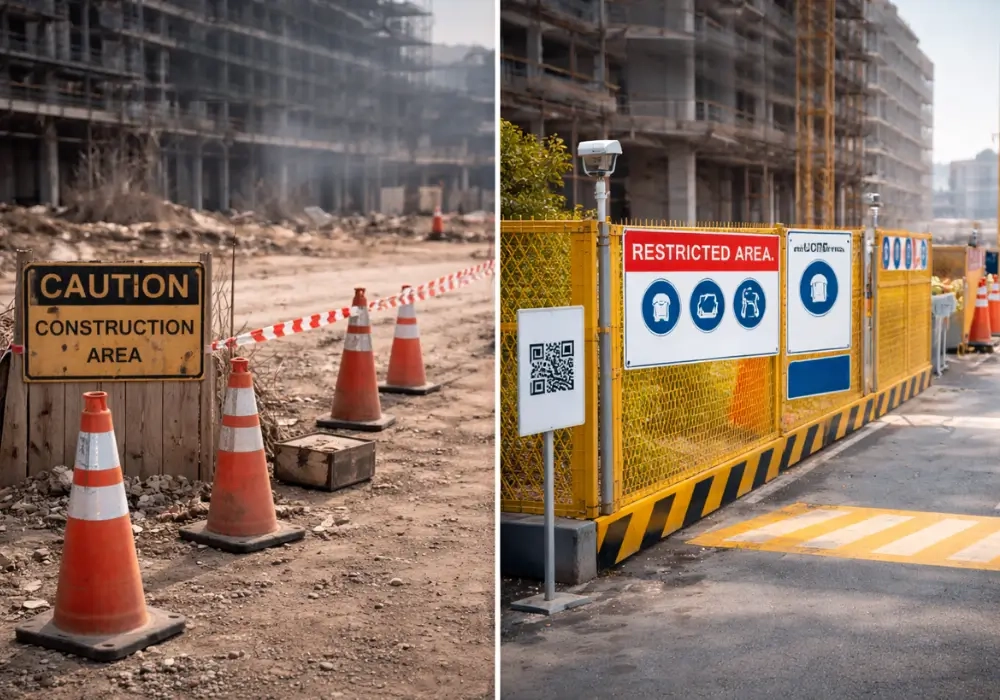
Clear signage: Hazard warnings, mandatory PPE zones and emergency exits must align with current construction work.
-
Personal protective equipment (PPE): Construction employers are expected to provide all workers with free PPE.
-
Digital tools: Smart monitoring tools provide 24/7 oversight, real-time alerts and automated compliance documentation without human involvement.
-
Fire safety management: The Regulatory Reform (Fire Safety) Order 2005 (FSO) mandates a "responsible person" to conduct fire risk assessments, particularly on sites with hot works and flammable materials.
-
Precise record keeping: Documentation is the basis of compliance. Risk assessments, employee training records, inspection logs, corrective actions, safety controls and exposure records must be kept up to date and audit-ready.
Read more: The Modern HSE Playbook for UK Safety Leaders
The Evolution of Health and Safety Legislation: Explained
In the past, construction safety regulations weren't as prioritised as they are today. Understanding this shift helps HSE leaders see where health and safety rules are heading and position themselves ahead of the curve.
The role of HSE
The Health and Safety Executive (HSE) is Britain's national regulator for workplace safety. HSE sets legal frameworks for contractors to follow to ensure everyone on-site is safe. They also conduct routine inspections and take enforcement action should non-compliance occur.
The focus has shifted from reactive enforcement (responding to incidents) to proactive prevention (preventing incidents before they happen).
-
Inspections: HSE focuses on high-risk activities like silica dust exposure, work at heights and RIDDOR reporting oversight. They conduct inspections based on risk profile and license high-hazard activities (e.g., explosives).
-
Documentation: Inspectors want real-time data and evidence of continuous monitoring, not just annual audits.
-
Enforcement action: HSE compliance holds principal contractors accountable. Failure to comply can result in penalties, site shutdowns or even prosecution for major infringements.
UK construction health and safety regulations
|
Regulation |
Year |
Purpose |
| Health and Safety at Work Act (HASAWA) | 1974 | Main legislation specifying employer duties to ensure worker safety, health and welfare "so far as reasonably practicable". |
| Electricity at Work Regulation | 1989 | Demands electrical safety for those in design, construction, operation or maintenance of electrical systems and equipment. |
| Personal Protective Equipment at Work Regulations (PPER) | 1992 | Requires provision, maintenance and enforcement of appropriate PPE during risky activities (demolition, working at height, etc.). |
| The Health and Safety (Safety Signs and Signals) Regulations | 1996 | Employers must provide safety signs when health and safety risks cannot be avoided or controlled in other ways. |
| Lifting Operations and Lifting Equipment Regulations (LOLER) | 1998 | Lifting equipment (cranes, hoists, forklifts) must be fit for purpose, clearly marked, properly planned and handled by a competent person. |
| Control of Substances Hazardous to Health Regulations (COSHH) | 2002 | Identify, assess and control occupational health risks and exposure to hazardous substances. |
| Working at Height Regulations | 2005 | Mitigate fall risks through planning, equipment (PPE) selection, training, risk controls and emergency actions. |
| Control of Noise at Work Regulations | 2005 | Adhere to occupational noise limits (87 dB), conduct risk assessment and provide safety equipment for workers. |
| Control of Vibration at Work Regulations | 2005 | Manages hand-arm vibration exposure through limits and health monitoring. |
| RIDDOR (Reporting of Injuries, Diseases and Dangerous Occurrences Regulations) | 2013 | Mandatory reporting to the HSE of all serious on-site incidents within 10 days: occupational fatalities, illnesses and injuries. |
| Construction (Design and Management) CDM Regulations | 2015 | Framework requiring duty holders (clients, designers, principal contractors) to plan, manage and coordinate health and safety throughout project phases. |
| Building Safety Act(Applicable to England) | 2022 | Gateway safety standard systems for higher-risk buildings, with the Building Safety Regulator (BSR) overseeing design and construction phases. |
Read more:
-
PPE Detection in Action: Keeping Construction Projects Compliant with HSE
-
The Growing Expectation of Tech-Enabled Compliance in Construction
Smart Tech Improving Occupational Safety in Construction
As HSE safety standards rise, many construction firms are turning to smart technology to track safety hazards and ensure compliance consistently.
Here's how connected technology supports modern construction safety management:
Rapid Deployment Surveillance
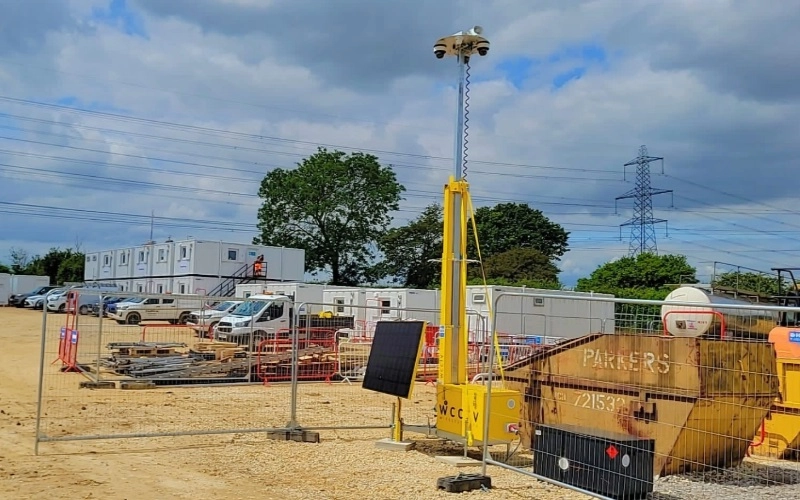
Fully-managed, advanced CCTV Towers and Temporary CCTV solutions provide 24/7 surveillance across building sites. Standing up to 6 metres tall with near-360° PTZ cameras, they monitor everything that happens on-site both day and night.
What's more, Redeployable CCTV Cameras can be positioned as construction projects progress and are especially helpful when blind spots and hard-to-reach areas need to be covered.
When paired with professional remote monitoring services, trained operators at NSI Gold Accredited monitoring facilities review site footage in real-time. These security professionals can then initiate various responses (audio voice-down challenges, mobile keyholding team dispatch) when issues arise.
For HSE managers, this level of surveillance means sites are continuously monitored, aligning with HSE safety standards.
Read more:
AI-video analytics and smart detection
Systems powered by artificial intelligence (AI) are setting a new benchmark in the construction industry. Using machine learning and advanced software, they analyse site activity and distinguish genuine risks (PPE violations, perimeter breaches, fire hazards) from false alarms caused by weather, moving traffic or wildlife.
Advanced software platforms allow HSE managers and site teams to control PTZ cameras, set up privacy zones and monitor up to 64 security cameras simultaneously from any device. Taking a smarter approach to site safety frees teams from time-consuming manual work while ensuring workplace safety in half the time.
Here's what AI-powered smart detection systems can do:
-
PPE detection: Automatically flags site workers entering high-risk zones without the required protective gear (hard hats, safety goggles, hearing protection, hi-visibility clothing, etc.)
-
Intrusion detection: Distinguishes genuine security threats from false alarms. They're so sophisticated that they can tell the difference between someone scaling a fence and harmless movement caused by passing wildlife with near-pinpoint accuracy.
-
Smoke and fire detection: Provides fast, reliable alerts the moment smoke or flames are identified on site and is the smartest way to protect people, property and operations.
The best part? By timestamping every incident (including near-misses) with corresponding video footage, these systems automatically provide the continuous monitoring that regulators expect. This means no more manual site walks, manual data entry or the stress that comes with audit preparation.
Read more:
-
How Artificial Intelligence is Revolutionising CCTV Tower Monitoring
-
AI-Powered Risk Detection: Smoke, Fire and PPE Compliance in Construction
IoT technology
Many site hazards go unseen, like poor air quality, excessive noise and extreme temperatures in outdoor construction environments. The solution? IoT-based environmental monitoring solutions to track these invisible threats:
-
Air quality sensors: Align with COSHH safety laws by monitoring fine particulate matter (PM1, PM2.5, PM10), CO₂, toxic fumes and other pollutants that can cause health and safety risks to workers.
-
Noise monitoring sensors: By tracking sound (30-130 dB) and frequency (20Hz to 12.5kHz) levels across all working zones, these systems keep you compliant with the Control of Noise at Work Regulations.
-
Weather monitoring sensors: Provide live, location-specific atmospheric data on wind speed (0–110mph), temperature (-40°C to +60°C), humidity (10-99%) and rainfall (hourly) to support better planning, safety and compliance (HSE, CDM, ESG, etc.).
Sensors store up to 180,000 timestamped logs for trend analysis, regulatory reporting and ESG documentation, keeping safety officers on the right side of UK law.
Read more:
-
Noise Monitoring Compliance: Futureproofing UK Construction Sites
-
The Role of Environmental Monitoring in Meeting CDM 2015 Requirements
Smart access control
Under CDM 2015 and HASAWA 1974, principal contractors must prevent unauthorised entry on construction sites. Automatic Number Plate Recognition (ANPR) technology addressed this head-on. ANPR logs every vehicle entering and exiting construction sites, creating clear digital records without the need for manned security.
Read more:
Centralised data and automated compliance
Cloud-based platforms, like Stellifii, make oversight and compliance easy for construction safety leaders. By consolidating data from all connected systems (surveillance, environmental data, ANPR logs, etc.) into a single dashboard, HSE and site managers can retrieve everything with a click.
Smart software generates audit-ready reports up to 5X quicker than legacy systems, with every incident timestamped and logged for convenience. No more scrambling for documentation when HSE inspectors arrive unannounced; just better, more compliant site safety in a fraction of the time.
Read more:
Keep Up with HSE Regulations the Smart Way
HSE regulations aren't standing still. With compliance obligations tightening and inspectors increasingly wanting evidence of proactive risk management, safety officers can't afford to miss a beat.
Smart monitoring systems provide the real-time data and continuous oversight that regulators want, while supporting compliance without adding manual workload.
With over 2 decades of wireless monitoring expertise, our advanced solutions don't just meet UK regulatory requirements; they help reduce incidents and lower insurance costs while giving HSE managers more control than ever before.
Contact our team to discuss how we can help.