In many local authorities, managing roadworks and traffic projects is more reactive than proactive. Highways managers only hear about a problem after it has escalated into a complaint and possibly even resulted in loss and injury. By then, your professional reputation is compromised, and your team is under increased scrutiny.
A more successful management approach uses smart detection and automated reporting to improve visibility into high-risk traffic and project operations. Stronger oversight and quick notifications enable you to act promptly, helping improve safety and maintain project schedules.
In this article, we aim to help leaders make the shift from managing complaints to actively preventing them before they escalate. We explore how early visibility enables you to investigate issues sooner, take corrective action faster and communicate more confidently with residents and councillors. This way, you demonstrate that your projects are in capable and professional hands, winning public trust and confidence.
The Cost of Reactive Traffic and Project Management
Allowing roadworks complaints to escalate before providing a response, or relying on manual reports and periodic patrols, is a reactive approach. It means you're always scrambling to contain existing problems, rather than preventing them from arising. The costs of a reactive approach can be steep, with financial, reputational and operational consequences.
-
Escalating complaints: The longer you leave an issue (e.g., excessive worksite noise, infrastructure vandalism, live traffic gridlock) unresolved, the more people become aware of it. Public frustration builds quickly, and before you know it, you face a flood of complaints.
-
Reputational damage: Councillors and your community increasingly expect prompt and accurate explanations for traffic disruptions, roadwork delays or unsafe work practices. When you don't address issues competently and transparently with solid evidence, it harms your department’s credibility and your professional reputation.
-
Operational inefficiencies: Relying on physical site visits to check asset security or PPE compliance is labour- and time-intensive. Valuable hours are wasted on the road that could be better spent on higher-value management, such as planning safety strategies that will contribute to reducing the high number (30,000) of people killed or seriously injured on Britain's roads annually.
-
Team stress: Investigating incidents after the fact places your team under constant strain and stress. This pressure drains morale, can cause illness and pushes important long-term projects onto the back burner.
-
Theft and vandalism: Millions of pounds in plant, machinery, metals and expensive materials are lost annually to crime and vandalism on project sites. Beyond the value of the assets, theft can cause costly delays while work teams wait for replacement equipment.
-
Regulatory penalties: Failure to meet strict HSE or environmental standards can lead to heavy fines. Whether it is an investigation into excessive dust or a breach of CDM 2015 regulations, the cost of regulatory enforcement and corrective measures can jump to tens of thousands of pounds in a short period.
-
Workplace injuries: In 2024, the total cost of workplace injuries in the UK amounted to £1,348,189,560. It's believed many injuries could have been prevented with proper PPE usage. This highlights the importance of proactively verifying that crews on your projects wear appropriate safety gear (electrical hazard protection, hard hats, high-visibility, safety boots, masks, etc.).
-
Weak data confidence: It's estimated that poor data quality costs the UK economy hundreds of billions of pounds annually. When intelligence gathering involves manual processes and inconsistent reporting, you cannot be 100% confident in your information sets. This uncertainty can delay crucial decisions or lead to incorrect strategies based on misleading data.
Moving to Proactive Traffic Oversight with Intelligent Alerts
Traffic management teams can now integrate high-quality surveillance, IoT sensors and AI-driven insights into network locations to strengthen oversight and response.
With modern technology, you can now manage multiple risk areas and potential complaints from a single control platform. Cloud-based platforms consolidate and analyse feeds from all locations and push near-immediate notifications to your team when a risk indicator is identified (e.g., unauthorised access, missing PPE).
Below, we break down the key capabilities and features of alert-driven systems.
Advanced visibility
The first step in setting up alert notifications is establishing a monitoring system. CCTV Towers with HD PTZ (Pan-Tilt-Zoom) cameras can provide near-360° monitoring of key locations day and night. Designed for temporary and/or high-risk environments, our CCTV and Traffic Management Towers record continuous video footage of traffic, safety compliance and related site activity.
Reviewing the footage allows you to verify complaints, investigate incidents (with visual evidence) and address compliance failures before they escalate. In addition, all our Towers are connected to a live monitoring service operated by an NSI Gold Accredited partner. Here, professional operators view your feeds in real-time, identify risks and initiate actions, helping ensure asset protection.
Our CCTV solutions can be rapidly installed (20 minutes for basic setups) and don't rely on the national grid or internet infrastructure. Solar-powered with 4G/5G connectivity, they are fully self-contained, making them well-suited to rural environments and challenging network terrains.
Their mobility and quick setup mean coverage can be easily repositioned as your project and/or oversight needs evolve, minimising visibility gaps. Our compact solar-powered Mini Tower, in particular, offers complete flexibility. Designed for single-person installation, the unit can be quickly relocated across the work zone to cover specific on-the-ground activity - e.g., Proper PPE use on utility company excavations.
Traffic and highways environments that benefit from strategic visibility include:
-
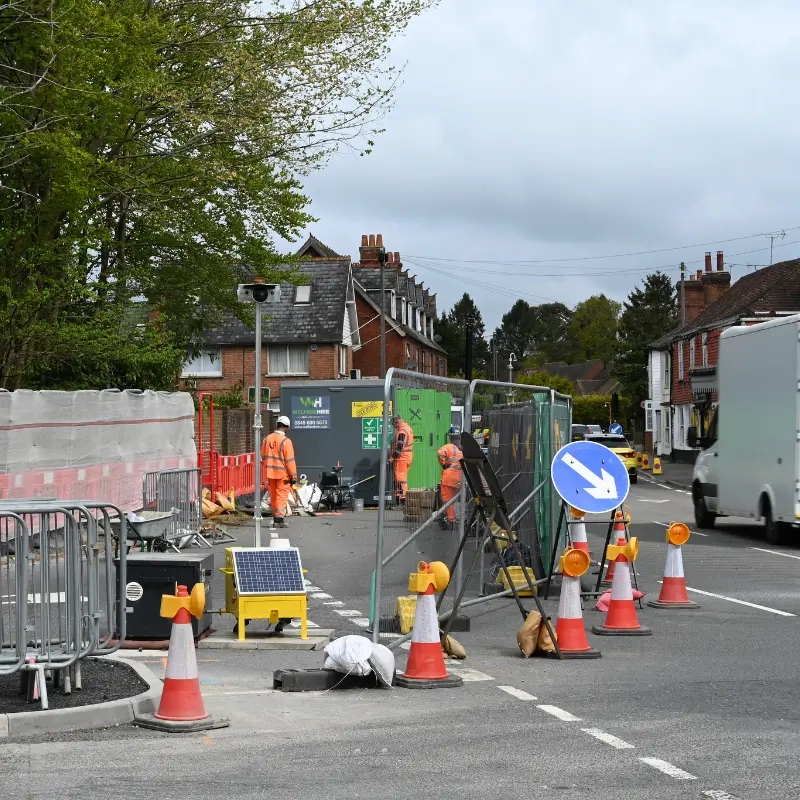
Roadworks, maintenance and emergency zones which create traffic/safety risks that require close monitoring and control to protect workers and the public.
-
Regions with constantly shifting hotspots where crime, vandalism and other risk patterns are fluid and move regularly.
-
Major infrastructure projects where mobile monitoring solutions keep you constantly updated on project progress and safety compliance.
-
Temporary traffic management schemes where video footage (sometimes supported by real-time traffic alerts) helps teams verify complaints, investigate incidents and update traffic plans.
-
Special events such as races, parades, festivals and marches where additional oversight is required to protect public/road user safety and manage environmental concerns such as noise or pollution.
-
Locations without traditional infrastructure, such as underserved rural communities and other isolated regions.
Deployable CCTV platforms provide the backbone for smart detection and alert systems, which we examine further below.
Read more:
Near-instant AI-driven alerts
By integrating AI-powered tools into CCTV Towers, traffic managers can stay fully informed on the specific risks their team is tracking. AI video analytics trained on tens of thousands of hours of real-world examples accurately recognise and flag a range of hazards, while filtering out false alarms.
Let's explore common examples of this capability.
-
Prolonged work activity: To help ensure contractors stick to workplace rules, you can be notified if a site is flagged for having workers who continue to operate past working hours.
-
ANPR (Automatic Number Plate Recognition) Systems: Flag and log vehicle movements, incursions and unauthorised traffic entering the work area, enhancing access control and security.
-
PPE compliance: AI analytics identify workers not wearing required protective equipment, issuing live audio warnings to crews and alerting managers.
-
Security management: AI detection monitors perimeters and notifies of unauthorised access to help protect assets against theft and trespassing.
-
Smoke and fire detection: AI-powered fire detection provides early warning of fire or smoke, allowing teams to respond before loss or damage.
-
Environmental monitoring: IoT-based sensors for noise, dust and air pollutants capture data that helps manage airborne hazards and noise levels before they reach thresholds or prompt neighbourhood complaints.
The tools allow you to set customised thresholds in designated zones that trigger alerts before limits are breached. Alerts sometimes involve no human involvement; for example, the system can issue a live audio warning/reminder to workers not wearing mandatory PPE.
In other instances, the auto-generated alert is backed up by human intervention. For example, a security operative verifies a breach alert on the camera feed and responds accordingly.
Read more:
Complete oversight in one platform
As mentioned, multiple sites and responsibilities can be managed from a single platform. Consolidating incident alerts into a central hub greatly strengthens and simplifies control.
Our dedicated cloud-based platform pulls together feeds from up to 81 cameras and insights from several tracking tools. You can access cameras and reports remotely on mobile or desktop. Specially designed software and reporting dashboards provide up-to-the-minute project oversight, including reports on:
-
Safety hazards
-
Security threats
-
Vehicle movements and incursions
-
Environmental risks
-
Weather factors
Advanced visibility ensures leaders have the big-picture intelligence they need to manage complaints, compliance, investigations and project performance with the facts at their fingertips. The platform retains a comprehensive audit trail of all incidents for later export and review, building a wealth of intelligence.
To protect your vital data and video materials against ongoing, increasing cyber threats, our secure, cloud platform is AES-256 end-to-end encrypted and the hardware is fully NDAA-compliant (i.e., deployable on government projects).
Below, we present an overview of the monitoring solutions you can integrate into our platform, based on your needs.
|
Solutions |
Main Features and Purpose |
How Alerts Support Safety and Complaint Handling |
|
Uses AI analytics to detect and alert when workplace personnel are not wearing PPE as required by law. Records and logs time-stamped evidence of PPE violations. |
Alerts help contractors reinforce compliance and maintain safer work zones. Incident records support investigations, reviews and help to prove regulatory compliance. |
|
|
Uses AI to recognise and flag the early signs of smoke or fire, filtering out false alarms. Automatically retains logs and visuals of all fire risks and alerts. |
A rapid reaction to alerts protects the public, crews, infrastructure, assets and equipment. The system provides evidence that fire dangers were identified and tackled early. |
|
|
Measures fluctuations in site-specific climate conditions:
|
Quick alerts help managers to protect the site, crew and assets from dangerous weather whilst limiting project delays. The system retains objective data and metrics to justify work stoppages or schedule changes. |
|
|
IoT sensors measure noise levels across ranges of:
The system logs data and alerts managers before permitted limits are reached so corrective action can be taken. |
Reacting quickly to alerts protects workers and the public from noise hazards. Incident records help to show that noise-related complaints were addressed and compliance thresholds were respected. |
|
|
IoT sensors continuously capture readings for:
When pollutant levels approach unsafe thresholds, managers are notified immediately. |
Alerts prompt action before air quality conditions become unsafe or violate permitted limits. The system provides evidence to deal with complaints about emissions or health risks. |
|
|
Intrusion Detection Systems integrated into CCTV Towers allow you to customise detection zones. AI analytics spot and push alerts of security intrusions to designated contacts, including professional Remote Monitoring partners. This human oversight ensures alerts are verified and rapid action is taken to warn off intruders. The system effectively filters out false alarms and provides full reports and video of security incidents. Our Mobile Keyholding Response service sends a licenced keyholder (security professional) in response to verified threats. |
Proactive security responses limit unauthorised access 24/7, safeguarding infrastructure, equipment, materials and people. Helps you investigate and respond to complaints about site security, theft, vandalism, trespassing and anti-social behaviours. |
|
|
ANPR (Automatic Number Plate Recognition) Systems |
Tracks and logs all vehicles entering and exiting designated areas. The details captured include the vehicle's registration number, make, model, speed, and colour. ANPR can raise alerts about unauthorised, suspicious or stolen vehicles. |
ANPR notifications improve work zone security, access control and safety, while reducing unsafe driving on site. Time-stamped data assist police, insurance and complaint enquiries or investigations. |
Read more:
- AI-Powered Risk Detection: Smoke, Fire and PPE Compliance
- What are Environmental Monitoring Sensors?
- Asset Protection 101: How Mobile CCTV Stops Theft, Trespass and Damage on Remote Sites
6 Benefits of Automated Traffic Oversight and Quick Alerts
The benefits of smart monitoring with alerts include fewer complaints, safer traffic projects, stronger public communications and happier work teams.
-
Fewer complaints: A focus on preventing problems before they arise means the public experiences fewer frustrations. Lower levels of public inconvenience and unhappiness mean your department receives fewer complaints, creating space to focus on higher-value initiatives to improve service delivery.
-
Safer, more compliant projects: Alerts highlight risks across fast-moving, regulated environments clearly and early. With this intelligence, your team can quickly resolve issues such as missing PPE, unauthorised vehicle access, environmental hazards and theft attempts. A proactive detection and prevention approach helps to create safer, more compliant workplaces.
-
Improved professional reputation: When you act to prevent issues from escalating into public grievances and social media campaigns, you avoid negative news stories. More than that, you show residents and councillors that problems are being actively managed. This builds trust and credibility, boosting your professional standing and authority.
-
Less stress and greater productivity: With all relevant alerts unified in a single platform, you and your team can manage more effectively and efficiently. The stress of trying to piece together information to respond to complaints is significantly reduced, improving overall morale and productivity.
-
Confident communication: When a resident or stakeholder demands answers about roadworks disruptions or safety concerns, you're no longer caught off guard. Instead, you have objective, time-stamped evidence/data and can respond confidently, showing you're aware of the situation and are acting to resolve it. Clear, prompt communication reassures communities that roadworks and traffic management are professionally managed.
-
Fewer liability claims: Active security and safety compliance oversight leads to fewer incidents and accidents. By proactively reducing incident rates, you also reduce the number of legal, insurance, regulatory and other liability claims addressed to your department.
Explore Smart Monitoring and Alerts to Reduce Network Complaints
Rapidly deployable monitoring systems have become a cost-effective, flexible solution for overseeing high-risk work and traffic projects.
These intelligent solutions offer smart detection, AI-powered alerts and unified platform control. With all your evidence and data in one place, visibility is clear and risk management is simplified.
This alert-driven strategy helps you move from constantly firefighting escalated complaints to actively preventing them. Your community sees and appreciates that projects on the network are actively monitored and professionally managed.
If this sounds like a solution that will benefit your team, contact us today, and let's chat about advanced monitoring that delivers assured, professional control.