For contractor directors responsible for delivering profitable highways schemes, strong oversight matters more than ever. Projects are becoming increasingly complex due to stricter environmental standards, higher construction costs and wide variations in performance from one site to the next.
Directors are expected to know what's happening everywhere on their network despite working with monitoring tools that don't speak to each other and slow, outdated reporting systems. Without a standardised framework for monitoring and reporting, an expected profit can turn into a loss before you know it. And that risk only multiplies when you're managing several sites simultaneously.
In this article, we discuss how contractors lose margins on highways projects, highlighting 8 common factors, from fragmented reporting to theft, environmental issues, compliance failures and delays. We also look at how a unified system that standardises monitoring, reporting and oversight across all contracts safeguards margins while improving safety and performance.
8 Areas Where Contractors Lose Margins on Projects
Below we break down 8 common project areas that cost money if not tightly controlled and how technology can help construction firms secure their bottom line.
1. Fragmented reporting and inconsistent oversight
One of the biggest challenges for highway authorities overseeing multiple projects is that each construction business works differently. Monitoring methods, reporting systems, compliance tools and performance standards can vary widely. Information is gathered and shared inconsistently (email, phone call, spreadsheet, etc.) and reports are often late or only sent after a problem has already occurred.
Without a standardised framework, it's nearly impossible to manage complex projects effectively. Inevitably, incidents fall through the cracks, minor issues escalate and hidden costs pile up. The cost of poor communication alone drains the construction industry of millions annually. And poor scheduling (because teams aren't aligned) can lead to increased overhead and reduced productivity.
On top of that, monitoring teams must spend valuable time undertaking physical inspections and stitching together information from disjointed systems, adding to the bill.
Automated, centralised reporting combined with standard operating procedures plays a vital role in streamlining reporting and protecting profits.
How integrated technology helps
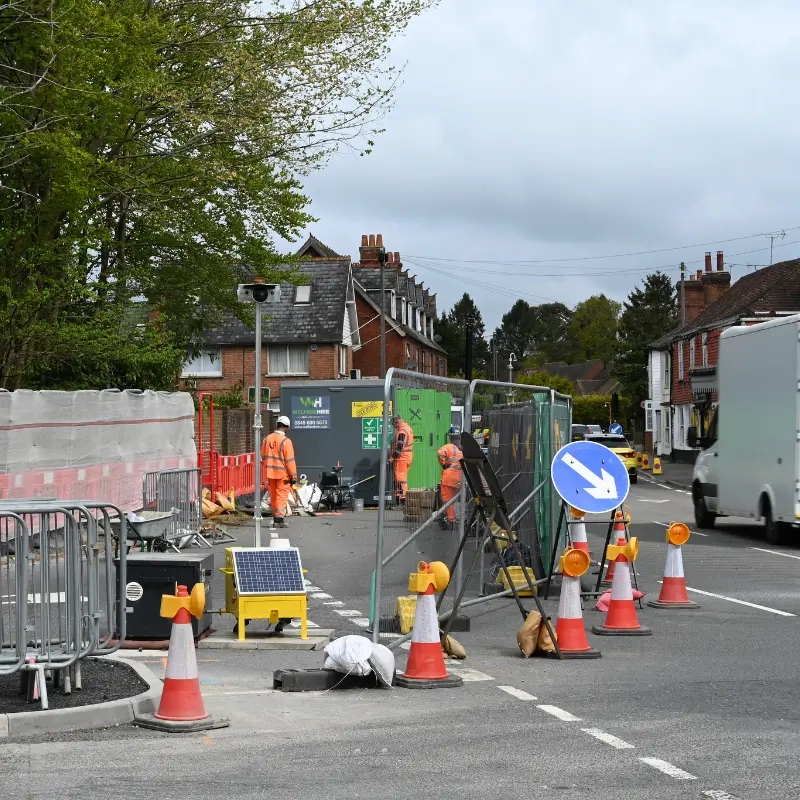
Advanced CCTV Towers with PTZ (Pan-Tilt-Zoom) cameras offer rapid surveillance of active and evolving project zones. Our solar-powered, 4G/5G connected Traffic Management, Mini Tower, and CCTV Towers are purpose-designed for such temporary deployments.
These flexible, mobile units can be installed in 20 minutes (for basic setups) and easily moved, delivering real-time visibility wherever you need it: traffic management schemes, temporary roadworks and upgrades, high-risk locations and remote rural areas without infrastructure.
Custom software allows project teams to review high-definition live and recorded video in a single dashboard through our cloud-based management platform. Our Towers also integrate smart detection tools (fire, PPE, intrusion detection) and environmental monitoring to deepen project oversight and keep profitability on track.
By replacing fragmented systems with a single, unified platform, you standardise how sites are monitored and managed. Automation becomes a real cost saver by reducing manual processes, while consistent control everywhere protects costs and drives efficiencies across your portfolio.
All our Towers are supported by NSI Gold Accredited remote monitoring partners, with professional operators responding live to defined and developing incidents, avoiding unplanned expenses surrounding your security.
Read more:
- How to Monitor Temporary Roadworks Without Permanent Infrastructure
- What Are Rapid Deployment CCTV Towers?
2. Environmental challenges
To avoid regulatory, financial and public pressures, project owners must adhere to several environmental laws:
- The Control of Noise at Work Regulations 2005 require workers' hearing to be protected from excessive noise in the workplace.
- Under the Control of Substances Hazardous to Health (COSHH) Regulations, employers must control employees' exposure to hazardous substances, such as dust, toxic fumes, vapours and gases.
To enforce regulations and safeguard employees, the HSE sets Workplace Exposure Limits (for harmful substances) and noise limits that contractors must follow. And environmental bodies, such as the Environment Agency, expect project owners to ensure noise and hazardous materials from their sites don't endanger or disturb the public.
Roadwork activities produce tremendous amounts of noise, dust, fumes and other environmental emissions. Without proper systems to measure and control these conditions, staying consistently within legal limits is nearly impossible. Failure to effectively manage eco hazards and weather risks has several financial repercussions:
- Fines and penalties
- Higher rates of worker injuries leading to increased compensation claims
- Formal public complaints forcing regulators to shut down operations or restrict work hours
- Legal claims and insurance disputes
- Community protests against pollutants/noise leading to work disruptions and delays
These risks and costs can multiply quickly for leaders overseeing multi-site operations.
How integrated environmental monitoring tools help
IoT environmental monitoring tools, as enhancements to our Towers, help councils and construction companies track noise, pollutants and weather conditions during road projects.
- Air Quality Sensors continuously measure dust, particulate matter (PM1, PM2.5, PM10), CO₂, TVOC, carbon monoxide and other airborne contaminants. When conditions approach thresholds, site teams are notified so they can act to prevent violations, public/worker harm and penalties.
- Weather Monitoring Sensors track temperature, humidity, winds, rainfall, and other atmospheric factors that could impact operations. This project data helps contractors plan workflows around weather risks, justify schedule changes and take safety measures to protect people and assets while minimising downtime that eats into margins.
- Noise Monitoring Sensors use a condenser microphone to record noise levels in all work zones across 30-130 decibels and 20 Hz-12.5 kHz. Alerts are generated if preset thresholds are approached, protecting worker safety and avoiding investigations and fines.
Environmental approvals delays can also set back project commencement dates. Showing that you've properly implemented environmental controls with data-backed evidence can speed up this approvals process.
Read more:
3. Compliance failures
Whether redesigning a merge point, reinforcing a bridge or undertaking surface maintenance, highways projects are heavily regulated. To run a compliant site, construction companies must adhere to local work permits, environmental regulations and a maze of safety standards, such as PPE protocols.
Contractors are also expected to follow the government's Chapter 8 guidelines and any temporary traffic management measures implemented to safeguard crews/road users and limit disruptions. Non-compliance relating to any of these rules can lead to:
- Regulatory fines and penalties
- Workers' compensation and legal claims
- Accidents that damage equipment and infrastructure
- Higher insurance premiums
- Work stoppage orders
- Worker injuries, even fatalities
Strong, scalable compliance tracking and enforcement are essential to avoid rule violations and financial problems.
How integrated monitoring tools help
It's believed that a large portion of the nearly £1.35 billion lost to workplace injuries in the UK could be prevented by proper PPE use. Our PPE Monitoring Systems use AI analytics to spot and warn workers not wearing the required personal protective equipment. The system also alerts relevant managers, supporting active enforcement to reduce safety risks and fines.
Environmental monitoring provides project data on air pollutants, noise and weather variables, helping ensure they don't endanger workplace and public safety or cause costly regulatory actions.
Both PPE and environmental systems store complete event records in a centralised dashboard, allowing compliance teams to address audits fully and confidently.
Read more:
4. Security incidents
The total cost of plant, equipment, materials and metals stolen in the UK's construction sector amounts to hundreds of millions of pounds annually. Petty vandalism and wilful damage add to this substantial bill.
Beyond the direct cost of theft, security breaches can also expose contractor directors to legal liabilities. The company can be held accountable if a trespasser is injured on-site, even though they entered the compound illegally.
Traditional security measures (e.g., patrolling guards, low-grade cameras) expose several vulnerabilities. Foot patrols can't cover every inch of a large site 24/7. Basic cameras may record a theft but don't include interventions to prevent it, and often the recorded footage is too poor to assist investigations and recovery efforts.
How integrated monitoring tools help
Our Intruder Detection System uses PTZ surveillance cameras and AI video analytics to identify suspicious behaviours day and night. AI enables quick and accurate detection and interception of threats, with minimal human intervention. To minimise false alarms, the solution easily differentiates between a person scaling a perimeter fence and harmless wildlife or blowing trees.
Intrusion Detection integrates with our CCTV Towers and remote monitoring services, involving professional operators at NSI Gold Accredited control centres. Upon receiving an alert, operators verify it on the camera and take near-immediate action (live audio voice-down challenges/light warnings, summoning the police if necessary). These interventions deter the majority of intruders, ensuring assets and margins are protected 24/7.
Our optional Mobile Keyholding Response service dispatches a security professional to the site to investigate confirmed threats.
To enhance safety and security further, you can integrate our Automatic Number Plate Recognition (ANPR) solution. ANPR records all vehicles entering and exiting work zones, logging plate, make, model and speed details. Accurate vehicle tracking improves access control, limits theft and encourages accountable driver behaviour, reducing accidents and profit erosion.
Read more:
5. Equipment damage
Equipment and machinery are exposed to a range of risks during construction work, and failure to safeguard these assets has costly consequences. Repairs, replacements and work stoppages cut directly into margins, while investigations and insurance disputes consume valuable management time.
Common causes of equipment damage include:
- After-hours damage, due to unauthorised operation by crews or vandalism by intruders
- Vehicle incursions leading to collisions with machinery, barriers and other vehicles
- Fire incidents damaging equipment and property
- Severe weather events
- Vandalism and deliberate destruction
Without an accurate record of events to guide future prevention strategies, similar incidents are likely to recur, impacting project progress and profitability.
How integrated monitoring tools help
- CCTV monitoring captures continuous footage, providing a timestamped record of incidents to support insurance payouts, avoiding out-of-pocket expenses. Centralised cloud reporting brings video, alerts and environmental data together, securing relevant evidence for whenever you need it
- Our Smoke and Fire Detection solutions use AI to detect early signs of smoke or fire, while ignoring false triggers such as dust and steam. AI-based detection works much more reliably than conventional alarms in wide-open outdoor spaces, triggering prompt alarms and interventions to avoid property damage. The system retains logs and footage of all fire risks and alerts for investigations, insurance and review.
- ANPR bolsters access control and identifies unapproved vehicles, minimising unauthorised entry and accidents and unplanned expenses.
- Weather monitoring provides early warning of high winds, heavy rainfall and other unfavourable conditions, allowing teams to secure, cover or temporarily remove assets to limit damage and loss.
Read more:
6. Slow incident escalation and response
When a safety, environmental or security incident occurs on site, the response can be the difference between learning and loss. Many incidents go entirely unseen due to visibility barriers and intelligence gaps, a clear failing in the system.
When incident monitoring relies on physical inspections, spot readings and manual reporting, project managers will almost always be a step behind. These processes are inconsistent and slower than near-instant automated alerts.
While slow responses to immediate dangers, such as fires, can be disastrous, every minor issue that's not addressed at the right time could turn into an expensive headache. For example, a perimeter breach attempt isn't reported promptly on Friday night; on Sunday the criminals return and steal valuable equipment.
How integrated monitoring tools help
Unifying video, detection tools, environmental insights and automated alerts in a central platform provides contractor directors with an immediate view of events on the ground across all risk areas. When time is of the essence, you can remotely access alerts, review supporting video/data, assess the situation and initiate swift, informed actions to avoid loss.
Read more:
7. Weak evidence for claims and disputes
Contractors often lose money because they lack the proof to defend themselves in disputes. When their evidence is inconsistent or incomplete, resolving liability claims becomes more difficult and expensive. As a result, contractors could incur unnecessary charges:
- Penalties due to delays or disruptions without concrete evidence to justify them (e.g., timestamped records of dangerous weather conditions).
- Legal claims for damages (e.g., a vehicle collision) where the contractor could avoid blame if they had video footage and/or vehicle movement logs.
- Rejected insurance claims because of incomplete records.
- Regulatory fines and enforcement actions.
- Workers’ compensation claims that could be defended with clear video of the event.
How an integrated monitoring platform helps
A smart monitoring platform and specialist tools (including PPE, ANPR and environmental/weather monitoring) ensure every client project captures consistent, defensible records. Video, data logs and reports create a digital audit trail that is hard to challenge.
When events and data are captured directly into a management platform, you immediately benefit in 2 ways:
- You have a record of all incidents recorded in your system.
- There is less dispute about objective records, consistently collected, free from human bias and error.
Our cloud-based monitoring platform uses AES-256 encrypted cloud storage to house evidence securely for a suitable period after the incident. If you need to pull documentation to resolve a dispute with any party, you can do so with a few clicks.
Read more:
8. Project delays and stoppages
Project delays due to external factors (e.g., labour shortages) or more direct concerns (contractor inexperience, weak oversight) can significantly increase costs and eat into profits.
Here are some of the main reasons projects fall behind:
- Planning and design shortcomings are among the top causes of construction delays. Design changes can cause major holdups as new plans and approvals are required.
- Nearly 39% of UK construction managers claim inclement weather is a major contributor to work setbacks and financial losses.
- Construction projects often experience schedule delays due to late issue detection.
- Compliance failures lead to investigations and increased scrutiny, slowing progress.
- The need for reworks due to quality issues, incorrect materials or deviations from plan is a common factor. According to 2022 industry reports, around £10-25 billion is spent on construction rework annually, making it a major contributor to job cost overruns.
- Slow decision-making and inspection sign-off, lack of resources, scope changes and late progress payments are other realities that stall projects.
How integrated monitoring tools help
Useful solutions in combating delays include:
- Proactive PPE and performance monitoring help to reduce compliance holdups and reworks.
- Weather monitoring assists leaders to adjust operations around adverse conditions to limit work stoppages.
- Managing everything through our central platform brings key stakeholders onto the same page, improving communications and decision-making to mitigate delays.
Protect Project Profits with Smart Integrated Monitoring
Contractor directors can improve their bottom line by introducing smart centralised monitoring to highways projects.
Cloud-based monitoring offers advanced visibility, early risk detection and data-driven decision-making. When security, environmental, safety or compliance risks are flagged early, they can be contained effectively, reducing disruptions and budget overruns.
Stronger reporting and AI-powered insights allow leaders to identify, understand and shut down vulnerabilities where margins commonly leak. The result of tighter cost control is more secure, efficient and financially sustainable operations.
To discover how contractor directors can not only protect, but over time, increase profitability, contact our team and let's chat.