Local authorities are under growing pressure to improve visibility across their road network operations while demonstrating safety, compliance and value for money. They need better visibility into roadworks risks, contractors' performance and temporary traffic initiatives.
Greater understanding of these areas helps strengthen roadworker safety, regulatory compliance, environmental oversight and asset protection. It also creates consistent, evidence-backed reports that can improve public communications and budget allocations, contributing to greater stakeholder trust.
Evidence-led strategies are built around highly mobile CCTV, environmental sensors and centralised cloud platforms that provide more cohesive, flexible monitoring than static surveillance and fragmented reporting.
Our article explains how a centralised system integrating video, smart sensors and risk management tools provides leaders with the visibility and actionable insights they need to oversee multiple network projects effectively. It also highlights how automated documentation enables traffic teams to address councillor and resident concerns with evidence and data, while demonstrating responsible stewardship of public funds without relying on permanent infrastructure.
Why Road Network Visibility Matters More Than Ever Today
Strong oversight of critical network operations (maintenance, infrastructure upgrades, temporary traffic schemes) has always been important to delivering a safe, efficient road service and meeting regulatory and reporting requirements.
Increasingly, better intelligence has become invaluable in supporting long-term transport strategies, public accountability, legal obligations and environmental priorities.
Here's why:
Increased UK roadworks
Based on Department for Transport projections, traffic growth on England and Wales's roads could rise by up to 54% by 2060. Extensive works will be required to prepare the country's network and ageing infrastructure for this increased volume.
There is major concern about the challenges this buildout poses, with 62% of local highway leaders anticipating a roadwork crisis by 2030 unless industry collaboration improves. Close oversight will be essential to manage projects on your network safely and successfully into the future.
Read more:
Greater public and political pressure
Since MPs and councillors must account to their constituents, they expect traffic managers to account transparently for public concerns about their roads. Local communities also demand updates and explanations for safety risks or works that affect their lives.
Without clear insights into events on the ground, you struggle to manage disruptions, verify complaints, ensure safe work practices or explain how critical incidents were handled. Public frustration at perceived incompetence can quickly escalate into social media or press attacks on your department.
Obligations under The Highways Act 1980
Under Section 58 of the Highways Act, if a roads authority is sued for damages, they must prove they took reasonable care to ensure the location was not dangerous for traffic. It's only through monitoring records that you can show you were aware of a hazard and took reasonable steps to mitigate it.
Section 41 of the Act (The Duty to Maintain) requires roads to be free from dangers like potholes, obstructions and weather conditions that could endanger traffic. For both public safety and the council's legal defence, it's vital that hazards are addressed sooner rather than later.
Environmental concerns
As the UK aims for net zero carbon emissions by 2050, there is a mounting focus on eco-friendly and sustainable work practices. Project owners need to pay attention to several environmental rules and standards: Workplace Exposure Limits for air pollutants, noise exposure control, Control of Substances Hazardous to Health (COSHH), Control of Pollution Act 1974, and more.
Smart tracking of noise and emission-producing activities is the only way to manage worksite environmental risks with confidence.
The Costs of Poor Visibility on Projects and Traffic Schemes
The consequences of network blind spots include delayed incident detection, legal liabilities, reputational damage and regulatory actions.
-
Slow network detection and response: Without continuous visibility, highways teams tend to rely on public reports or physical inspections. These methods produce delayed, unverified information that makes it harder to intercept problems, explain disruptions or show that issues are being actively managed.
-
Reputational harm: Ongoing safety issues and high levels of complaints raise questions about your professional competency. Having to continuously answer councillors' concerns places increased political pressure on your department, while failing to address community complaints convincingly can seriously tarnish your public reputation.
-
Regulatory challenges: Poor visibility into project compliance means that when HSE, environmental or council inspectors arrive on site, they might find a range of violations. This can lead to fines, investigations, further inspections and enforcement actions, including work stoppages. Increased regulatory scrutiny often causes project delays, furthering disruption and frustration.
-
Contractor disputes: Without firm oversight, some contractors take shortcuts and don't always follow safety, security and traffic controls. When you have concrete evidence of these slipups, it's easier to engage them constructively and correct mistakes. If you rely on secondhand reports rather than solid proof, these discussions can turn into disputes while hazards go unchecked.
-
Operational stress and strain: Time-consuming inspections and manual processes can place strain on already stretched teams. Stress, and even burnout, becomes a real factor when the job seems an endless cycle of firefighting avoidable incidents, triaging complaints and excessive administration.
-
Weak accountability and transparency: Without an audit trail, including visual and data evidence, highways teams can't accurately verify complaints, conduct investigations and demonstrate that safety, environmental and compliance risks were effectively managed.
-
Legal liabilities: Failing to maintain responsible oversight may be considered a breach of your statutory duty of care. This can expose the council to costly compensation claims and legal disputes under the Highways Act 1980 (including Sections 41 and 58).
-
Poor information means poor decisions: Haphazard, inconsistent data collection leaves information and knowledge gaps. Leaders may base important decisions on flawed/incomplete information, taking the wrong path, with expensive consequences.
The central advantage of active network visibility is that it reduces the time it takes to identify and contain threats. A proactive strategy that prevents incidents from escalating produces measurable outcomes all around: fewer accidents and compliance breaches, lower liability claims and less loss, injury, damage and stakeholder criticism.
Comprehensive visibility also aids in planning for future growth and improved service delivery, showing that public funds are sensibly and impactfully invested.
5 Common Challenges to Network Visibility in the UK
Several visibility barriers limit how effectively local authorities can manage road projects in the UK.
Let's briefly look at the 5 main challenges:
1. Inflexible permanent CCTV
Relying on permanent infrastructure to monitor shorter-term activities is, in most cases, neither practical nor economical. Fixed CCTV installations are static structures covering specific sites, so they can't be easily and inexpensively moved to target evolving project needs or temporary work zones.
2. Rural visibility gaps
Compared to urban centres, large stretches of rural roads are underserved by permanent monitoring infrastructure. Small populations, difficult terrains and large distances make it difficult to justify investment in many of these areas. This is a definite blind spot for highways teams trying to deliver successful projects to all communities.
3. Budget constraints
Traffic teams often work within tight financial constraints, with monitoring infrastructure competing with other essential services for funding. Traditional systems require high upfront investment and ongoing maintenance, which limits the ability to expand visibility within their yearly budget.
4. Overstretched teams
Council teams tasked with monitoring/reporting often balance multiple responsibilities across infrastructure, maintenance and public engagement. Staffing and resource shortages make it impossible to cover all bases all of the time, leading to delays in identifying and resolving issues before loss/damage occurs.
5. Fragmented reporting
Data collected through traditional monitoring is often unhelpfully siloed across departments or recorded inconsistently. This fragmentation makes it harder to gain a big-picture view of events and conditions across all locations. Without complete information, you may struggle to reassure councillors and the public that your projects are under competent control.
What is a Modern Road Network Visibility Solution?
Modern network monitoring solutions feature operational technology that integrates multiple tools to provide near-360° coverage of project risks from a single smart platform.
Here is a rundown of core components and capabilities:
-
Rapidly deployable CCTV towers: Unlike permanent CCTV, which can take months to install, these surveillance systems can be set up in minutes. They operate independently of mains power and internet via solar/battery generation and 4G/5G connectivity. Their key advantage is quick and easy deployment to nearly any environment, from crime hotspots to remote rural road
-
Environmental monitoring integration: Environmental tracking using IoT sensors keeps managers constantly updated on air quality, noise levels and local weather patterns around roadworks and busy traffic projects. This capability supports local authority/contractor's ESG and compliance reporting.
-
Automated intelligence and alerts: Smart systems use AI-driven analytics to filter out background noise and immediately notify control centres and/or designated contacts of genuine threats: security breaches, traffic incursions, fire risks, excessive noise or missing PPE.
-
Cloud-based centralised dashboards: Cloud connectivity provides secure, remote access to live and recorded video and current reports via web or mobile applications. This allows safety and security teams to review events and coordinate rapid responses from wherever they are. Unified dashboards present a coherent view of all the relevant details to guide the best decision in each circumstance, from worker safety to traffic management, theft prevention or weather risk.
-
Automated reporting: Auto-generated incident reports (backed by evidence and data sources) show what happened, when it happened and the corrective steps taken where relevant. Accurate, standardised reporting within the platform builds an invaluable knowledge base. The result is teams become increasingly aware of the major risks across their network and how to limit them.
-
Secure cloud data storage: All video and documentation are housed centrally in encrypted cloud storage, reducing the risk of scattered files across local servers. Seamless cloud computing ensures an incident audit trail is available at the push of a button to assist investigations, insurance claims, compliance audits and public enquiries.
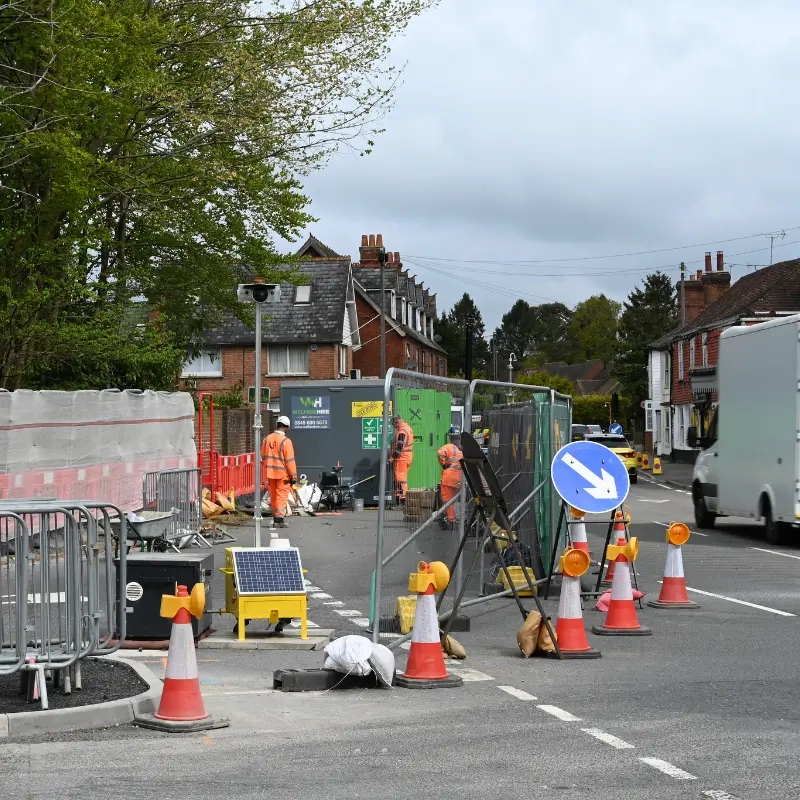
Network Visibility Tools that Support Modern Road Monitoring
WCCTV offers a range of monitoring setups designed for temporary, targeted coverage of nearly any location. By integrating specialist tools, highways teams can oversee security, safety, environmental monitoring and project oversight from our dedicated cloud-based platform. All equipment and supporting software can be rented so you only pay for coverage when it's required.
Let's take a look at the available tools and smart platform.
Central Cloud Platform
At the heart of our solution is a secure, cloud-based platform that combines live video, recorded footage, AI-powered alerts and environmental data in one place. Teams can monitor multiple locations remotely, review incidents as they unfold and quickly share intelligence (timestamped footage, data readings, relevant reports) with colleagues, contractors and stakeholders.
The platform supports up to 81 simultaneous camera feeds, helping you track events across critical locations and temporary projects from any internet-connected device. Protected with AES-256 end-to-end encryption, it safeguards footage and data against cyber threats while providing secure access to authorised users.
By integrating CCTV, AI video analytics and environmental monitoring into the platform, you gain a comprehensive, data-backed view of network conditions, enabling faster decisions and stronger management.
Deployable CCTV Towers
Our autonomous CCTV Towers offer rapid, flexible monitoring wherever visibility is needed, from roadworks to infrastructure projects, remote routes and temporary traffic plans. Once surveillance is in place, you can integrate smart detection (PPE, fire, intrusion detection) and environmental tools for near-complete visibility.
Mini CCTV Tower
Our portable, flexible Mini Tower features:
- Compact, solar-powered design with battery backup and 4G/5G connectivity.
- PTZ cameras for wide-area coverage that can zoom in on situations, maintaining high-resolution clarity.
- Units can be deployed and repositioned by a single person without requiring an engineer, providing rapid oversight with minimal effort.
- Ideal for monitoring short-term works, inspections, maintenance and specific on-site risks.
CCTV Towers
- Up to 6 metres tall with high-definition PTZ cameras delivering near-360° coverage.
- High-quality day and night images enable operators to monitor large areas from a single deployment.
- Basic deployments can be operational in as little as 20 minutes.
- Solar-powered and fully autonomous, requiring no mains power or fixed communications.
- Easily relocated as projects progress or monitoring priorities change.
- Our Traffic Management CCTV Towers are built specifically for traffic management contractors.
All our Tower deployments are supported by an NSI Gold Accredited remote monitoring partner, providing live operator intervention and appropriate escalation when threats are detected.
Read more:
PPE Detection and Monitoring
In 2024, the total cost of workplace injuries in the UK amounted to £1,348,189,560. It's believed many injuries could have been prevented if workers were using proper protective equipment.
Our PPE Detection uses AI analytics to detect and alert managers when workers are not wearing the required safety gear, with an advanced feature that activates live audio warnings directly to personnel not following protocols.
The solution encourages safer workplaces and stores timestamped visual evidence of breaches to help drive constant improvements and prove compliance.
Smoke and Fire Detection
Every year, hundreds of fires impact UK worksites. Smoke and Fire Detection uses AI to pinpoint and flag the early signs of smoke or fire, filtering out false alarms. Intelligent video-based detection operates effectively in wide-open outdoor spaces where many conventional alarms don't work properly.
The system automatically retains timestamped logs and visuals of all fire risks and alerts for investigations, insurance and review.
Intrusion Detection Systems
Night-vision HD PTZ cameras scan for activity around your perimeter and/or the designated zones you set. AI analytics capture potential threats (unauthorised access, theft attempts, trespassing and vandalism) and generate near-immediate alerts.
Connected to an NSI gold-standard monitoring partner, the security service protects compounds, critical infrastructure, materials and other assets 24/7, while generating incident reports for further action, such as upgrading the security plan.
Our Mobile Keyholding Response service offers an extra safeguard by dispatching a security professional to investigate confirmed intruder alarms.
Weather Monitoring Sensors
Weather Monitoring Systems capture site-specific climate data, including:
-
Temperature (from -40°C to 60+°C)
-
Humidity (10-99%)
-
Wind (0–110mph)
-
Rainfall (hourly)
-
Dew point
Precise atmospheric data enables managers to respond to weather risks proactively (e.g., rescheduling concrete pours to avoid rain, ensuring proper cover for equipment), safeguarding the site, whilst limiting project delays. Objective data on climate conditions provides valid evidence to stakeholders questioning work adjustments or delays because of weather and also supports insurance claims.
Noise Monitoring Sensors
IoT-enabled sensors use a condenser microphone to track sound and frequency across ranges of:
-
30-130 decibels (dB)
-
20Hz-12.5kHz
The system can be set to issue alerts before allowable thresholds are reached. This prevents workers and the public from being exposed to harmful noise hazards. Incident data proves that action was taken to keep sound within ordinance limits and helps to answer community complaints.
Air Quality Monitoring Sensors
IoT sensors continuously capture air quality readings, monitoring and alerting work teams to avoid breaches of exposure thresholds for:
-
Dust
-
Particulate matter (PM1, PM2.5, PM10)
-
CO
-
TVOCs
Air quality tracking protects workers and the local community from harmful airborne contaminants. It creates an audit trail of readings to demonstrate that emissions were responsibly controlled, presenting objective evidence to respond to inspectors' queries or residents' complaints.
Read more:
ANPR (Automatic Number Plate Recognition)
In 2024, nearly 5,900 incidents involving incursions into traffic management zones were reported, highlighting the risks of unauthorised access into work areas.
ANPR uses Optical Character Recognition (OCR) to log vehicles travelling into worksites and restricted zones. Besides number plate details, the system's high-resolution cameras can capture make, model, speed and colour of vehicles to provide deeper context for investigations.
The solution strengthens access and vehicle control and adds another layer to security efforts. ANPR retains reports and video footage for investigations, analysis, insurance and complaint handling.
The Benefits of AI-Powered Visibility for Highways Teams
Below, we summarise the measurable advantages of continuous monitoring with AI insights versus traditional low-tech strategies.
|
Outcomes |
AI-Driven Deployable Monitoring |
Traditional Methods |
|
Reporting |
Automated standardised reports with objective data and video evidence enable better, faster project decision-making. |
Manual logs and periodic updates delay reporting and are prone to subjectivity, human error and inconsistencies. |
|
Incident handling |
Proactive detection using AI alerts enables faster intervention and prevention. |
Reactive response after public complaints or visible disruption means incident resolution is slower, aggravating frustration and/or harm. |
|
CCTV flexibility |
Rapid deployment CCTV can be scaled and repositioned quickly across sites. Coverage is easily adapted to project needs. |
Fixed infrastructure with limited coverage is expensive, static and slow to expand. |
|
Operational efficiencies |
Fewer physical patrols and manual processes streamline workflows and efficiencies. |
Labour‑intensive monitoring, duplication of effort and inconsistent performance. |
|
Regulatory compliance |
Automated audit trails and faster interventions support and prove diligent environmental and safety compliance. |
Spreadsheet‑based or fragmented compliance records make it harder to demonstrate consistent adherence. |
|
Accountability |
Transparent reporting to councillors and the public builds trust through objective facts, video and data. |
Relies on slower, subjective, sometimes conflicting reports that cloud feedback. |
Best Practices for Achieving Visibility Across Your Roads
Here's a quick 7-step guide to implementing effective network monitoring:
-
Strategic monitoring plan: Start with a high-level plan of the operational sites requiring advanced monitoring over the next period (3, 6, 12 months). Identify the specific priority focuses, such as asset security and/or environmental tracking.
-
Select appropriate monitoring solutions: Evaluate and choose versatile deployable systems that enable quick, effective and relocatable oversight. The best solutions can combine multi-functional tools - for example, monitoring security as well as providing environmental readings and safety insights.
-
Standard operating procedures: Develop operational procedures defining user responsibilities, reporting standards, incident escalations and evidence management for every project.
-
Site assessment and camera/sensor placement plan: Consider the site layout, facilities, key points and restricted areas to guide camera/sensor placement, ensuring essential coverage with no gaps. Professional providers, such as WCCTV, can help you optimise placement and coverage.
-
Activate and test the system: With the help of your provider, implement and activate the CCTV and supporting tools. Test the connectivity, camera feeds and data capture to check the solution is delivering everything it should.
-
Training: Ensure all users receive the necessary training on the tools, data and video insights as well as the management platform and dashboards. Our intuitive app and easy-to-view dashboards require minimal training, helping teams quickly become confident using the platform.
-
Regular review: Review the system regularly to identify gaps or performance issues that need addressing.
Ready For A Smart, Flexible Network Monitoring Solution?
Smart visibility and evidence-led interventions not only improve risk management, but also demonstrate strong operational control, good governance and responsible public spending.
This explains the wide adoption of intelligent platforms that deliver cost-effective oversight where you need it, when you need it, without delay or capital expenditure.
Versatile, rapidly deployable solutions that combine video, AI alerts, environmental monitoring and rich reporting into a single platform allow highway professionals to transform the effectiveness of their councils.
To be ready for the high-stakes, sustainably-focused projects of the future, as well as tomorrow's emergency, contact our team today about smart, deployable monitoring solutions that let you lead with confidence.