
Operations directors running several highways schemes at once make better decisions when they can see their whole portfolio clearly. If oversight depends on disconnected tools, spreadsheet reports, chasing updates and site visits, control is fragmented and weakened. Reporting and records are compromised by out-of-date and inconsistent information, often leading to flawed decisions.
In this blog, we look at how centralised dashboards improve traffic oversight and highways projects. A centralised monitoring dashboard is a platform that integrates data from multiple sources for comprehensive, actionable insights across every scheme. We explain how this unified view can provide a consistently clear picture of site activity, safety, environmental conditions and compliance.
The result is stronger, simpler oversight where decisions are based on evidence rather than delayed second-hand reports.
The Challenges of Managing Traffic Projects Without Centralised Information
Let's explore how portfolio management is weakened when directors lack a consistent, centralised view of all operations.
Poor, inconsistent visibility across schemes
Without a standard oversight approach across all locations, each traffic project tends to develop its own systems. This can result in widely varying monitoring, compliance, incident recording and quality standards.
This inconsistency makes it harder for directors to compare performance, identify recurring risks or reinforce proper processes. Problems can remain buried in individual projects, and scaling a successful system across new schemes is complicated.
Safety, security and environmental information sits in silos
Security, environmental controls, safety incident detection and other monitoring systems may operate independently, with different teams responsible for each.
When information is fragmented and owned by multiple stakeholders, broader collaboration that improves performance is harder to achieve. A director may hear that an incident occurred (e.g., an emergency service call-out), then have to waste time consulting different systems and people to understand the full context and how serious it was.
Fast-developing work environments create visibility gaps
Highways and traffic management schemes are evolving environments, characterised by changing activities, expanding scope, shifting locations and different conditions (e.g., work progressing from an urban to a country setting). Traffic management arrangements often have to adapt as the project progresses, and a monitoring system used in one phase may need to be moved to manage the next.
Visibility gaps often leave management without critical information as conditions become more unpredictable and risks escalate.
Remote and rural sites demand too much physical oversight
Directors often need to travel considerable distances to check on work, investigate a pollutant complaint, verify a rural site security plan or chase delayed reports.
Travel costs management time, and physical inspections aren't a viable, long-term strategy in multi-site operations. Too much can change on the ground between visits; new risks can emerge hours, even minutes, after the inspection, leaving the director unaware.
Incidents take too long to investigate
When a serious incident (traffic collision, security breach, safety hazard, flooding damage) occurs, details of the event are often spread across disconnected reporting systems.
Teams must search multiple systems, cross-check and stitch together records to try and establish exactly what happened. This can delay crucial decisions and responses and make it harder to provide a clear account to clients, insurers, stakeholders or commercial teams.
Leaders can be overwhelmed by information
Managing a large active portfolio can generate vast volumes of CCTV footage, alerts, reports and project information. However, more data from more systems does not necessarily improve vision and visibility. In fact, the overload often causes the common business stumbling block "paralysis by analysis."
Without a way to join up relevant data and highlight exceptions, senior managers spend more time filtering or verifying information instead of acting decisively, informed by the facts.
These challenges mount up as project numbers increase and larger sites are acquired, involving more stakeholders and teams. As complexity increases, the need for a consistent, connected view of operations across your portfolio becomes vital.
What Does a Centralised Oversight Solution for Traffic Projects Look Like?
A centralised monitoring solution brings information from all your traffic and highways projects into a single management platform. Within this platform, dashboards are a visual tool, turning scattered site data into information decision-makers can read at a glance and act on.
By reviewing dashboard information, leaders stay up to date with workplace and traffic conditions across all schemes. They're also able to check risk alerts, live and recorded footage, environmental data, security breaches and safety incidents.
Armed with a clearer picture of events, directors can investigate and address problems earlier and focus their attention where it's most needed. A project or traffic management dashboard informs stronger, evidence-based decisions and generates records that help teams manage compliance and other stakeholder reporting.
What makes a centralised dashboard work?
A central management platform with smart dashboards is built around 3 main technologies and components:
- Automated data capture
- AI-driven analytics and reporting
- Unified viewing in a cloud platform
These 3 components empower stakeholders and decision-makers with a deeper situational awareness across their portfolio, supporting better, safer, more compliant projects.
1. Consistent, automated data collection
CCTV cameras and IoT environmental sensors capture video and data automatically from all monitored locations. These camera and sensor systems are often mobile, making them well suited for temporary contracts.
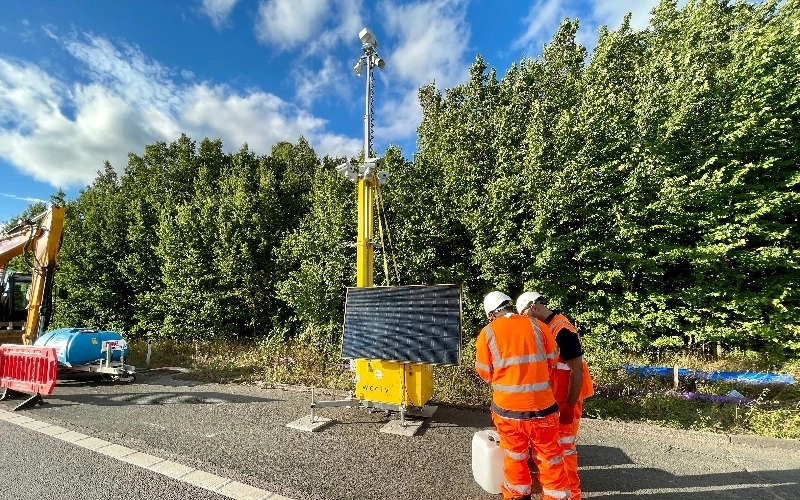
Portable CCTV Towers and Mini Towers with HD, night-vision capabilities run on sustainable solar energy and use 4G/5G connectivity to transmit video feeds. Specialist Traffic Management Towers provide essential visibility and evidence capture for traffic management contractors overseeing challenging live carriageway schemes, diversion routings or short-term emergency projects.
These deployable CCTV systems can follow projects as work progresses, so you shouldn't lose priority coverage for a moment.
2. AI analytics and reporting
It's unrealistic to expect that real-time data from multiple schemes can be manually processed and quickly understood. It's also unreasonable for teams to monitor camera feeds continuously, without lapses in concentration. Artificial intelligence and machine learning solve these limitations.
AI analytics are trained on large volumes of real-world scenarios to automatically recognise and flag safety and compliance events, such as:
- Driver incursions into work zones (a growing risk)
- Missing PPE
- Trespassers in a compound
- Excessive noise or dust
- Smoke and fire hazards
- Unsafe weather conditions
Intelligent AI filters out harmless false indicators such as animals, debris, blowing sheeting and authorised vehicles. Instead of watching every feed 24/7 and trying to process vast volumes of data, the right people automatically receive the right notifications and real-time insights to support quick, prioritised responses.
3. Unified cloud platform
Videos, alerts, sensor readings and incident logs are unified in one view in a secure cloud-based platform. Authorised users can access dashboards from their desktops or mobile devices to see what's happening on every site.
Managers can check a noise alert against live footage, confirm a reported PPE incident with timestamped evidence or compare conditions across schemes without calling supervisors or waiting for a report. Every event is logged, building a digital audit trail for clients, insurers, reviewers, or regulatory inspectors.
Read more:
- The Ultimate Guide To CCTV Towers
- How Artificial Intelligence is Revolutionising CCTV Tower Monitoring
- When Is Deployable CCTV Necessary on Highways Projects?
6 Benefits of a Centralised Dashboard for Highways Projects
When operations directors can see what is happening across every work zone without being physically present, they are better placed to deliver successful projects and more effective traffic management schemes. Here are 6 ways a centralised dashboard supports successful delivery:
- Faster, better-informed decisions: With the latest information available remotely in dashboards, directors can track conditions across multiple schemes from any location. If an issue arises on a traffic operation, they can address it before it becomes a problem. Clear video, alerts and records show what has happened and guide the best response.
- Stronger safety and compliance oversight: Assessing live and recorded footage, environmental data and alerts helps directors quickly understand safety, compliance and traffic flow control. A better understanding enables earlier, better intervention and more seamless coordination between teams to enhance compliance and worker/road safety.
- Greater consistency across projects: One platform helps apply consistent standards and reporting across all locations, making performance comparable. It also makes it easier to set Key Performance Indicators (KPIs) and drive key metrics such as incident response, PPE usage and environmental thresholds to improve work performance.
- Better evidence for claims and disputes: Timestamped evidence and reports provide an objective record for complaints, damage claims, contractual disputes and insurance processes. Retrieving it from the platform takes a few clicks, so queries are resolved faster, and your position is easier to defend in the case of litigation or major disputes.
- Less travel and admin: Since a centralised dashboard turns scattered information into practical oversight and actionable insights, directors don't have to travel to sites so often to check on operations. With less travel and admin on their schedule, leaders can focus on achieving key project deliverables.
- Cost savings and improved operational efficiency: Unified monitoring within one platform simplifies management and helps reduce costs. One supplier relationship and a single login replace the vendor sprawl and inefficiencies of juggling 5 or 6 different tools. And automation reduces manual workloads, freeing managers and teams to focus on higher-value priorities.
Read more:
WCCTV Solutions for Centralised Monitoring of Highways Projects
WCCTV provides and installs CCTV, supporting software and integrated incident management tools (including intrusion, smart detection and environmental monitoring). Managed through our cloud-based platform, these tools give directors deeper insights into portfolio risks.
From vehicle movements to security breaches, noise, air quality and weather conditions, these tools populate central dashboards with vital data to strengthen multi-location project oversight.
Here's a summary of the management insights our [monitoring solutions] offer:
|
Monitoring Systems added to CCTV Towers |
Features and Capabilities |
Management and Dashboard Insights |
|
Records all vehicles entering and exiting designated zones, logging real-time data, including:
|
Provides a record of vehicle movements, access activity and traffic incursions. Directors can identify unusual activity and recurring access issues to strengthen effective traffic management, access control and overall safety |
|
|
AI trained on security risks monitors preset zones such as compounds holding high-value assets and spots suspicious behaviours and breaches. The system activates swift deterrents, including alerts to remote monitoring professionals. As an add-on, Mobile Keyholding dispatches a trained security officer to breached sites. |
Tracks intrusion events and responses, helping directors compare site security issues across schemes and identify locations requiring tighter controls. Can also help identify repeat "trespassers" or groups who may be moving across sites. |
|
|
Employs AI to spot and issue an audio warning to workers not adhering to PPE rules, while alerting their managers. |
Systems deliver actionable insights into PPE incident rates, near-misses, recurring weaknesses, subcontractor compliance and areas where further intervention is needed to create safer workplaces. |
|
|
Uses AI analytics to pinpoint and alert relevant contacts to the early signs of smoke or fire, whilst also filtering out false alarms. |
Records all smoke and fire alerts, helping directors monitor incidents and responses to strengthen fire prevention measures. |
|
|
Captures site-specific climate data, including:
The system can alert when unsafe climate conditions are noted. |
Provides a record of weather conditions and alerts across schemes, supporting decisions around work stoppages, delays and weather-related risks. Timestamped data provides evidence for project records and claims. |
|
|
IoT environmental sensors track workplace sound and frequency levels (30dB to 130dB; -20Hz to 12.5kHz). Sensors can alert when preset permitted noise exposure limits are reached. |
Tracks noise levels, threshold breaches and trends by location, time and activity. This helps directors identify problem areas and investigate complaints, whilst retaining documentation for regulators or community enquiries. |
|
|
Continuously track common airborne hazards, including:
The tool monitors and alerts when preset exposure thresholds are reached. |
Provides measurable air-quality data and records threshold breaches across schemes. Retains 180,000 timestamped records to help directors identify trends, demonstrate environmental responsibility and operate healthier projects. |
Read more:
- IoT Environmental Sensors for Traffic Management: Benefits for Highway Projects
- AI-Powered Risk Detection: Smoke, Fire and PPE Compliance
- How Integrated CCTV and ANPR Keep UK Sites Secure
- The Benefits of CO2 Monitoring Sensors
Improve and Simplify Highways Project Control in One Platform
Centralised dashboards present essential information from active projects in one secure, cloud-based view, accessible on a desktop, tablet or phone.
This detail-rich overview of performance, safety and compliance across every site enables stronger project control, more seamless communication between teams and well-informed decisions for better results.
With over 20 years of expertise in smart monitoring, our platform-based solutions simplify highways and traffic management from day one. One platform with dashboard intelligence that's available when you need it most helps leaders manage increasingly complex portfolios with confidence.
Wherever you are on your digital transformation journey, reach out to our team to discuss how integrated monitoring with AI-based tools can scale your success.

