Highways operations directors are expected to deliver diverse schemes, from major infrastructure construction projects to local traffic operations in many different environments.
Beyond productivity targets, successful project delivery depends on maintaining safety, protecting critical assets, managing compliance and responding proactively to risks.
Operating safe, secure workplaces is often complicated by the lack of fixed infrastructure to support monitoring. The temporary and fast-developing nature of these schemes, with evolving work phases and rolling locations, heightens the challenge.
Deployable CCTV for traffic and highways projects has become widely used to address these challenges. Mobile CCTV towers can be installed rapidly without permanent infrastructure, providing reliable site oversight through solar power, wireless connectivity and remote monitoring capabilities.
Our article highlights the situations where rapid-deployment CCTV adds real value and explains how integrated safety, security and environmental monitoring can help directors maintain consistent portfolio oversight as projects and operational requirements change.
When to Use Deployable CCTV for Highways Projects: 7 Use Cases
Below, we discuss 7 operational situations/environments where mobile CCTV solutions can effectively support traffic and highways project oversight.
1. Remote highways projects without permanent infrastructure
Large stretches of the UK’s rural road networks remain underserved by modern infrastructure and utilities. For highways contractors working in rural regions, a lack of mains power and internet often complicates project communications. Poor lighting, under-maintained roads, rough terrain, blind corners, overgrown foliage and limited emergency services can compound difficulties.
An operations director overseeing a rural scheme must rely on periodic, often delayed site reports. Regular visits to these off-grid locations are impractical and not an efficient use of management time. When management visibility is weak, incidents go undetected, and the risk of asset loss, accidents, injuries and liability claims escalates.
How deployable CCTV can help
Modern deployable CCTV Towers and Traffic Management Towers with high-definition PTZ cameras help contractors establish oversight in remote locations without power or communications infrastructure.
Towers typically stand between 5 and 7 meters tall, and a few well-positioned cameras can deliver near 360° site coverage.
A CCTV tower powered by solar panels and battery backup can operate without hardwiring or site power, using 4G/5G networks to transmit video to a cloud monitoring platform. This allows you to track working conditions remotely from their phone or desktop, with some custom software letting you manage cameras and share video files.
2. Evolving project phases and work zones
As highways schemes progress through different works and traffic phases, maintaining control becomes more complex.
Changes in road layouts or work zones require new traffic management plans. Access controls, barriers, lane closures and temporary signals may have to be repositioned quickly. At the same time, new phases bring in new crews and subcontractors, who may need tighter supervision.
There is also pressure on managers to make critical decisions even though they don't have the full picture, because, for instance, a fixed camera view no longer captures the actual work zone.
In this rapidly changing scenario, blind spots and coordination slips are a constant risk. If they're not checked, they can disrupt workflows and compromise worker and public safety.
How deployable monitoring can help
Redeployable CCTV towers are fully portable and can be easily repositioned as excavation areas, storage facilities, entry points, traffic arrangements and other scheme priorities change. This mobility and flexibility ensure you maintain visibility wherever you need it.
For example, WCCTV's rapid-deployment Mini CCTV Towers can be installed in 20 minutes for basic setups and repositioned by 1 person without requiring technical expertise.
A big advantage for directors overseeing multiple highways and traffic projects is integration: connecting CCTV and risk management tools in one place. Instead of operating separate security, environmental monitoring, safety and incident reporting systems, you can manage all of these responsibilities through a central cloud-based platform.
Our cloud-based monitoring platform unifies data from up to 81 cameras, allowing you to view live and recorded footage, alerts, reports and environmental data in central dashboards. This organised overview helps you understand what's happening across your portfolio and prioritise your focus and resources.
3. Live traffic and temporary traffic management
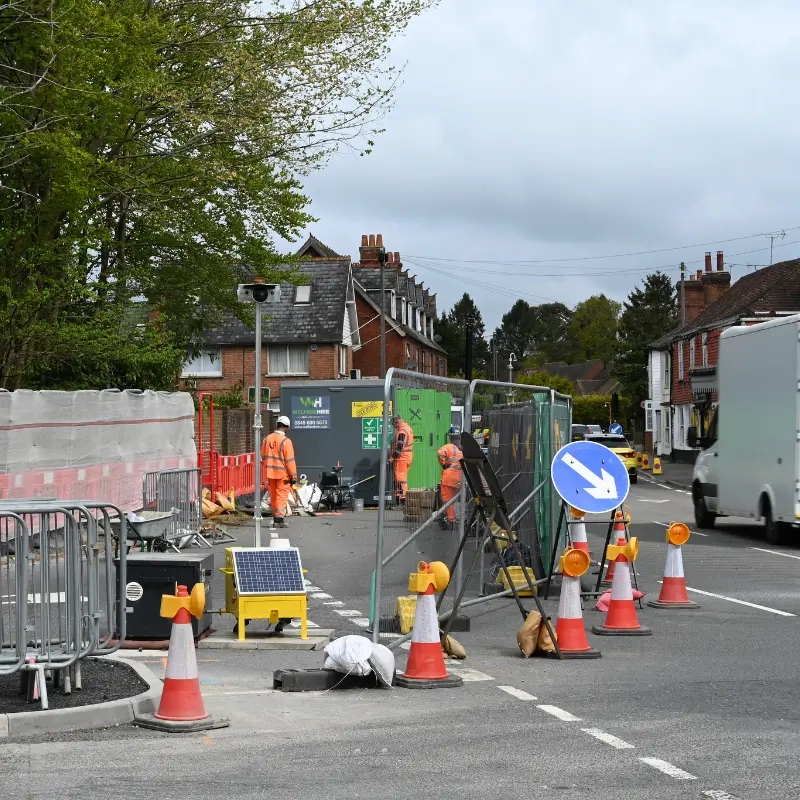
Highways contractors often operate alongside live traffic, and works can disrupt normal vehicle flow around the scheme. Temporary lane closures, diversions, contraflows and changing access controls can create vulnerable points where vehicle movements, congestion or unauthorised access must be understood quickly. Specialist traffic management towers help give greater insight into these risks.
Dangerous driving and unexpected incursions into project zones regularly endanger roadworkers' and drivers' safety. In 2024, 5,899 driver incursions into roadwork sites were recorded, up nearly 300% from 2023.
Health and Safety Executive (HSE) guidelines caution that members of the public can be injured or killed on work and construction sites. The body stresses the importance of controls to keep people away from work areas wherever possible.
Since supervisors can't operate every control or be physically present at every barrier and access point, a smart monitoring approach is essential to limit accidents, disruptions and complaints.
How deployable monitoring can help
Traffic management towers with high-definition cameras can be deployed within minutes to provide visibility into operational areas, strengthening safety, traffic control and public reassurance.
Managers can log in and verify compliance with Chapter 8 signage requirements and zone access plans. They can also identify safety risks and traffic flow issues earlier, while recorded footage provides vital evidence for investigations and reporting.
Traffic tower units are designed specifically for traffic management operations, delivering wide-area coverage from heights of around 6 metres.
Modern traffic management CCTV solutions often incorporate:
- Live remote monitoring can also be tailored to your project’s needs. To protect workers and equipment, active monitoring can alert site teams when unauthorised activity or intrusion is detected.
- Add-on Automatic Number Plate Recognition (ANPR) for vehicle identification and monitoring. ANPR uses AI imaging to record vehicle details (make, model, colour and speed). This allows contractors to track traffic movements, monitor site access points, restrict incursions, capture speeds and prevent unauthorised entry.
4. Environmental and weather monitoring
Noise, dust, chemical fumes and other emissions from roadworks pose health hazards to crews and the public, and modern contractors are expected to manage these hazards effectively.
Failure to do so creates a range of risks: liability claims, nuisance complaints, enforcement actions, regulatory penalties, work disruptions and project delays. Tracking weather variables is also important to prevent extreme conditions from impacting workers and traffic operations.
Periodic measurements are not enough to manage noise, pollutants and weather exposures responsibly or satisfy regulators. When sites use different environmental monitoring systems, comparisons between projects are impossible, which weakens controls and sustainability results.
How deployable monitoring can help
Environmental monitoring sensors connected to cameras measure noise and airborne pollutants, and track local atmospheric conditions. Data combined with visual evidence provides a fairly comprehensive picture of conditions. For instance, when a sensor reports high dust levels, you can check cameras to see what activities are causing the dust and adjust operations to reduce it.
- Air Quality Sensors continuously monitor dust, particulate matter and other harmful emissions (TVOCs, CO, CO₂) against predefined limits. Diligent monitoring and control help highways teams mitigate airborne hazards, keeping road users and crews safe and schemes on track.
- Noise Monitoring Sensors record workplace sound across wide decibel and frequency ranges. The system notifies managers when noise levels reach preset thresholds, preventing harmful exposures, complaints, regulatory actions and penalties.
- Weather Monitoring Sensors provide accurate wind, rainfall, humidity and temperature updates. Location-specific climate data enables the site manager to change schedules to work around weather events, protecting personnel, the project timeline and road safety.
5. Protecting plant, equipment and materialsplant, equipment and materials
Operations leaders must protect project and traffic assets, as far as reasonably possible, during and out of work hours. This makes security a top priority, especially on sites with high-value plant, specialist equipment/tools and stores of materials and fuels.
The challenge is that large, remote or lightly staffed compounds can be difficult to monitor through guard patrols alone. Indeed, some locations are unsuitable for manned guarding because site conditions are so hazardous that personnel numbers must be restricted.
Security visibility gaps create weak points for criminals to exploit, and even a single theft can have severe repercussions. It can disrupt operations, require scheduling changes and generate much admin as teams must report to stakeholders, including insurers, owners and the police.
How deployable monitoring can help
Deployable CCTV helps deliver real-time visibility into every corner of your project, offering more reliable coverage than traditional security guards, who can't be everywhere at once.
By their presence alone, CCTV towers are a visible deterrent against crime and other anti-social behaviours. Add AI threat detection and intelligent monitoring by trained professionals, and you build a robust security defence.
WCCTV's Towers with HD night vision cameras can integrate with add-on Intrusion Detection Systems that use AI video analytics to identify suspicious movement and actions, triggering near-immediate deterrents. Interventions include alerts to a remote monitoring centre, where trained operators issue a live audio challenge or activate light warnings to deter criminals and trespassers.
As an extra layer of protection, our Mobile Keyholding Services send a trained security professional to any location where suspicious activity is confirmed. This can save you/your team from attending callouts in the middle of the night.
With the integration we mentioned earlier, managers can review multi-site security alerts and events in a central platform, making security coverage smart, efficient and effective.
6. Workforce safety and PPE
Highways and traffic projects involve multiple contractors, teams and subcontractors working in dynamic, evolving environments. Safety practices, including PPE protocols, can vary widely between teams, requiring consistent reinforcement to ensure all workplaces comply with standards.
Project managers cannot continuously monitor every activity, particularly on large undertakings. Directors overseeing multi-site operations would spend the whole week travelling if they relied on physical inspections to address safety issues.
How deployable monitoring can help
CCTV integrated with smart detection systems keeps projects safer and compliant by quickly identifying and alerting to PPE, fire, environmental and incursion situations.
- AI-enabled PPE Monitoring and Detection Systems spot and flag when crews are not wearing the safety gear required by HSE PPE regulations. These systems detect incidents, generate real-time alerts to relevant managers and audio reminders to non-complying employees, while retaining a detailed record of the event within the platform.
- Smoke and Fire Detection Systems use AI analytics to alert teams to the early signs of smoke or fire, enabling a rapid response to protect people, equipment and critical infrastructure. AI video detection works reliably in outdoor environments like major road infrastructure projects, unlike conventional fire alarms that need smoke/heat to reach a sensor to activate.
- Automatic Number Plate Recognition tightens access control and curbs the dangers of vehicle accidents, while proactive environmental monitoring protects workers, communities and local road safety.
7. Incident investigation and project evidence
When serious security, safety or compliance incidents occur, leaders are expected to explain what happened, where and when, and what action followed.
If there are no records of the event or information is spread across disconnected systems, you need to retrieve and cross-check records and logs and gather witness accounts. This is time-consuming, especially when several teams and/or subcontractors are involved.
By contrast, a reliable digital audit trail of events ensures you have the evidence needed to conduct investigations and defend the company's position in contractual disputes, claims, insurance issues and regulatory enquiries.
How deployable monitoring can help
CCTV and smart monitoring support ongoing reporting and data gathering, with records securely stored in a central cloud platform. Authorised users have near-instant access to documentation to investigate incidents or claims with factual evidence.
Timestamped footage, alerts, incident reports and environmental data from all projects can be retrieved on any connected device with a few clicks. This ensures leaders can respond promptly and professionally to any enquiry, on any site, with a transparent account of events.
Strong, standardised record-keeping across all operations reduces the commercial risk of one or two projects paying large claims because they didn't have the evidence to defend the company's position.
How WCCTV's Integrated CCTV Monitoring Solutions Can Benefit Contractor Directors
WCCTV provides flexible CCTV and platform-based monitoring solutions that bring highways project visibility into one place: our securely AES 256 encrypted cloud management platform. Here, leaders have easy access to live views and recorded footage from every monitored environment and camera
You can also integrate intrusion alerts, PPE and fire detection, environmental monitoring and ANPR tracking for confident control of priority areas.
Here's a glance at the advantages of our monitoring solutions for directors overseeing complex multi-site operations in diverse settings.
|
Key benefits |
Descriptions |
|
Centralised oversight and better decision-making |
A centralised view of schemes improves information sharing, operational understanding and project comparisons. Actionable insights and constant updates support better, faster decision-making. |
|
Improved security, safety and compliance |
CCTV integrated with intrusion detection, PPE, environmental monitoring, fire detection and ANPR helps teams identify risks earlier and maintain safer, compliant schemes. |
|
Stronger reporting and evidence |
Footage, data and reports stored in our central platform provide an objective record that helps support investigations, stakeholder reporting, insurance claims and compliance requirements. |
|
Fewer site visits and less admin |
Remote access to recorded and live project information lets you review operations from anywhere. This cuts travel time and admin, while facilitating big-picture oversight and insights. |
|
Consistent standards across projects |
A standardised monitoring solution creates consistent portfolio oversight. Centralised reporting and standard controls reduce risks and visibility gaps, helping protect margins and performance across your portfolio. |
|
Cost efficiencies/ long-term value |
Integrated monitoring accelerates efficiencies through reduced admin/travel/vendor sprawl, better data, streamlined oversight and affordable scaling. Some companies have saved up to 88% on security costs using CCTV with centralised monitoring. |
Explore Deployable CCTV and Monitoring Solutions for Highways Projects
Challenging rural environments, changing work conditions, high-risk traffic operations and strict compliance expectations put growing pressure on highways and traffic teams.
The pressure on operations directors is even greater. They are responsible for safety, security, environmental controls and compliance across an entire portfolio. Deployable CCTV offers a viable solution by providing the visibility leaders need, even when there is no existing infrastructure on-site.
The value extends beyond enhancing security and checking on remote locations and rolling traffic operations. Our deployable CCTV systems allow you to integrate AI-powered safety, security and environmental tools to enhance project oversight on an organisational level.
Get in touch with our team to explore integrated, scalable CCTV monitoring solutions through our cloud-based platform. Protect people, profits and the environment everywhere you work with confidence.

