
For contractor directors overseeing multiple highways projects across the UK, the stakes are high and the risks ever-present. One incident, such as a security breach, a delayed safety report, or excessive noise, at an isolated site may be manageable. But when it's multiplied across numerous locations, operations can quickly spiral out of control.
Small mishaps compound into costly consequences, including worker injuries, regulatory penalties, budget overruns, legal liabilities and tarnished client and public relations.
Delivering successful projects and maintaining a respected industry reputation requires tight, professional control over performance, safety and compliance everywhere you work. Modern smart monitoring and detection systems integrating CCTV and automated risk management tools make this possible.
In this article, we highlight the leading multi-site highways risks contractors face on projects and explain why standardising monitoring, reporting and evidence collection helps you complete essential public projects profitably at scale.
7 Major Risks on Multi-Site Highways and Traffic Projects (And How to Prevent Them)
Below we explore 7 common risks on UK road projects, from fragmented oversight to safety, security and environmental hazards. We also look at how modern technology supports practical monitoring to minimise operational risk wherever you work.
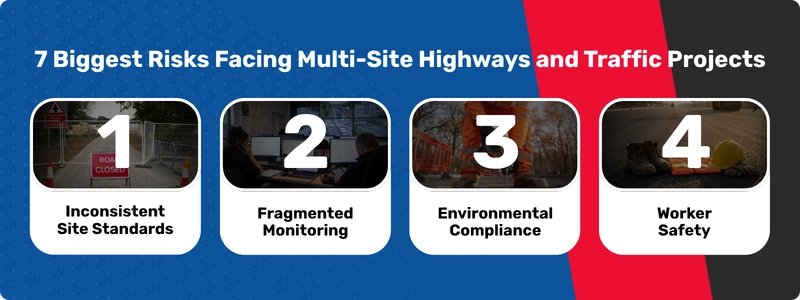
1. Inconsistent site standards
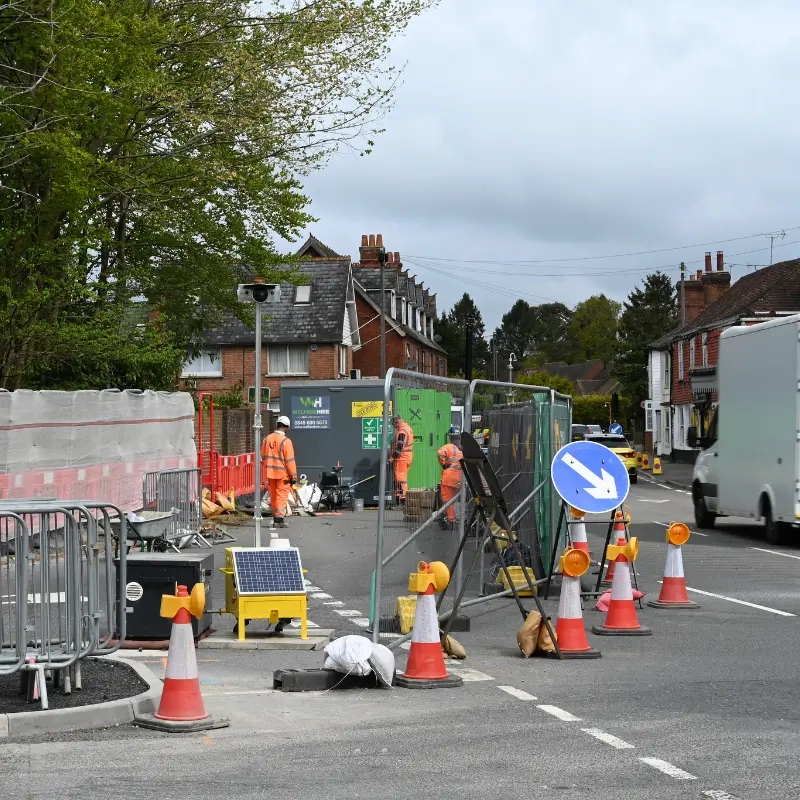
One of the biggest challenges for directors overseeing multiple work zones is maintaining consistent standards across every site. Firstly, the scope of operations varies widely, from a strategic road network upgrade to roadway maintenance or a temporary traffic lights scheme.
Then there are variations in how different teams practise safety, report incidents, control noise, limit pollutants and implement traffic flow management. Inconsistencies multiplied across dispersed locations can be hugely stressful and costly. Contractor directors find themselves involved in unnecessary admin, lengthy investigations, delays and disputes, reworks and public complaints. Not to mention tough conversations with stakeholders.
Varying standards also make it difficult to demonstrate proper quality control to inspectors and compliance practices to regulators.
Monitoring technology solutions
A unified view of operations has become essential to deliver complex, modern projects on time and within budget. Modern cloud-based platforms allow leaders to standardise monitoring and control across every project they run.
Our cloud management platform combines smart software, mobile CCTV, automated alerts and centralised reporting into a single interface. You can view dashboards remotely via an intuitive mobile or web app, wherever you are. Besides verifying that agreed standards are followed everywhere, you receive prompt notification of emerging risks. This allows you to respond proactively, safeguarding sites, crews and the company's reputation.
Our rapidly deployable CCTV systems form the foundation for this remote, real-time visibility across your portfolio:
- Our Traffic Management Towers are designed specifically for traffic management schemes: carriageway works, risky diversions, route closures, road layout redesigns. They can be deployed quickly and operate reliably in locations with limited or poor infrastructure (rural roads, ageing networks).
- For temporary priority zones needing fast, flexible monitoring, our Mini CCTV Towers can be installed by a single person. They can also be repositioned without specialist assistance or a technician on-site. Like the other units, the Mini Tower is solar-powered with 4G/5G connectivity and fully NDAA-compliant.
- Our CCTV Towers can be installed in 20 minutes (for basic setups), delivering high-definition PTZ (Pan-Tilt-Zoom) camera coverage from heights of up to 6 metres. These highly visible platforms also act as a deterrent against theft, vandalism and trespassing.
All our Towers are supported by NSI Gold Accredited remote monitoring partners, with professional operators in control centres responding rapidly to security threats whenever necessary.
2. Fragmented monitoring
In multi‑site highway projects, careful planning and coordination among stakeholders is crucial, but fragmented monitoring often undermines this.
Fragmented oversight sees information gathered and shared via emails, phone calls, spreadsheets, standalone apps and sometimes not reported at all. The result is that communication suffers, risks go undetected and minor issues snowball into major disruptions.
While regular inspections of infrastructure are necessary to maintain highway safety, managers and directors often spend too much time conducting physical site inspections and piecing together scattered reports because field updates are slow and monitoring systems aren't efficiently connected.
The unified monitoring solution
Unified monitoring across all locations provides directors with reliable visibility into conditions and events on the ground everywhere they operate (our platform can consolidate up to 81 camera feeds).
With centralised management, all stakeholders use the same system, reducing duplication and ensuring decisions are based on current, shared and objective information. When everyone works from the same valid datasets, it's easier to manage risks and drive compliance. A shared platform also helps ensure consistent training and guidance across operations.
By connecting our smart detection tools (Smoke and Fire, PPE and Intrusion Detection) and environmental monitoring into the platform, you achieve near-360° project oversight in one place.
3. Environmental compliance
The environmental impacts of highway construction projects include increased noise, dust, airborne contaminants, leaking chemicals and changes in wildlife habitats. Given the far-ranging threats, worksites are subject to strict environmental regulations.
Contractors are required to protect workers from excessive noise under the Control of Noise at Work Regulations 2005, and manage exposure to dust, fumes and gases under the Control of Substances Hazardous to Health (COSHH). The Health and Safety Executive (HSE) sets strict limits for harmful substances and noise, while agencies like the Environment Agency expect project owners to prevent pollutants contaminating surrounding neighbourhoods.
Managing environmental exposures in workplaces that generate huge amounts of noise, dust and fumes is challenging. Without proper monitoring and control systems, it’s almost impossible to stay consistently compliant. For multi‑site operations, the risks and exposures pile up, and the fallout can be severe:
- Regulatory fines, penalties, legal claims and work restrictions are all real-world consequences of poor environmental compliance.
- When crews are subjected to unsafe conditions, the likelihood of serious harm increases. For example, silica dust exposure can lead to lung cancer in highway workers.
- Higher rates of occupational harm and injury result in higher workers' compensation claims.
- During projects, noise levels can easily reach 80 decibels (approaching harmful levels), affecting not only workers but also local residents and pedestrians.
- Eco hazards and disturbance often trigger complaints from concerned surrounding communities.
Environmental monitoring solutions
Our CCTV systems and cloud platform can integrate advanced IoT-based environmental sensors that track noise, dust and harmful emissions in real-time. This allows you and your site managers to better manage environmental safety and compliance.
- Noise Monitoring Sensors: IoT-enabled sensors and connected cameras continuously monitor and report when workplace noise approaches legal and/or unsafe limits. Sensors measure decibel levels (30dB to 130dB) and frequency range (20Hz to 12.5kHz) during the hours you set and raise alerts to ensure compliance. The platform stores up to 180,000 timestamped logs for trend analysis and to support complaint handling and compliance.
- Air Quality Sensors measure dust, TVOC, particulate matter (PM1, PM2.5, PM10), CO₂, carbon monoxide and other airborne contaminants affecting the site. The system alerts managers when conditions approach thresholds, allowing teams to act to prevent violations, penalties and health issues.
- Weather Monitoring Sensors: Adverse weather conditions can increase hazards in highway construction and maintenance. To manage this danger, our Weather Monitoring Systems capture location climate data, including temperature, wind (speed and direction), rainfall and dew points. Site-specific weather updates, more precise than local bulletins or general forecasts, enable managers to respond to changing conditions proactively (e.g., introducing berms and sandbags, ensuring crews have waterproof PPE for wet weather). Timestamped weather data helps explain and justify climate-related work stoppages and adjustments to owners.
Read more:
4. Worker safety risks
As mentioned, inconsistent safety standards can arise when numerous crews work across different sites. Projects bring together multiple teams and subcontractors, each with different performance and supervision levels. The associated risks of this situation include:
- Supervision and visibility gaps: With multiple subcontractors spread across busy sites, appropriate supervision is often absent. And we know that unsupervised teams are more likely to take shortcuts and breach safety compliance
- Personal Protective Equipment (PPE) violations: Weak enforcement of PPE use (hard hats, high visibility clothing, safety boots, goggles, face masks, etc.) leaves workers vulnerable to a range of hazards. The risks of accidents and injuries from collisions, falling objects, noise, dust and toxins all increase when safety gear protocols aren't followed.
- Vehicle incursions: Roadworks next to live traffic expose crews to collisions when barriers and signage fail and/or drivers don't heed warnings. Construction also impacts public safety by altering traffic patterns and increasing noise and uncertainty.
- Air pollutants: Excessive dust, fumes, vapours and other chemical contaminants pose serious worker and public safety hazards if not properly controlled.
- Hot work: Cutting, grinding and welding activities introduce fire and explosion dangers, especially around flammable materials. Weak fire prevention procedures increase the threat.
Monitoring solutions
Temporary traffic management strategies should create safe buffer zones between workers and traffic, while speed limits in construction zones should be clearly posted and enforced. By reviewing live and recorded footage from Traffic Towers, directors can check that these measures are in place.
Automatic Number Plate Recognition (ANPR) can be integrated into our Traffic and CCTV Towers to record all vehicles entering and exiting work zones. Tracking vehicle movements and speeds strengthens access control, reduces incursions, reinforces speed limits and encourages overall safer driving.
As CCTV integrations, our PPE Monitoring and Smoke and Fire Detection use AI analytics to detect and alert teams to PPE and fire risks. Actively monitoring and managing these risk areas reduces accidents and fire damage, ensuring safety and demonstrating professional control. All PPE and fire incidents are logged to support compliance, investigations, insurance claims and reviews.
Environmental monitoring of noise, air quality and weather conditions helps teams work safely and compliantly. The tools create reliable data logs to verify complaints, manage compliance and report delays to stakeholders.
Read more:
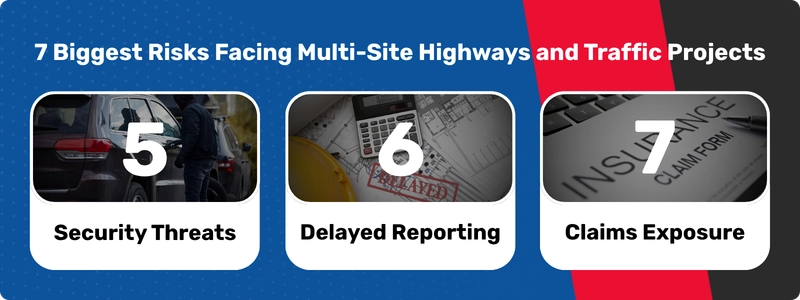
5. Security threats
Security breaches on road projects are a serious and ongoing risk for directors. Both petty criminals and Organised Crime Groups (OCGs) target valuable equipment, materials, fuels and metals on worksites. The cost extends beyond the initial financial loss. Delays waiting for replacement materials and equipment can severely impact profit margins, and the losses pile up when multiple sites are affected.
Physical barriers, traditional guard patrols and basic cameras are usually inadequate protection. Most perimeters can be breached, guards can't be everywhere at once and low‑tech cameras without live backup frequently fail to deter intruders.
Security monitoring solutions
To safeguard multi-site operations, smart professionals are investing in centralised monitoring solutions with automated detection and real-time alerts (together with adequate lighting and solid perimeter fencing).
- Our Intrusion Detection Systems are deployed on our CCTV Towers and connected to NSI Gold-Accredited control centres. Here, security professionals oversee all locations to protect assets 24/7. AI identifies suspicious movements and behaviours and raises near-immediate warnings, activating some immediate deterrents. Operators then intervene decisively, via:
- Live voice warnings and strobe lights
- Calling police when the situation demands it
- Our optional Mobile Keyholding service will send a mobile keyholder to investigate the alert.
- ANPR strengthens security by tightening access control and vehicle movement. This reduces risks related to unauthorised entry, accidents, theft and reckless driving. System-generated incident logs and video assist investigations, compliance, disputes and reviews.
6. Delayed reporting
When something goes wrong on highways and traffic sites and is not promptly communicated to the relevant team, the situation almost always worsens.
Minor issues escalate: A delay in identifying workers handling chemicals without protective gloves might seem like a minor oversight, but the lapse could result in skin injuries or burns. Beyond the direct harm, workflows are disrupted, compensation claims arise, valuable management time is spent on additional reporting and regulatory investigations might follow.
Operational disruption: Without timely reporting of weather/environmental risks, fire indicators or a security threat, managers can’t quickly redeploy crews or bring in emergency support. Failure to intercept containable issues early means they are more likely to turn into major events.
The impact of a fire, equipment theft, flooding or serious gas leak could shut down the entire site. Associated risks of operational disruption include missed deadlines, expensive idle time, contractual penalties and knock‑on effects across multiple subcontractors.
Financial penalties: Weak visibility and reporting mean workplace infractions, such as noise or air quality violations or PPE non-compliance, go unnoticed until regulators step in. This exposes contractors to fines and potential legal action, including project shutdowns until corrective measures or investigations are concluded.
Monitoring and reporting solutions
Incident monitoring that relies on physical inspections, sporadic data readings and manual processes will always be reactive and delayed. The smarter approach is automated detection, data-backed reporting and real-time alerts, controlled from a central platform. This way leaders can utilise:
- CCTV for live visibility and recorded video to track incidents.
- PPE Detection to reduce PPE non-compliance and safety incidents.
- Fire Detection to proactively combat fire dangers.
- Environmental monitoring to better manage weather disruptions, noise and emission risks.
7. Claims exposure
The high-risk, high-stakes nature of road projects means sites are almost always exposed to claims risks. Without reliable audit trails of events, this exposure increases, and liability becomes harder to challenge. Below we highlight common claims that arise and how evidence gaps worsen your position:
- Worker injury claims that could be defended with clear video footage of the incident.
- Fines for environmental violations when exposure limits weren’t properly documented.
- Rejected insurance claims because no logs or videos are proving proper security and safety measures were in place.
- Contractual penalties tied to missed deadlines. Often these can be mitigated with concrete evidence justifying delays (e.g., records of unsafe weather conditions).
- Public complaints that escalate because there is no documentation to dispute the public's version of events.
Technology solutions
Smart monitoring platforms close the evidence gaps and strengthen your defences. CCTV with integrated add-ons (intrusion detection, PPE compliance, ANPR tracking and weather/environmental sensors) creates a consistent record of all events across every site.
Video footage, timestamped data logs and reports are securely stored in one location: our central cloud platform. If you need to retrieve a record to defend a claim or resolve a dispute, it's available at the push of a button.
Control Multiple Projects Confidently with WCCTV's Smart Central Monitoring
Relying on different monitoring tools and reporting methods to oversee multi-site operations exposes your company to severe risks, from crew fatalities to environmental damage and even bankruptcy. Today's fast-developing projects demand modern monitoring solutions that standardise strong controls across busy portfolios.
WCCTV's smart central platform helps contractor directors oversee critical safety, security and environmental responsibilities everywhere they operate. Advanced visibility and evidence-led control ensure managers lead with confidence, execute on target and position their companies for sustainable growth.
Contact us today to discuss centralising project monitoring through our cloud platform and lead with confidence and vision.
