High-stakes highways projects regularly lead to claims and disputes among clients, principal contractors, subcontractors and other stakeholders. Directors managing multiple works contracts must acknowledge this reality, but they should also take proactive measures to limit the risks.
Advisable strategies here include strong communications, clearly-defined contracts, consistently maintained records and mechanisms for identifying trouble early. Too often, records are scattered across different systems and performance oversight is weak. When leaders can't clearly see and prove what happens on the ground, it's difficult to defend claims and disputes with confidence.
Smart monitoring and detection systems integrating CCTV and centralised reporting allow contractors to catch issues early and maintain a full audit trail of critical events across all locations. In this article, we cover 6 common causes of UK highways project claims, and explain how centralised, cloud-based risk management and record-keeping limit liability and protect your company's earnings.
6 Causes of Project Claims and How to Prevent Them
Below, we break down 6 reasons claims arise on highways projects and highlight monitoring solutions that help prevent claims through better operational oversight.
1. Delays and disputes around responsibility
Highways projects and critical work phases are subject to contractual completion dates, and technical specifications for work must meet strict safety requirements. Missed deadlines due to delays or defects are a common source of claims, particularly when the parties disagree about what caused the issue. A wide range of disruptive factors might have contributed:
- Adverse weather (nearly 40% of UK site managers report bad weather has resulted in project delays and financial losses)
- Defective work that doesn't meet quality and/or safety standards requires rework
- Late arrival of materials, or availability challenges
- Subcontractors fail to complete tasks on schedule
- Regulatory enforcement action temporarily stops or restricts work
- A client instruction changes the project scope
When claims are made, the questions become: was the delay avoidable, and who should be accountable? Without reliable records, it can be hard to prove whether the holdup was caused by the client, main contractor, subcontractor, an external event or a combination of factors.
New Engineering Contract (NEC) guidance stresses the value of accurate visual and project records in assessing delays, so it's worth discussing how modern monitoring solutions improve project records.
How tech-enabled monitoring helps prevent delay disputes
High-definition CCTV systems offer continuous visibility into works operations, helping leaders establish how a delay occurred and making it easier to resolve disputes. Rapidly deployable CCTV ensures problems such as poor performance and compliance breaches are identified and addressed early. Advanced oversight also supports remote quality checks, limiting conditions that create rework.
Our solar-powered CCTV Towers, Traffic Management and Mini Towers deliver high-definition video coverage of work environments as diverse as major highway upgrades, temporary traffic schemes and rural road maintenance. Systems come with secure, user-friendly software for viewing footage, managing cameras and sharing video files.
As an optional integration to our Towers, Weather Monitoring Sensors provide an objective record of conditions that affected work plans (temperature, humidity, wind, rainfall, dew point). Rather than relying on conflicting accounts of weather disruptions, you can compare recorded conditions against site activity to explain weather-linked disruptions.
CCTV and Traffic Management Towers with add-on Automatic Number Plate Recognition (ANPR) log vehicle movements and arrival times and verify when delivery vehicles entered the site. This confirms if materials arrived on time, and can help identify where a delay originated.
Our dedicated cloud-based management platform stores timestamped video, sensor data, logs and reports from up to 81 cameras in a central system. When dealing with delay-related claims, you can access the relevant records and send copies with the push of a button.
Read more:
- How to Monitor Temporary Roadworks Without Permanent Infrastructure
- Mobile CCTV for Short Term Road Safety Projects
2. Evidence gaps
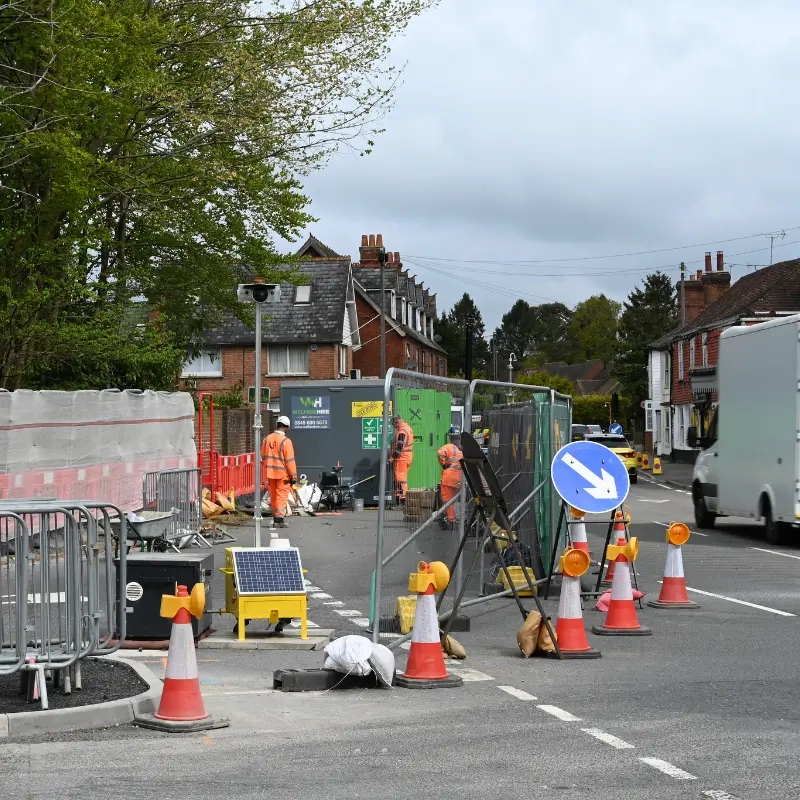
A [lack of visibility] and weak evidence often makes claims more expensive and difficult to resolve, regardless of who is responsible. Claims resolution processes include negotiation, mediation, arbitration or litigation. To make their arguments, legal teams or adjudicators look for reliable, documented proof of what happened.
When your evidence is stitched together from emails, message threads, standalone reporting tools, unlinked spreadsheets and paper logs, it's easy for opposing parties to poke holes in it. This often leads to difficult negotiations and soured business relationships. Not to mention wasted management time and thousands of pounds in solicitors' fees.
This goes to show the importance of maintaining strong, consistent records across all projects. Timestamped video footage, accurate data logs and factual incident reports provide hard-to-contest evidence of events. When navigating contentious issues, this documentation goes a long way to secure easier, more favourable settlements.
How tech-enabled monitoring platforms help
Centralised monitoring platforms close the evidence gaps and strengthen your defences. CCTV with integrated add-ons (smart detection and environmental monitoring tools) consistently records all events across every site. When these events and data are captured directly into a central management platform, you have an automatic record of all incidents with no breaks in the evidence chain.
Our dedicated cloud-based monitoring platform offers this capability, enabling leaders to access objective, current information in smart, unified dashboards. Your evidence includes timestamped video, data logs, alerts and incident reports, creating a very reliable digital audit trail.
Our platform uses AES-256 encrypted cloud storage to house all records safely, ensuring authorised users can easily and securely retrieve files from any connected device whenever needed.
Read more:
3. Personal injury claims
Highways and traffic management schemes are high-risk environments, with construction activity often taking place alongside live traffic, pedestrians and local neighbourhoods. This creates personal injury hazards to both workers and the public.
Around 50,000 construction employees sustain on-site injuries every year. Health and Safety Executive (HSE) guidelines warn that members of the public can be killed or seriously injured by construction operations, and recommend keeping people away from work areas wherever possible.
Common examples of accident risks on highway projects are:
- Unclear separation between commuters and working trucks and machinery
- Dangerously positioned barriers, posing a risk to drivers
- Poorly signed trenches, excavations or potholes
- Unsafe demolition works
- Slips, trips and falls, the leading cause of workplace injuries
- Collisions between crews and work/ public vehicles
- Preventable worksite fires
Injuries suffered can lead to liability claims and damage costs, although claimants don't have an automatic right to compensation under law. Employees must show that their employer breached their HSE duty of care or acted negligently. The public must similarly prove negligence by the construction firm.
If you, as the contractor, can show that they were aware of the hazard and took reasonable steps to mitigate it (backed by supporting evidence/documents), you usually have a solid defence against personal injury claims.
How tech-enabled monitoring helps
ANPR solutions help reduce traffic incursions into work zones and flag unauthorised vehicles and those exceeding speed limits. CCTV offers a big-picture view of traffic and safety controls, and integrated PPE Monitoring ensures crews are wearing appropriate protective gear (e.g., high-visibility vests in busy traffic channels).
Our CCTV with integrated Smoke and Fire Detection employs AI-video analytics to spot the early traces of smoke and fire near-instantly. Automatic alerts enable teams to respond rapidly to prevent fire damage to traffic control and other assets or injuries that could spark claims.
Read more:
4. Environmental issues
Environmental issues have become a major cause of complaints and claims on modern highways and traffic projects. Noise, dust, fumes and other potentially harmful emissions are unavoidable on active worksites, but failure to manage these hazards can result in:
- Prosecution and penalties
- Regulatory enforcement actions
- Liability claims
- Intensified inspection and scrutiny
Under the HSE's Workplace Exposure Limits, employers have a statutory duty to safeguard workers from excessive dust, fumes, vapours and other toxins. The UK's Environment Agency expects project owners to ensure construction noise and hazardous materials don't endanger or disturb the public. The Control of Noise at Work Regulations 2005 also require that employees be protected from excessive sound levels.
Residents and businesses exposed to loud noise or dangerous chemicals in their air or water can seek compensation for alleged damage or injury. Regulators can also impose stiff financial and legal penalties for environmental violations. For context, in 2024, the Environment Agency brought 168 prosecution cases, 98 of which resulted in fines totalling £3.8 million.
How tech-enabled monitoring helps
Our IoT-based environmental monitoring solutions help you track and manage noise and airborne pollutants effectively across traffic schemes, such as live-carriageway work zones and diverted routes.
Air Quality Sensors continuously measure location dust, particulate matter, chemical fumes and other airborne contaminants. Traffic management leaders set exposure limits, and when conditions reach thresholds, teams are notified so they can act to prevent breaches. Active control of air quality ensures road users and workers aren't negatively impacted by dust, toxins, etc.
Noise Monitoring Sensors record noise levels on all traffic and highways schemes (across ranges of 30-130 decibels and 20 Hz-12.5 kHz frequency). Alerts are generated when preset thresholds are reached, protecting everyone at and around the location, while avoiding regulatory issues.
Read more:
- What are Environmental Monitoring Sensors?
- IoT Environmental Sensors for Traffic Management: Benefits for Highway Projects
5. Compliance breaches
Compliance failures prompt claims when a breach of contractual, health and safety, environmental or traffic-management requirements compromises delivery and/or causes loss.
Breaching HSE-enforced PPE standards opens the door to several risks. When workers don't use appropriate safety gear (hard hats, high-visibility clothing, safety boots, goggles, face masks, etc.), they are more vulnerable to occupational hazards. Accidents and injuries from collisions, falling objects, noise, dust and toxins become more likely. This, in turn, increases the risk of delays and injury claims.
When a site fails to implement the required Chapter 8 traffic-management arrangements, operations may be stopped until the controls are put in place. If the contractor believes the disruption was due to another party's actions (e.g., a subcontractor), the resulting dispute can easily end up in court.
As highlighted in the previous section, exceeding the applicable legal limits for environmental hazards also has severe legal and financial repercussions.
How tech-enabled monitoring helps
CCTV coverage of traffic schemes allows managers to log into the platform remotely and view live and recorded footage to check that project teams are adhering to Chapter 8 and other compliance requirements.
Our PPE Detection with AI-powered cameras identifies and flags when workers enter a high-risk or restricted zone without the required PPE protection. Automated alerts remind non-compliant workers and allow site managers to investigate and address issues before they escalate into a liability.
Environmental monitoring sensors allow you to minimise potential liabilities arising from dangerous weather conditions, air pollutants and noise hazards.
Read more:
6. Security incidents and liabilities
Theft and vandalism are widespread on UK highways projects and directly impact operational costs. Criminal activity and unauthorised access can also introduce several indirect losses and claims.
When vital equipment is stolen or damaged, a project might stall pending replacement or repairs. Knock-on delays could lead to missed deadlines, triggering contractual penalties.
A construction company can face a public liability claim from a trespasser injured by a hazard on-site (e.g., an unmarked excavation). Note that though this claim is allowed under the Occupiers' Liability Act 1984, the courts are not always sympathetic to trespassers who entered a property/site "illegally".
Highways insurance claims in relation to theft or damage can also get complicated. There are often disputes over who was responsible for preventing or managing the risk (the contractor, client, highways authorities or the security provider). The process is dragged out while the incident is investigated, and your claim could ultimately be denied due to poor security controls, leaving you out of pocket.
How tech-enabled monitoring helps
Our fully-managed security services incorporate night-vision CCTV and support our Intrusion Detection Solutions. The system uses AI analytics to analyse live video for criminal or suspicious behaviours. Upon spotting a threat, it initiates immediate deterrents and alerts selected contacts. The service is backed by NSI Gold-Accredited remote monitoring partners who activate voice challenges and light warnings to safeguard assets and prevent loss claims before incidents escalate.
Depending on the intervention level required, you can add our Mobile Keyholding Service, where licensed professionals attend the location to investigate.
ANPR strengthens access control, preventing unauthorised entry and alerting to suspicious circling vehicles. Tight controls play a valuable role in reducing vehicle damage and theft, while incident reports logged in the cloud platform simplify insurance claims.
Read more:
Protect Yourself From Highways Claims with Smart Project Monitoring
Whether you're in dispute with a local authority, subcontractor or insurer, without reliable evidence you face an uphill battle securing a favourable outcome. Frequently, companies and key directors become distracted by stressful legal processes and emerge with nothing but bruised reputations and hefty bills.
Consistent project monitoring, timestamped records and centralised evidence management help to avoid these outcomes. Cloud-platform oversight and consistent records strengthen your ability to defend claims, prove compliance, and protect margins across multiple contracts.
For over 2 decades, we have offered CCTV and smart monitoring solutions to help contractors gather the essential intelligence and evidence needed to deliver successful highways projects, while limiting commercial risks.
Protect yourself from claims. Contact our team today to discuss integrated monitoring solutions for confident, clear-eyed control of all your undertakings.