For directors managing multi-site roadworks projects, reliable visibility into every site and a unified view across the portfolio is essential. Without complete visibility, dangerous blind spots and performance gaps can emerge, threatening project delivery and profitability.
Many contractors still rely on disconnected monitoring systems: separate spreadsheets, standalone tools, old email threads, manual paper logs. The problem with these disconnected systems is that they slow decision-making, increase operational costs and drag down performance. What's more, each undetected vulnerability and inefficiency can potentially lead to a [major risk] that affects the entire business.
In this article, we cover the hidden costs of disjointed monitoring on traffic projects and how fragmented oversight threatens your company's bottom line. We discuss how connected systems that combine CCTV, environmental monitoring and smart reporting within a cloud-based platform strengthen and simplify oversight across operations.
What are the Hidden Costs of Disconnected Monitoring Systems on Roadwork Projects?
Below, we discuss the main costs and consequences of disjointed systems when monitoring multi-site traffic and road network schemes:
Fragmented data and reports
When systems don't speak to each other, it's impossible to gain a unified view of operations. Information is spread across email threads, siloed tools, paper logs, spreadsheets and inconsistent site reports. Besides fragmenting and complicating oversight, overall data quality is reduced.
When contractor directors are compelled to make urgent decisions based on outdated, unreliable and/or incomplete information, it can lead to costly mistakes, inaccurate executive reporting and flawed strategies. Studies show around half of respondents believed bad data contributed to poor outcomes in 1 in 3 decisions. Owners and field teams quickly lose confidence in project leaders who regularly make misguided decisions.
Higher incident and accident rates
Disconnected monitoring leaves visibility gaps and blind spots within both individual sites and the larger portfolio. Without tight, consistent control, it's incredibly difficult to proactively prevent accidents. Instead, teams operate reactively, reporting injuries, asset loss or traffic incursions after the fact.
The costs of slow reaction times are high. Worker injury rates increase, equipment is damaged more often, compliance is weak and public complaints, often amplified by social media, are loud. The company's reputation suffers, and regulatory penalties and investigations consume management time and shrink margins.
Near misses often go unrecorded, making incident data incomplete and misleading. The stats might indicate a site is safer than it actually is, allowing unchecked hazards to recur until a disaster happens. For example, a slow, unchecked gas leak eventually causes an explosion.
Increased admin overheads
Weak and fragmented visibility places an extra burden on directors who constantly feel that serious issues could be developing on sites "behind their back".
Project leaders often spend considerable time travelling to conduct physical inspections, verify compliance or chase delayed updates. Investigations are lengthy exercises, piecing together scattered information, subjective accounts and double‑checking facts and figures.
Directors may deal with conflicting reports that lead to confusion and erode trust in the data before them. Stakeholder reporting becomes stressful and time‑consuming as everything must be double-checked to ensure accuracy.
According to McKinsey Global Institute research, the heavy administrative drag is part of the reason global construction productivity has grown by only 1% annually over the past 2 decades, compared to 2.8% for the global economy.
Compliance breaches and regulatory penalties
Clients and regulators expect proof of diligent safety and environmental practices. Without a central record of timestamped logs, video footage, and incident reports, demonstrating regulatory compliance across multiple locations can be challenging.
On an active roadworks project, uncontrolled noise, air pollutants and missing PPE leave contractors potentially exposed every day. Unless your monitoring system accurately identifies compliance issues and raises automatic alerts, breaches can go unnoticed until an inspector arrives on site. By then, it's too late, and depending on the severity of the transgression, contractors could face regulatory fines, further inspections, work restrictions and even shutdowns.
Ultimately, compliance challenges increase due to fragmented data, and the costs of violations can be steep.
Read more:
Evidence gaps
Project managers routinely receive complaints about excessive worksite noise or reports about teams performing dangerous hot work near flammable materials. But a lack of available evidence means the issues aren't decisively addressed, increasing the likelihood of accidents, damage and fines.
Unseen incidents and evidence gaps weaken several processes, including:
- Client and public complaints because managers don't have enough information to respond transparently and authoritatively.
- Performance and safety reviews due to the lack of video footage (e.g., a fire incident) or relevant data (noise readings) to support meaningful discussions and encourage improvements.
- Disconnected monitoring systems and silos can hinder the adoption of AI and machine learning, potentially holding back productivity and profit gains.
Difficulty defending claims
Contractor directors often lose money because they lack the proof to defend themselves in liability and claim situations. Insurance disputes, workers’ compensation demands, environmental damage claims and regulatory investigations all require strong evidence to argue your position. Favourable outcomes are less likely when you're dealing with inconsistent, incomplete documentation.
On top of that, directors often spend valuable management time in court cases and disputes, rather than focusing on their core mission: delivering successful projects on time, within budget, and without exposing the business to unnecessary claims or reputational damage.
Read more:
Inconsistent operational standards
When systems are fragmented, standards vary widely across teams, project managers and subcontractors. Some operate to professional standards consistently; others perform well some of the time, while a certain percentage always falls short.
To bring everyone at every site up to standard requires clearly documenting expectations and then verifying that the agreed processes, including reporting, safety management, quality standards and project data sharing, are all followed. However, if your existing system is fractured, it's nearly impossible to scale consistent best practices, which is so crucial to operational and business success.
What a Unified Project Monitoring System Actually Looks Like
While disconnected systems are still common in industries like construction and manufacturing, contractors are increasingly adopting smart unified monitoring solutions.
Modern cloud-based platforms can consolidate several functions and reporting tools in one place. Our dedicated cloud platform connects CCTV, environmental monitoring, incident reporting and project data into secure central dashboards. This integrated safety and security solution provides directors with a big-picture view of events across their portfolios.
Key components of this integrated solution include:
- Deployable mobile CCTV units that can be rapidly installed, scaled and repositioned across work sites and traffic projects (usually on temporary deployments).
- Cloud services that scale easily, ensuring data is accessible, secure and standardised.
- Automation and AI analytics that reduce manual processes (including manual data entry that increases the risk of human error). AI analytics detect risks near-instantly and provide actionable insights to inform better, faster decision-making.
Here's a snapshot of how these elements work together:
|
Component |
What It Does |
Efficiency Wins |
|
CCTV and IoT sensors |
Cameras deliver live and recorded evidence of site activity, incidents and compliance. IoT sensors measure weather and environmental variables (noise, air quality). Mobile units can be deployed flexibly and quickly across projects. |
Reduces reliance on manual inspections; creates defensible video and data records for safety compliance and claims. |
|
Central platform |
Integrates CCTV feeds, security monitoring, environmental tracking, incident logs and project data into one cloud‑based system. |
Eliminates fragmented reporting; ensures standardisation and consistent oversight across all sites. |
|
Automation and AI analytics |
Detects defined risks (e.g. environmental breaches, traffic incursions, trespassing) and triggers near-instant alerts. |
Cuts response times, supports human verification and enables proactive risk management. |
|
Cloud services |
Securely stores data, scales across multiple sites and provides seamless platform access for authorised users. |
Offers quick information access to all users on mobile or desktop. Plus easy scalability, encrypted record storage and simplified reporting and sharing. |
These components all work together to support a better, faster, more secure monitoring setup. Cloud connectivity lets you review video footage, sensor data, AI alerts and incident reports in the central platform. This remote visibility, from anywhere with an internet connection, provides the actionable insights you need to manage operations without being physically present.
Read more:
4 Benefits of Consolidated Monitoring for Roadworks Projects
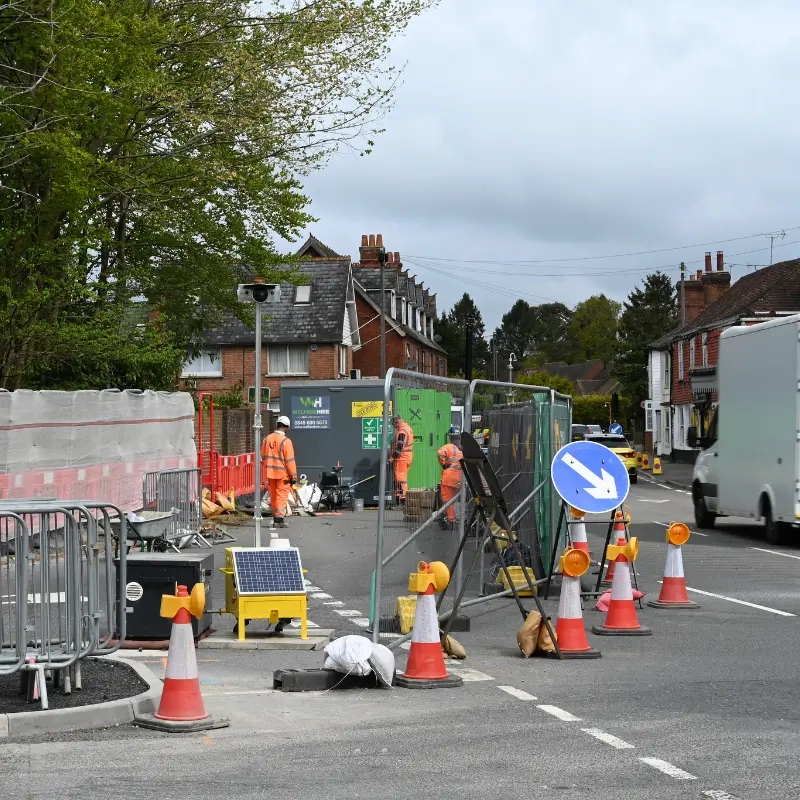
Consolidating cameras/sensors and safety, security and environmental tracking within an integrated platform eliminates vendor sprawl and the cost and complexity of juggling multiple tools.
Some of these advantages include:
- Total operational visibility: Unified dashboards give you complete insight into every active and remote site. Standardised reports and actionable intelligence inform better, faster data-driven decision-making across all schemes.
- Proactive risk prevention: Live video and sensor data and automated AI alerts help you catch issues early. This proactive oversight enables your teams to take appropriate action, preventing issues from escalating expensively.
- Defensible evidence: Secure, timestamped audit trails and data/video evidence put you in a strong position to challenge unreasonable claims, resolve disputes and prove regulatory compliance.
- Consistent, scalable standards: A uniform, scalable model makes it easier to apply best practices, streamline workflows, allocate resources efficiently and protect profit margins across all roadworks.
Integrated Solutions for Advanced High-Level Monitoring of Highways
Our smart monitoring tools and custom software help contractor directors manage multiple sites from a secure cloud platform. It can integrate several solutions (security, safety, environmental monitoring, project oversight) and up to 81 camera streams into a central control hub.
For each solution, you can customise monitoring zones and set thresholds based on worksite rules and regulatory standards. By proactively reviewing video feeds, alerts and insights through a mobile or web app wherever you are, you're able to remotely manage multiple monitored environments and responsibilities.
Below, we highlight the integrations offered, depending on your operational needs.
Mobile CCTV surveillance
Fully portable CCTV towers and Traffic Management towers with 4G/5G connectivity offer rapid visibility into temporary or longer-term undertakings, from major infrastructure upgrades to traffic projects to emergency schemes.
- Our highly visible yellow CCTV Towers, standing up to 6 metres tall with PTZ infrared night vision cameras, can be installed in less than an hour (basic setups). They deliver clear HD images day and night and also act as a deterrent against trespassing, crime, fly-tipping and other anti-social behaviours.
- Offering similar HD clarity, our compact Mini CCTV Towers can be set up by one person and repositioned without needing an engineer on-site. This makes these units extremely versatile surveillance options.
With solar energy (and battery backup), these NDAA-compliant units work dependably 24/7, even in rural areas without power or internet.
As mentioned, our platform takes in up to 81 camera feeds, with project data and video securely protected with AES-256 end-to-end encryption. It's worth noting that cybersecurity vulnerabilities are common in disconnected systems because poorly managed storage (different servers, files, apps) offers numerous attack surfaces.
Environmental monitoring sensors
Our platform can integrate IoT-based environmental sensors alongside our CCTV Towers. These tools let you to efficiently manage noise, weather, dust and other pollutant risks around works and traffic projects.
- Noise Monitoring Sensors: Measure ambient sound on worksites and send alerts before decibel levels approach safe limits. This helps you manage legal compliance and maintain safe working conditions, while limiting complaints, regulatory penalties and enforcement actions.
- Air Quality Sensors: Measure dust, fine particulate matter, CO₂, TVOCs and carbon monoxide (CO) to help your teams control airborne pollutants. This oversight protects workers, supports ESG and limits out-of-pocket fines and damage claims.
- Weather Monitoring Sensors: Provide updates on wind, rainfall, humidity, and temperature fluctuations to help you plan for hazardous conditions. Data-backed evidence allows you to implement protective measures to safeguard assets and adjust schedules to minimise delays because of adverse weather.
These automated systems keep a clear audit trail of incidents, which saves time and money when it comes to completing compliance and sustainability audits.
Read more:
Smart detection systems
As optional integrations into our Towers, Smart Detection Systems use AI analytics to recognise common construction hazards (security breaches, fire, PPE violations). The AI is trained to filter out false triggers (wildlife, debris, dust, shadows, steam, machinery emissions/smoke) to minimise unnecessary alarms.
- Intrusion Detection Systems: To protect your assets, our Intrusion Detection Systems with AI analytics analyse footage and alert selected contacts when they identify unauthorised access, vandalism or theft attempts. The system is backed by NSI Gold Accredited remote monitoring partners who verify alerts on the feed and issue live audio challenges to warn off intruders.
- PPE Monitoring and Detection: Active, consistent PPE reinforcement helps build a stronger safety culture; it also reduces preventable costs such as worker injuries, fines and compensation claims. Our PPE Monitoring systems spot and notify managers if crews aren't wearing the required protective gear, and can also alert the transgressing crew members.
- Smoke and Fire Detection Systems: Quickly and reliably identify fire signatures such as smoke trails, flickering light and colour pattern changes. The system generates quick alerts so that crews can respond swiftly to tackle fire dangers. It performs better in external environments than traditional fire alarms, which often experience device/sensor failure due to the open space (or wind blowing smoke away from the device).
- Automatic Number Plate Recognition (ANPR): To tighten access control, ANPR uses HD cameras with AI imaging to classify and track vehicle movements with high accuracy. This real-time monitoring helps prevent unauthorised access and reduces collisions, vehicle damage and injury.
Timestamped visual evidence and reports of fire, PPE and intrusion events are retained in the platform's cloud storage to assist investigations and defend claims.
Read more:
- AI-Powered Risk Detection: Smoke, Fire and PPE Compliance
- How Artificial Intelligence is Revolutionising CCTV Tower Monitoring
Explore Integrated Monitoring Platforms to Improve Control
Contractor directors trying to monitor multiple roadworks and traffic projects with disconnected systems pay a heavy price: flawed reporting, higher incident and accident rates, compromised compliance, liability claims, reputational damage and job stress.
Managing operations through a cloud platform combining CCTV, AI-powered detection, IoT-based sensors and standardised reporting allows leaders to move from reactive firefighting to proactive management. Directors who actively protect their teams, while defending the company’s reputation and driving profitability, become respected and valued leaders.
If your current system exposes vulnerabilities or falls short of your standards, contact our team today to find integrated monitoring solutions with the right tools to power up highways and traffic project oversight.