
Contractor directors overseeing multiple projects need a consistent view of what is happening at every traffic project site. Monitoring performance with a standardised approach is essential for understanding the big picture and delivering portfolio success.
Without standardised controls, vital reporting is often delayed, fragmented and difficult to compare. This compromises decision-making, safety, operational efficiencies, compliance and profitable delivery. Fragmentation also means that small problems that might be identified quickly on one project can go unnoticed on another, creating expensive risks and eroding margins.
Understanding how inconsistent monitoring affects project performance helps leaders identify where stronger oversight with joined-up systems can strengthen management. Our article highlights the common operational costs of tracking performance using disconnected systems, and explains how a unified monitoring platform provides consistent, reliable intelligence that boosts operational performance.
7 Performance and Operational Risks of Inconsistent Site Monitoring
Below, we take a closer look at 7 common areas where disjointed monitoring negatively impacts portfolio performance.
1. Weak visibility into site activities
Managing multiple traffic and highways projects successfully means knowing what's happening at every site throughout the workday. Without a clear understanding of conditions on the ground across your portfolio, performance and safety lapses can catch you unaware at any time.
When overseeing multiple teams and subcontractors, physical walk-arounds can't cover all bases, and supervisors are often distracted by numerous competing priorities. This leaves blind spots where unsupervised crews may take shortcuts, such as ignoring PPE rules, using equipment unsafely or completing a task to poor quality standards.
When these issues aren't caught early, it's harder to prevent avoidable loss, damage or unnecessary rework. Minor blind spots can turn into major incidents, and the fallout compounds across your portfolio. Operations are disrupted, and managers get pulled into stressful investigations instead of driving performance. The result: Delivery, margins and professional reputations suffer.
2. Worker and public safety risks
Unaligned safety standards across highway network projects create significant risks for both construction personnel and the public. When project managers can't enforce consistent safety practices, hazards are easily overlooked and compliance slips.
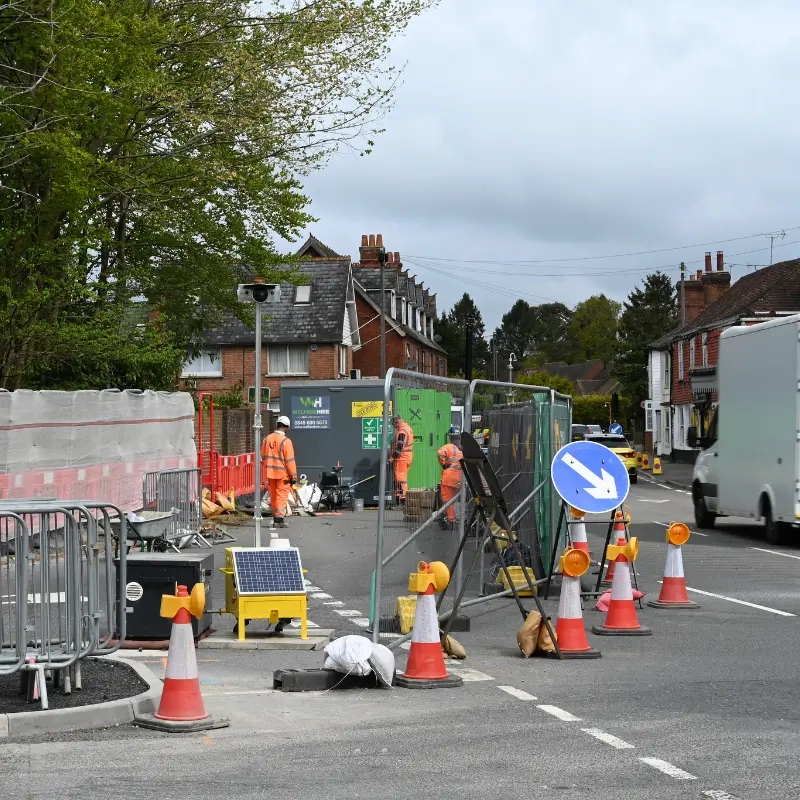
Active work zones near live traffic expose crews to collisions when barriers fail, or drivers disregard signs/traffic signals. Weak PPE reinforcement makes workers more vulnerable to collisions, falling objects and environmental hazards.
Construction work produces high levels of noise, dust, fumes, vapours and chemical contaminants. If these aren't controlled within local authority and regulatory limits, they present health risks to crews, road users, pedestrians and residents.
Near misses (e.g., hot work near flammable materials) frequently go unrecorded, creating a false impression of project safety. Meanwhile, traffic congestion around the site can delay emergency services, heightening risks.
3. Operational inefficiencies
When reporting standards and monitoring approaches vary widely across construction sites and traffic schemes, it creates additional admin and operational inefficiencies.
Without a clear overview in a central platform, directors must juggle multiple tools and face the stress of never knowing where the next performance bottleneck may develop. To avoid unpleasant surprises, leaders often spend considerable time travelling to track project progress, verify work standards, check compliance and investigate incidents.
When something does go wrong, investigations become lengthy processes in piecing together subjective accounts and scattered records.
Inconsistent data collection and incomplete reports also undermine confidence in worksite documentation. Directors waste valuable time double-checking information before making decisions or reporting to stakeholders. Managing key performance indicators, public complaints and operational reviews also becomes more strained.
Lastly, disjointed oversight makes it impossible to scale best practices across your portfolio, holding back business efficiencies and success.
4. Compliance breaches and regulatory pressures
Without active management, enforcing and proving compliance on traffic management schemes is a major challenge. Even short-term projects are governed by various government and local regulations.
Contractors are expected to protect workers from excessive noise under the Control of Noise at Work Regulations 2005, and limit exposure to dust, fumes and gases under the Control of Substances Hazardous to Health Regulations (COSHH). The Health and Safety Executive (HSE) enforces strict safety requirements around PPE use, chemical handling, accident reporting and more.
Highways contractors must also follow Chapter 8 guidelines and any temporary traffic management measures implemented to safeguard crews/road users and optimise traffic flow around work zones.
Efficient control of potential breaches (excessive noise, airborne pollutants, missing PPE) is essential to meet compliance requirements. If you can't demonstrate responsible practices, the consequences include increased regulatory pressure, penalties, work stoppage orders and other enforcement actions.
Read more:
5. Security gaps and tough stakeholder conversations
Equipment and materials theft cost UK project sites hundreds of millions of pounds every year, and vandalism adds to the toll. When critical plant or materials are stolen or damaged, teams can sit idle while you wait for replacements, stalling productivity and shrinking margins.
Security breaches also require reporting and investigations, which often lead to awkward conversations with owners who might question your competency.
Operating multiple locations without vigilant security controls is an expensive gamble. If your sites aren't properly secured and actively monitored, you are a soft touch for criminals. On top of that, insurers take longer to assess and may even deny claims because your protections don't meet policy conditions.
Read more:
6. Communication breakdowns and compromised decision-making
When projects run on different systems and outdated reporting processes, communication problems are common. Important updates aren't shared in time, and vital reports may be overlooked entirely. Communication breakdowns also contribute to coordination disruptions, throwing workflows out of sync and causing delays and wasted resources.
Inconsistent monitoring creates gaps in project and portfolio data, meaning it's fundamentally flawed. Basing important decisions on incomplete, outdated or misleading information can lead to misguided strategies and costly errors. In studies, construction leaders have reported that one third of all poor decisions were made as a result of bad data.
7. Legal and commercial exposures
Highways projects are expensive contractual undertakings, and contractors face constant exposure to claims. Common claims and disputes include:
-
Worker injury claims, often as a result of preventable accidents.
-
Environmental penalties when exposure limits are breached.
-
Contractual penalties tied to missed deadlines.
-
Performance penalties because of poor delivery and quality issues.
-
Insurance disputes because of difficulty proving reasonable due diligence.
-
Public damage claims around environmental and safety hazards.
Contractors are frequently forced to pay claims because they lack the proof to defend themselves. Workers’ compensation demands, environmental damage claims, insurance disputes and regulatory investigations all require solid evidence to build a convincing defence and limit liability.
On top of that, directors often spend excessive time defending liabilities and in litigation rather than delivering successful projects.
Read more:
- The Cost of Disconnected Monitoring on Traffic Management and Roadworks Projects
- The Biggest Risks Facing Multi-Site Highways and Traffic Projects in the UK
How To Achieve Consistent Site Monitoring Across Traffic and Highways Projects
Project leaders are increasingly moving from physical inspections and fragmented reporting to intelligent CCTV cameras and cloud-based platforms. High-resolution cameras feeding into a central platform enable remote monitoring of site conditions from a connected phone, laptop or office computer. Active oversight across every location gives you the visibility needed to catch issues early, protecting your people, assets, the public and company profits.
Centralised cloud-based management strengthens yet simplifies oversight while greatly boosting efficiency. The best systems offer flexibility, specialist software, automated reporting and multi-functional tools, including security and safety management and environmental monitoring in one place.
Our secure cloud-based platform combines video streams from up to 81 CCTV cameras and can integrate a range of compliance, safety and environmental tracking tools.
Our rapidly deployable CCTV systems are solar-powered (with 4G/5G connectivity) and fully NDAA-compliant:
- Traffic Management Towers are designed specifically for traffic management operations: live carriageway schemes, lane closures, diversion routes and busy roadside projects.
- Compact Mini CCTV Towers can be installed by a single person and easily repositioned without technical support.
- Our standard CCTV Towers are near-6-metre-tall units that deliver wide-area CCTV coverage and offer environmental monitoring capability, while also acting as a deterrent against theft, vandalism, trespassing and fly-tipping.
These mobile, self-powered units are ideal for temporary works and maintenance projects and are easily deployable in locations without power or internet, such as rural and ageing networks. Basic installations can be completed in as little as 20 minutes.
Our CCTV Towers and cloud-based system provide the platform for specialist integrations, delivering centralised visibility across operations. This offers a comprehensive monitoring and project oversight solution, which we explore further in the next section.
Read more:
- What Are Rapid Deployment CCTV Towers?
- How to Monitor Temporary Roadworks Without Permanent Infrastructure
Integrated Solutions That Help Directors Manage Traffic Project Performance
The table summarises the various add-on solutions that can integrate with our CCTV Towers and dedicated cloud platform to provide consistent site oversight across a project portfolio.
|
Monitoring Tool |
Main Features |
Performance and Operational Benefits |
|
Uses AI analytics to detect and alert managers when workers are not wearing mandatory PPE (hard hats, high‑visibility clothing, boots, goggles, masks, etc.). The system also activates live audio warnings to non-compliant workers. |
Active enforcement of protective gear rules creates safer outcomes and less disruptive workplaces. The system provides timestamped visual evidence of compliance failures to support performance reviews and improvements. |
|
|
Smoke and Fire Detection uses AI video analytics to pinpoint and flag the early signs of smoke or fire. This smart detection tool works reliably in open outdoor spaces where standard fire alarms are often ineffective. |
Early fire warnings enable a rapid response to protect the site and crews and prevent disruption. The platform retains timestamped details and footage of all fire incidents for investigations, reviews and insurance purposes. |
|
|
Weather Monitoring Systems capture site-specific climate data, including:
The system can be set to alert when risk conditions are approached. |
Live weather data supports informed decision-making around climate risks, safeguarding sites and crew, whilst limiting project delays. The platform stores objective data to help explain performance disruptions or work adjustments due to weather events. |
|
|
IoT-enabled sensors track sound and frequency levels (30-130 dB/20Hz - 12.5kHz) across active workplaces. The system enables alerts before permitted exposure limits are reached. |
Ensures compliance with local noise ordinances, protects workers/the public and prevents noise hazards that could upset operations if left unchecked. Incident data is retained to prove that action was taken when limits were reached. |
|
|
IoT sensors continuously capture readings for:
Monitors and alerts to avoid breaches of exposure thresholds. |
Protects crews, commuters and residents from harmful airborne contaminants. Stores data-backed records to assist compliance, complaints and investigations about emissions. |
|
|
High-definition, night-vision cameras with AI analytics scan compounds continuously for potential threats (unauthorised access/tresspassing, theft attempts and vandalism). Our add-on Mobile Keyholding Response service offers an extra layer of protection by sending a professional operator to investigate confirmed intruder alarms. |
Intrusion Detection combines real-time monitoring and alerts/deterrents with active interventions by NSI Gold-Accredited remote monitoring partners. This security solution deters crime in the vast majority of cases, minimising criminal disruptions. Besides protecting assets, the system generates detailed incident records for reporting and further action. |
|
|
ANPR uses Optical Character Recognition (OCR) to log vehicles entering designated and restricted zones. Besides number plate details, high-resolution cameras capture make, speed and the vehicle's colour. |
ANPR helps detect traffic incursions into work zones and flags unauthorised or unsafe vehicles that could jeopardise operations. Stronger access control and real-time speed data help improve security, driver performance, traffic management plans and road safety around project access points. The system retains reports and video to assist investigations, insurance and complaint handling. |
Clients typically select tools to layer into their CCTV monitoring setup based on the key performance areas they're tracking. The key is that if you integrate common solutions across all projects, you are gathering the same information sets in the same way.
All video, data logs and incident reports are unified and stored in one platform, exportable and shareable with a few clicks. This allows you to analyse valid real-world data and make meaningful comparisons between projects.
Read more:
- Unifying Security and Site Monitoring: The New Standard for UK Contractors
- Weather Monitoring Tools for Construction Sites
- AI-Powered Risk Detection: Smoke, Fire and PPE Compliance
Upgrade Project Performance Monitoring with a Unified Platform
The implementation of standard procedures and centralised control transforms traffic project performance monitoring. Connecting CCTV, risk reporting, environmental sensors and project data within a single cloud-based platform provides contractor directors with a consistent operational model across every site.
Advanced, standardised oversight simplifies control, improves efficiencies and delivers the actionable insights you need to manage performance confidently on every project. Professional control and intelligent reporting show owners, regulators, subcontractors and the public that your portfolio is in highly capable hands
With over 20 years of experience in smart CCTV and monitoring systems, we have the solutions to help directors track progress and drive stronger performance, safety and security on multi-site operations.
Contact our team today to discuss integrated solutions for consistent, simplified monitoring of all your working environments.

