Experienced contractor directors know that even the best planned projects with hard-working teams can fall behind schedule due to a range of factors. Visibility blind spots, materials theft, compliance slips and adverse weather all contribute to work delays. Projects are also becoming increasingly complex due to stricter environmental standards, higher construction costs and supply chain challenges.
The key to minimising work delays is to manage what you control as effectively as possible. This requires deep visibility into the risks that might derail operations. Consistent monitoring provides essential insights into conditions across all projects, helping leaders to intercept issues before they lead to expensive disruptions.
To help ensure your projects remain on course, our article explores the most common operational issues causing highways project delays and why these risks are easily missed. We also highlight how centralised monitoring and data-backed evidence help directors identify concerns early, improving safety and reducing avoidable delays before they affect profitability.
The Cost of Delays on UK Highways Projects
Nearly every time a project suffers a delay, there is a cost. Let's briefly look at real-world consequences of missing completion targets.
- When a deadline is missed, subsequent tasks on the project must often be pushed back. The total cost of forced rescheduling includes unplanned downtime, lower productivity, overtime pay, subcontractor complications and additional admin.
- Failure to deliver the project on time triggers contractual penalties. This cost, multiplied across several contracts, can significantly reduce company profits.
- Disputes around delays and contractual penalties sometimes end up in court, further draining the company's accounts.
- When the delay is due to reworks, it becomes especially expensive. According to 2022 industry reports, around £10-25 billion is spent on construction rework
We must also highlight the impact of traffic project delays on road users:
Extended disruption on major roads severely impacts commuters' journeys and economic activity. Traffic delays during construction from congestion and lane closures cause drivers to waste considerable time and fuel.
For context, it's estimated M25 Junction 10 delays cost tens of millions of pounds over 3 years. Data studies show that over a million hours of delays occurred during M25 construction in 2023 alone.
Understanding the Leading Causes of Highways Projects Delays
Below we highlight the leading reasons projects fall behind schedule and why risk factors aren't identified early enough. We also explore how consistent monitoring with smart technology prevents expensive setbacks.
No consistent oversight or reporting system
Highways projects typically involve multiple managers, teams and subcontractors, each working slightly differently. Inconsistent reporting, monitoring, compliance and performance standards across locations introduce numerous challenges:
- Without strong central oversight, it's difficult to catch incidents early. The result is that critical activities slip behind schedule, and minor issues escalate into major disruptions, affecting delivery and business performance.
- Information is typically scattered across multiple files, apps, spreadsheets and paper trails, which is hugely inefficient. Business research shows 85% of workers spend up to 2 hours a day searching for information to do their jobs.
- Fragmented oversight also reduces the quality of project data, weakening decision-making. When leaders take actions and make plans based on flawed information, errors and delays often result. Studies show that 1 in 3 poor decisions in construction are linked to inaccurate or incomplete data.
Practical technology solutions
Automated, centralised monitoring and standardised reporting play a vital role in ensuring consistent operational oversight to protect profits and timelines
Modern cloud-based platforms give contractor directors a complete view of activity across every location they manage. Unified dashboards accessible from anywhere (on mobile or desktop) keep you fully informed of conditions that could cause schedule and cost overruns.
Our cloud-based monitoring platform is built around advanced PTZ (Pan-Tilt-Zoom) cameras and IoT sensors. Intelligent cameras deliver near-360° coverage, recording high-definition footage 24/7. Surveillance is deployed using the following mobile CCTV equipment:
- 6-metre-tall rapidly deployed CCTV Towers, ideal for tracking environmental conditions
- Compact, ultra-flexible Mini Towers
- Traffic Management Towers (specifically for temporary traffic management assignments)
Built for temporary projects and traffic management schemes, these NDAA-compliant platforms are solar and battery-powered with 4G/5G connectivity. Their key benefit is quick and easy deployment (20 minutes for basic setups) in nearly any environment, from high-risk compounds to remote rural roads.
Our cloud platform consolidates feeds from up to 81 cameras, providing leaders with consistent high-level intelligence to guide informed decisions and keep schedules on target.
The system can also integrate smart detection tools (fire, PPE, intrusion detection) and environmental monitoring sensors to deliver comprehensive project oversight and control.
The platform retains a timestamped log and audit trail of all incidents, ensuring compliance teams have evidence to complete regulatory audits quickly and easily. All records are securely stored, protected with end-to-end AES-256 encryption.
Read more:
- Deployable vs Fixed CCTV For Road Authorities
- How to Monitor Temporary Roadworks Without Permanent Infrastructure
Weather and environmental conditions
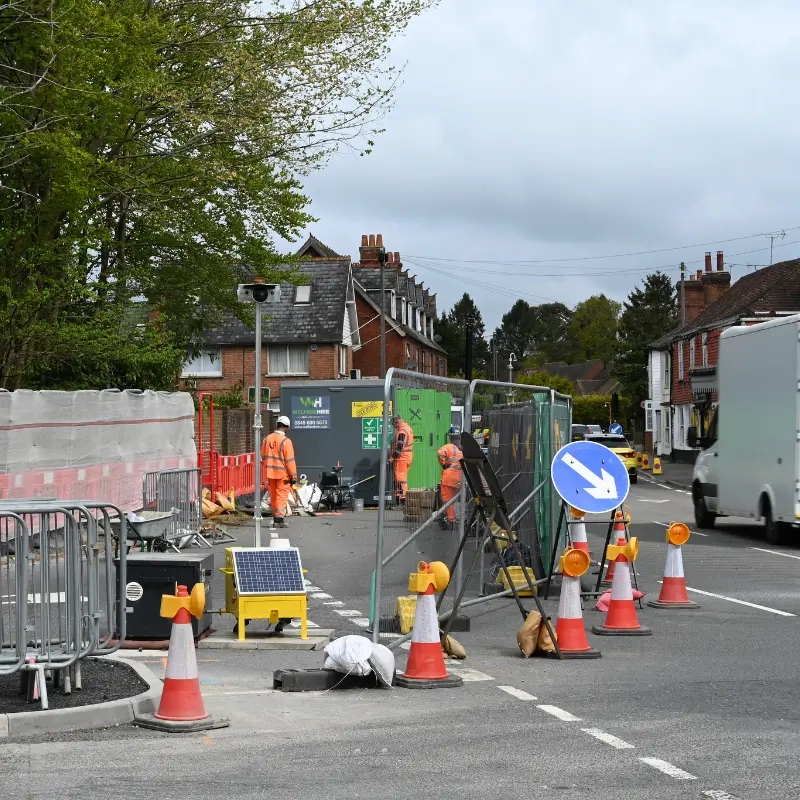
Nearly 40% of UK site managers say adverse weather is a major contributor to project delays and financial losses. Heavy rains can halt excavations and compromise road network visibility, while strong winds whip up dust and make bridge work unsafe.
Extreme cold compromises equipment performance, whilst soaring temperatures necessitate water breaks to avoid heat-related illnesses. Bad weather sometimes closes transport routes, delaying delivery of vital equipment and materials
Besides weather impacts, other critical environmental influences are:
- Noise restrictions: The Control of Noise at Work Regulations 2005 require that employees' hearing is protected from excessive occupational noise. Work near residential areas is also subject to strict noise controls. Complying with these regulations may force you to reschedule tasks and limit night‑time activities, prolonging projects.
- Dust management: Roadworks generate significant dust, which affects crews' wellbeing and can prompt complaints from residents. Poor dust control and suppression can lead to authorities enforcing work restrictions or even temporary site shutdowns.
- Pollutant controls: To safeguard workers, the Health and Safety Executive (HSE) sets Workplace Exposure Limits for dust, fumes, vapours and other harmful substances. It's also mandatory to protect the public from such pollutants, meaning emissions from plant and machinery must be monitored. If they reach harmful levels, operations may have to be suspended or adjusted to avoid violations that attract penalties or work stoppage orders.
Construction work produces so much noise, dust, fumes and other emissions that, understandably, hazards are missed unless conditions are continuously monitored using accurate tools.
Practical technology solutions
Our IoT-based environmental monitoring solutions help you track noise, pollutants and weather conditions accurately across all projects.
- Weather Monitoring Sensors record every site's micro-climate (temperature, humidity, wind, rainfall, dew point), providing detailed insights into changing conditions. Up-to-the-minute weather intelligence enables leaders to implement additional safety measures and adjust work plans around weather to minimise downtime. As with all our monitoring tools, the system retains timestamped data and reports that help to justify environmental-related delays.
- Air Quality Sensors continuously measure dust, particulate matter, chemical fumes and other airborne contaminants. Project leaders set exposure limits, and when conditions reach those thresholds, teams are notified so they can act to prevent breaches. Active control of sound levels ensures public/worker safety issues and regulatory problems don't disrupt operations.
- Noise Monitoring Sensors record noise levels in all work zones across 30-130 decibels and 20 Hz-12.5 kHz. Alerts are generated if preset thresholds are reached, protecting worker safety and avoiding complaints and investigations that might derail operations.
Environmental approvals delays can also set back project start dates. Employing systems that proactively manage site conditions with data-backed evidence can speed up the necessary approvals.
Read more:
Compliance challenges
Whether it's a strategic road network upgrade, a junction redesign or road surface maintenance, highway schemes are subject to scores of regulations. These include environmental laws, local noise ordinances and HSE health and safety standards.
Contractors must also follow the government's Chapter 8 guidelines. These cover temporary traffic management measures required to prevent collisions between crews and road users and keep traffic moving around work zones.
Without consistent compliance enforcement across every workplace, you run the risk of substantial delays due to:
- Preventable workplace injuries and fatalities that halt activities.
- Time-consuming investigations and additional inspections.
- Avoidable accidents that damage plant and equipment.
- Serious accidents such as explosions that require the site to be evacuated.
- Regulatory enforcement actions, including stoppage orders and work restrictions.
Practical technology solutions
- Our PPE Detection and Monitoring Systems employ AI analytics to spot and flag when workers are not wearing mandatory protective equipment. The system alerts managers and can also issue a live audio warning to the non-compliant crew member(s). Active PPE oversight and swift corrective actions ensure safety risks, penalties and compliance-linked holdups are minimised.
- Environmental monitoring sensors measure air pollutants and noise hazards to ensure they don't threaten workplace and public safety and prompt shutdowns. Climate tracking helps you plan around dangerous weather to minimise disruption and keep workers safe.
Both PPE and environmental systems store complete audit trails of events, allowing your compliance department to address inspections quickly and transparently with hard evidence.
Read more:
Security incidents
Equipment and other valuable assets are commonly stolen from construction sites across the country, which can lead to major road network disruptions and delays.
When specialist tools, materials, machinery, copper cabling and other plant are stolen or damaged, operations stall as teams wait for replacements and repairs. Directors are often distracted from their core focus as they are pulled into investigations and stakeholder reporting.
Early risk warnings are often missed because of the limitations of traditional security measures. Patrolling guards can't monitor every corner of a large site 24/7, and permanent CCTV isn't feasible on temporary traffic projects. Strong perimeter fencing is often not possible because of the evolving nature of traffic works, and inadequate lighting allows criminals to exploit weak visibility.
Even when security teams become aware of a warning indicator (e.g., minor theft, a circling vehicle or perimeter fence tampering), they may consider it an isolated incident and not part of a larger pattern.
Practical technology solutions
AI-powered Intruder Detection integrated with our CCTV Towers and remote monitoring services guards your sites against criminals and vandals day and night.
Professional operators at NSI Gold remote monitoring centres receive AI-driven threat alerts, verify them and take immediate action (live audio/light warnings, summoning the police if necessary). These interventions deter most intruders, ensuring your assets are protected, and crime-related disruptions are minimised.
Our optional Mobile Keyholding Response service dispatches a security professional to the site to investigate breach attempts, unauthorised access and similar threats.
Our add-on Automatic Number Plate Recognition (ANPR) solutions track vehicle movements across monitored locations. ANPR automatically records and timestamps number plates, including details on make, model, colour and speed. Accurate vehicle tracking improves access control, limits theft and encourages safer vehicle operations, reducing incidents that cause work stoppages.
Read more:
Equipment and materials availability
Project delays are often linked to the availability of critical equipment and construction materials. For directors overseeing multiple sites, equipment availability and delivery disruptions can be a major challenge. If not effectively planned for and managed, timelines will inevitably fall behind schedule.
Common vulnerabilities include:
- Specialist equipment availability: Large roadworks schemes employ specialist machinery such as piling rigs, and breakdowns or limited availability cause work to grind to a halt.
- Delivery disruptions: Essential materials such as steel and bitumen can be affected by global supply issues and transport delays, upsetting planned timelines.
- Damage: Vital equipment is often damaged by weather, reckless operation, vandalism, vehicle collisions and fire.
Without foresight and contingency planning, availability issues can ripple across schedules, forcing downtime and deadline extensions.
Practical technology solutions
- Weather monitoring assists leaders to adjust operations and/or introduce appropriate coverings to protect equipment and materials.
- ANPR systems, programmed to recognise delivery vehicles, ensure teams know when materials arrive and can respond quickly if deliveries are missed.
- Our AI-powered Smoke and Fire Detection Systems mitigate the risk of fire damage.
Rework disruptions
Rework is a substantial contributor to highway project holdups. The need to redo critical works arises from poor quality standards, incorrect materials, deviations from the plan, failed inspections, fire and weather damage. And the knock-on delays are significant:
- Additional labour hours must be scheduled, and new materials must be allocated, disrupting carefully planned schedules.
- Subsequent tasks on the build are stalled, causing teams to stand idle. For example, when foundation work must be redone, entire phases of the project are held up, and progress stalls completely.
- When crews are under pressure to catch up on lost time, they often take shortcuts and overlook safety protocols. Ironically, this rush and lapse of standards can create more rework.
Practical technology solutions
- CCTV and platform-based oversight help ensure potential problems, including poor performance/compliance issues, are identified early through remote monitoring of activities. The idea is to intercept errors before they become a fixed structure. Advanced oversight also supports safer working conditions and smoother schedules, avoiding rushed jobs that lead to rework.
- Our specialised Smoke and Fire Detection cameras with AI video analytics spot heat signatures and the early traces of smoke near-instantly. This system reacts faster and pinpoints the flame source more accurately than traditional fire alarms, which are not well-suited to large outdoor spaces. Automatic alerts enable teams to react quickly to prevent site damage and delays.
Read more:
Communication breakdowns
When projects rely on different systems and outdated processes, communication is weak, information sharing is haphazard and important updates are easily missed.
Without access to masterplans and schedules, each team focuses on its own tasks and is not always aware of how its work affects overall deadlines. Poor communication also causes coordination problems, complicating operations and wasting resources.
On top of that, key managers must undertake more physical inspections because field reports are slow and/or inaccurate. This wastes valuable time, increases admin and delays work sign-offs.
Practical technology solutions
As mentioned, modern cloud technology and smart software enable automated reporting and centralised dashboards that greatly improve information sharing.
By replacing fragmented communication with a smart unified platform, you standardise how sites are monitored and reported on. A central system ensures that all stakeholders work from the same reliable, defensible information, while automated reporting reduces manual inspections, administration, human error and delays.
When events and data are captured directly into a management platform, key personnel can quickly assess the latest information and coordinate activities to keep projects on target.
Stay On Schedule Across All Operations with Integrated Monitoring
Centralised monitoring of road projects through a cloud-based platform positions contractor directors to oversee their portfolio more closely and effectively, without a heavy administration burden.
When security, environmental, safety or compliance risks are flagged early, they can be effectively intercepted, reducing disruptions and delays. Stronger reporting and AI-powered insights allow directors to fully understand and manage risk areas before they jeopardise workflows.
Contact our team today to gain better, more confident control over operations. Deliver future projects successfully, profitably and on schedule.