
When overseeing multiple highways or traffic management projects, site security must be a top risk concern. Criminals target roadwork compounds actively, with equipment, material and cable theft costing UK contractors millions of pounds annually.
Operational directors have the demanding responsibility of protecting plant, materials and crews everywhere they work to limit the cost of security breaches. The challenge is made harder by tight budgets, stretched teams and stakeholders who demand detailed explanations whenever a serious safety or security incident occurs.
Traditional security guards and deployable CCTV towers are both widely employed on traffic and highway schemes. Depending on the location, both have their place, so it's useful to weigh them against each other, understanding the coverage and deployment benefits each offers as well as cost factors.
Our article breaks down how the 2 approaches compare across a multi-site operation, and explains how rapidly deployable CCTV systems, backed by centralised monitoring, often deliver stronger long-term value.
Why is Consistent Security Across Multiple Locations a Challenge?
Securing multiple highways or traffic projects to the same standard is an ongoing challenge for contractor directors. This is especially true when guarding depends on on-site security personnel.
Security guards can't always be in the "right place at the right time", especially in complex traffic management environments, and they're also entitled to breaks. This creates blind spots that opportunistic thieves and Organised Crime Groups (OCGs) are quick to exploit.
A manned guarding approach can introduce human error and limitations, meaning fatigue, distraction, apathy and poor training can all influence how vigilantly your compound is protected. Two sites can be secured to very different standards simply because they're staffed by different personnel.
The consequences of a perimeter breach can hit your programme hard. Stolen or damaged assets can cause delays, eating into margins. On top of that, project owners can be held liable if intruders are injured in a traffic management or work zone, even though they trespassed illegally.
Meanwhile, inconsistent incident reporting damages investigations and recovery efforts, and a lack of objective evidence compromises claim handling. For example, insurance claims are often denied because the business lacks the evidence to prove its security controls meet policy requirements.
4 Factors to Evaluate When Comparing Security Guards vs CCTV for Highways Traffic Projects
Below we highlight 4 critical considerations when comparing guard patrols with CCTV systems for highways and traffic management locations.
1. Visibility and coverage
On-site guards typically patrol, moving between compounds, checking access points and walking the perimeter on a schedule. To monitor a major infrastructure zone without leaving coverage gaps requires a sizeable, highly disciplined, trained and continually patrolling crew. This large guard contingent, of course, adds real cost to your budget.
A CCTV tower provides continuous oversight, day and night. High-quality PTZ (pan-tilt-zoom) cameras offer low-light and night-vision recording, capturing detail that human eyesight frequently misses.
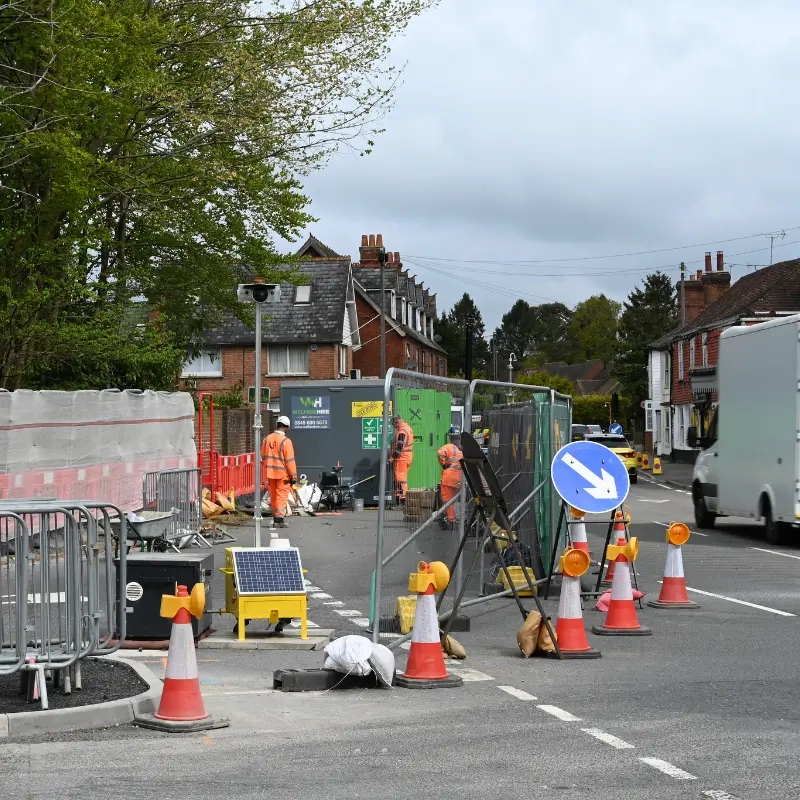
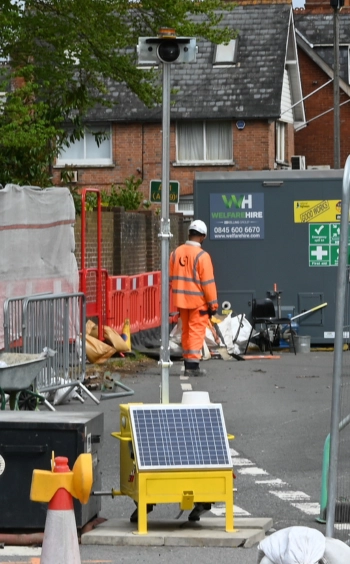
Strategically positioned towers can actively monitor a wide area, providing visibility across every corner of a large work zone. Traffic Management Towers are designed for the practicalities of both busy urban and remote traffic schemes, with the height (around 6 metres) to capture large and high-risk zones and surrounding traffic well.
Coverage advantages of CCTV
Well-positioned CCTV supported by a cloud-based platform provides 24/7 visibility across all monitored locations, without a shift change or lapse in concentration. By their visible presence, these towers and high-definition cameras also act as a strong deterrent against criminal activity.
2. Deployment speed and scalability
Introducing guard patrols or a security contract into your programme entails vetting, recruiting, onboarding and scheduling. This process takes time, so arranging or scaling coverage at short notice isn't always possible.
The vetting exercise alone (whether of individuals or guarding contractors) can't be shortcutted, since the quality and training of personnel directly impact the effectiveness of your protection. Sometimes, traffic and work conditions are so hazardous that you must limit your workforce for health and safety reasons.
Portable CCTV towers, by contrast, are designed for rapid, flexible deployment, even in work zones with above-average dangers such as busy rolling traffic operations. Mobile setups can be in place and operational within hours to monitor the required safety measures (restricted zone control, worker protection, traffic movement, managed lane closures, etc.).
This is invaluable when schemes change location regularly, and re-negotiating guarding or traffic controller arrangements each time is not practical.
Scaling coverage is also straightforward. Additional units can be deployed as you add new locations, and brought onto the same central platform within hours, not days.
Deployment advantages of CCTV
Highways projects and temporary traffic management schemes require flexible oversight that can respond quickly to shifting priorities and locations. Guard‑only models don't always offer this adaptability. As mentioned, adding personnel can take time, and guards on one traffic project may not accept a transfer to a new location because it's too far to travel.
CCTV coverage can be rapidly deployed and expanded, ensuring you always have visibility as your scheme develops or new traffic priorities arise. This model also lets you accurately match deployment costs to actual needs.
3. Evidence collection
Traditional security reporting depends on what was seen, remembered and written down, often by hand, and frequently after the fact. Relying solely on this approach leaves contractors short of vital evidence when it matters most.
When clients ask hard questions about an incident, or your contracted security provider disputes events or insurers question a claim, you need verifiable records to defend your position. Without it, you could face reputational damage, unplanned liabilities and costly insurance disputes.
Modern CCTV monitoring platforms capture and generate the objective evidence you need to reduce commercial risk following incidents (theft, vandalism, trespassing, sabotage, etc.)
Central cloud-based platforms store timestamped video footage and reports documenting what happened, when and how. This information lives in one place, where you can access it with a few clicks to address stakeholder questions, insurance and other claims.
Evidence-gathering advantages of CCTV
The consistent, objective evidence retained by modern CCTV platforms is a great improvement compared to inconsistent, subjective, often delayed human reports and paper logs.
4. Costs and value
A security guard's wage (£14 - £30+ hourly) may be cheaper than CCTV rental, but are physical foot patrols always the most cost-effective security system? Understanding the true cost of protecting your highways or traffic management project requires a more detailed analysis.
When employing manned guards at multiple locations, you carry the cost of:
- Ongoing staffing across every shift, every site, throughout the duration of all contracts.
- Management and admin overheads. These can include scheduling, supervision, benefits and headaches such as absences and disciplinary issues.
- Variable performance, which can translate to higher incident rates, disruptions, claims and time-consuming investigations.
- Weak or inconsistent evidence when something goes wrong.
With deployable CCTV systems, the cost structure is different:
- A predictable rental cost, where you only pay for the coverage you need.
- Quick, straightforward scaling, which allows you to match costs precisely to usage.
- Minimal management and admin. Installation, live monitoring, maintenance and support are usually taken care of by the supplier.
- No recruitment, personal vetting, absence cover or disciplinary problems to manage.
- Greater visibility into risks enables you to act preventively to limit accident and injury costs.
- Clear, timestamped, retrievable evidence for every incident, making dispute resolution easier and less expensive.
The value advantages of CCTV
For managing several workplaces over a few months, the cost of CCTV monitoring tends to compare favourably with the all-inclusive expense of traditional guarding. Indeed, it's been shown that over time, CCTV can save up to 88% on security costs compared to guards.
CCTV platforms not only reduce wages and overtime costs associated with security personnel but can also reduce monitoring team headcount.
Read more:
The Benefits of CCTV Security Cameras: A Side-by-Side Comparison
For a snapshot of the comparative advantages of CCTV platforms on traffic projects, the table below summarises how guards and towers perform across key areas.
|
Key Performance Area |
On-Site Security Guard(s) |
Deployable CCTV Towers |
|
Coverage |
Patrol-based, with gaps between checks; may not be suitable at all locations due to scheme complexities and health and safety concerns |
Continuous, day and night visibility aimed at theft prevention 24/7 |
|
Consistency across sites |
Varies by individual and shift |
Standardised across every site |
|
Deployment and repositioning speed |
Often delayed; depends on staff availability and recruitment |
Setup takes hours, not days; repositioning is also quick, with some requiring only one person to relocate |
|
Cost structure |
Expensive for 24/7 monitoring |
Flexible, affordable rental packages |
|
Management overhead |
Often demanding due to rostering, supervision, absence cover and disciplinary issues |
Minimal since largely handled by supplier |
|
Evidence |
Manual, dependent on individual reporting |
Clear, consistent timestamped video records and incident logs |
|
Scalability |
Limited by recruitment lead time and project suitability |
Straightforward to add units and storage |
Secure Your Projects with a Deployable CCTV Platform
WCCTV's range of CCTV Towers is an established solution for highways and traffic contractors needing temporary, multi-location or off-grid security urgently, with basic setups deployable in around 20 minutes. Self-contained, solar-powered towers with 4G/5G connectivity offer coverage even in the most isolated, off-grid areas.
High-definition PTZ cameras pan, tilt and zoom, never losing image clarity, providing security peace of mind day and night.
Custom software lets your team access footage, alerts and reports remotely on their mobile devices, while our team manages installation, connectivity and ongoing support.
- Our Traffic Management Towers are ideal for traffic management projects, supporting safety and security on live carriageways, diversion routes and roadside work zones, whilst offering the agility to move with developing project phases.
- Our CCTV Towers stand up to 6 metres tall and deliver a wider-area view, detecting events from up to 200 metres away. They are well suited to support environmental, safety and security monitoring.
- Mini CCTV Towers can be installed by a single person and easily repositioned without technical support. These compact units are well suited to monitor smaller works and close coverage of high-risk activities.
The fully-managed service is supported by NSI Gold Accredited remote monitoring facilities, where trained professionals act on threat alerts by issuing warnings to stop intruders in their tracks. Depending on the threat, responses can be escalated to include dispatching the police. The system captures and retains the necessary evidence for reporting and follow-up actions.
Our optional Mobile Keyholding service offers alarm monitoring/physical intervention, sending a security professional to the site to investigate any confirmed alert. A key benefit here is that it saves you/your managers the time and stress of attending security callouts.
Our Towers and cloud-based platform can also bring in Automatic Number Plate Recognition (ANPR), smoke and fire detection, PPE compliance and environmental monitoring for complete project oversight.
For directors overseeing multiple operations and responsibilities, this means one login for security and to monitor:
- Access controls
- PPE usage
- Environmental conditions
- Safety hazards
Below, we explain briefly how you can combine your security controls with these additional functions.
One connected cloud-based platform
The table summarises the solutions you can layer into our platform on top of CCTV surveillance. The system can consolidate video and data from up to 81 cameras, providing timestamped records, reviewable on mobile and desktop to keep you constantly informed across your portfolio.
|
Monitoring Systems added to CCTV Towers |
Features and Capabilities |
Operational Benefits |
|
Records all vehicles entering and exiting designated zones, logging plate number, speed, colour, make and model. |
ANPR improves access control and theft prevention. It also supports safer driving and can control restricted zones and traffic incursions. |
|
|
Intrusion Detection Systems |
AI trained on security risks spots intrusion attempts and other suspicious behaviours. The system activates swift deterrents, including alerts to remote monitoring operatives. |
Smart threat detection supported by rapid human intervention fortifies security defences and actively deters criminal elements. |
|
Employs AI to flag and alert managers and non-compliant workers when on-site PPE rules aren't followed. |
Smart detection/alerts reinforce PPE use, raising compliance and encouraging a safer work culture. |
|
|
Uses AI analytics to pinpoint and alert relevant personnel to the early signs of smoke or fire. |
Early fire warnings enable a rapid response to protect workers and property. |
|
|
Captures site-specific climate data, including temperature, wind, and rainfall. The system can alert when unsafe climate conditions are noted. |
Location-specific weather data enables informed decisions around weather hazards to safeguard crews and road users. Timestamped data also provides evidence to explain project pauses due to weather risks. |
|
|
IoT sensors track sound and frequency levels across work zones. Sensors can alert when permitted noise exposure limits are reached. |
Ensures compliance with local noise ordinances; protects workers and the public, avoiding complaints. |
|
|
Continuously track common airborne hazards, including dust, TVOCs, CO₂ and CO. The tool monitors and alerts when exposure thresholds are reached. |
Protects crews, road users and residents from pollutants. |
Read more:
- What are Environmental Monitoring Sensors?
- AI-Powered Risk Detection: Smoke, Fire and PPE Compliance
- How Integrated CCTV and ANPR Keep UK Sites Secure
The Next Steps to Securing Multi-Site Projects with CCTV
CCTV monitoring platforms are quick to deploy and scale and offer continuous event coverage, making them more suitable than guards in many highways and project environments.
For most multi-site highways programmes, deployable CCTV towers offer stronger long-term value and greater project oversight since they can support environmental and safety monitoring in addition to security management.
Our rapid deployment CCTV Towers and cloud-based monitoring platform are trusted by traffic, highways, infrastructure and security teams throughout the UK. These solutions not only record criminal activity but actively deter intruders and protect your schemes and assets day and night.
If you want to explore security options and see what modern CCTV offers, speak to our team at any time for assistance or a demonstration.
