
Managing multiple highways projects means dealing with different sites, teams, traffic conditions and contractual requirements. A common challenge in multi-site operations is that each location tends to have its own way of working, including its own reporting systems, safety culture and compliance standards.
For contractor directors accountable for successful delivery across an entire programme, this inconsistency is expensive. It complicates decision-making, weakens project documentation, limits scaling and makes it harder to show clients and stakeholders that all sites are effectively managed.
Leading contractors solve this challenge by standardising site monitoring with consistent portfolio-wide processes and technology. Integrating CCTV, safety, security and environmental data into a central platform with smart software strengthens operational oversight and delivers higher-performing, safer projects.
Our article offers a practical guide for leaders looking to build a successful monitoring standard across their UK highways and traffic management operations.
Why is Standardised Monitoring Important on Multi-Site Highways Projects?
Standardised monitoring and reporting are essential to achieve a clear, organised view of all operations across a portfolio. Highways and temporary traffic schemes are constantly evolving environments where new risks, challenges and priorities emerge hourly.
Work zones move as the project progresses, introducing fresh operational, traffic management, security and safety issues. Subcontractors rotate in and out, and busy project managers have their hands full trying to maintain quality standards.
External factors such as adverse weather or supply chain issues can also cause costly delays if not planned for. To add to the strain, each project must satisfy a host of local authority requirements, compliance standards, stakeholders' demands and public scrutiny.
Without a consistent framework, it's impossible to confidently manage all these variables. Information becomes fragmented, making it harder to identify issues early and maintain oversight across projects.
The costs of disconnected monitoring include:
- Uneven safety and compliance: One project may enforce PPE or Chapter 8 signage rigorously while another treats them as optional. Without standard practices, there is no consistent way to catch unsafe behaviours until something goes wrong.
- Slow, unreliable reporting: With each site sharing information through its own system (emails, spreadsheets, logs, WhatsApp groups), problems may only reach directors after loss or damage has occurred. Searching for relevant details also wastes time, with studies showing the majority (85%) of employees spend up to 2 hours a day looking for scattered job-related information.
- Weak evidence when it's needed most: Incomplete or inconsistent records compiled after the fact compromise complaint handling, claims, disputes and insurance investigations. These processes get delayed and often result in unfavourable outcomes, such as denied insurance payouts or regulatory penalties.
- Blind spots around site security and workplace conditions: Theft, vandalism or bad weather can cause a loss overnight because no one was actively monitoring the compound.
- Management time lost to firefighting: Directors are forced to travel between sites to get a basic picture of what's happening, distracting them from delivery goals and stakeholder management.
Multiply any one of these across a portfolio of 5, 10 or more active schemes, and the negative impact on margins and delivery piles up.
A centrally managed monitoring approach mitigates these risks. It protects margins and guides stronger programme performance and compliance. Consistent processes, technology and reporting disciplines flag issues before they disrupt schedules and erode profitability, and create stronger records involving less admin.
Read more:
- The Real Cost of Site Security Across Traffic Management Projects
- 7 Compliance Pitfalls Cost Construction Firms Millions
5 Benefits of Standardised Site Monitoring on Highways Projects
Let's take a closer look at the 5 measurable benefits project management teams can experience when successfully implementing consistent monitoring across all operations:
- Lower administrative overhead: Leaders spend less time travelling between sites, reconciling conflicting records, compiling stakeholder reports and waiting for updates. This frees them to drive delivery and high-level priorities rather than admin workloads.
- Improved compliance: Monitoring the same safety and environmental standards across sites can help teams identify compliance gaps earlier and apply consistent processes, reducing regulatory pressures. Maintaining high standards at every workplace prevents compliance failures at one location from damaging the company's reputation.
- Stronger claims defence: Consistent, timestamped logs and video records provide factual evidence that supports your position when disputes occur. This can significantly cut the time and cost of resolving contractual disagreements.
- Simplified oversight: One platform, a common methodology and high-level oversight replace disconnected site-level systems. A consolidated view and AI insights help you catch underperforming areas early and take corrective actions before they cost money.
- Scalability: New projects can be brought up to standard fast because the framework and technology are already in place. A standard model supports quick mobilisation and seamless scaling of best practices as your business grows.
Read more:
- Improving Site Performance Through Smart Monitoring
- How Artificial Intelligence is Revolutionising CCTV Tower Monitoring
How to Standardise Multi-Site Project Monitoring in 6 Steps
Below, we cover 6 practical steps to help you implement standardised monitoring across your highways and traffic project portfolio.
Step 1: Audit your existing monitoring processes
Before you can adopt a standardised monitoring strategy, you need a clear picture of what's happening across your sites today. So begin with an audit of every active project, considering these questions:
- What monitoring tools are in use (CCTV, sensors, in-person inspections, manual checklists) and who supplies them?
- How are key updates reported to project management leadership?
- How are incidents, near-misses and compliance checks recorded at present?
- Who reviews project information and reporting, how often is it reviewed and how is the information used?
- Where is evidence stored, and how is it retrieved to address claims, inspectors' queries, complaints and investigations?
- Is project data securely protected against cyberthreats such as hacking, malicious bots and malware?
Beyond revealing the mix of methods and siloed processes in use, this exercise usually also uncovers high-risk sites and outdated systems (e.g., fragmented and siloed reporting processes).
Step 2: Identify inconsistencies between sites
Audit conclusions commonly show that different teams and subcontractors solve the same problem in their own way. To understand and quantify these inconsistencies, it's necessary to compare sites against each other, looking specifically for:
- Reporting lags: Variances in how long teams take to report incidents/accidents and how quickly important information reaches decision-makers.
- Gaps in coverage: Site visibility gaps such as no record of environmental risks, incomplete security/ access logs, poor progress tracking and outdated fire prevention measures.
- Technology mismatches: Tools and equipment that can't be integrated into a central monitoring platform, or require site-specific logins and training.
- Variable compliance discipline: Sites where regulatory standards, such as Chapter 8 signage, PPE or environmental controls, are applied loosely.
A detailed site comparison can surface weaknesses that might be costing the company unnecessary money (e.g., low-quality, grainy camera footage that adds little value to security).
Step 3: Select deployable, scalable monitoring technology
The right technology should work reliably whether it's deployed on a major infrastructure project, rural road rehabilitation, temporary diversion route or street maintenance contract.
At WCCTV, our solar-powered, wireless Traffic Management and CCTV Towers are rapidly deployable, scalable solutions that don't require local utilities or fixed infrastructure. High-definition PTZ (pan-tilt-zoom) cameras provide clear day-and-night coverage from up to 200 metres away in almost all locations.
These fully-managed mobile units can be deployed within 20 minutes (for basic setups) and repositioned as the scheme develops. All installations and setups are handled by our team, who provide ongoing support.
For tighter or ground-level monitoring (excavations, a traffic intersection), our Mini CCTV Towers are a trusted option. Works teams can reposition these compact, versatile units without an engineer on site.
With CCTV in place, you can layer in our specialist monitoring tools based on your project needs. The table highlights the integrations you can opt for.
|
Monitoring Systems added to CCTV Towers |
Features and Capabilities |
Operational Benefits |
|
Records all vehicles entering and exiting traffic and project zones, logging plate number, speed, colour, make and model. |
ANPR enhances access control and theft prevention, and encourages safer driving on and around live highway schemes. |
|
|
Flags perimeter and zone breaches. This fully-managed security solution is backed up by NSI Gold Accredited remote monitoring partners who act promptly on alerts to warn off intruders. |
Deters theft and asset damage; restricts unauthorised access into active projects. Optional Mobile Keyholding Response sends a professional licensed keyholder to any threatened project area. |
|
|
Employs AI to flag and alert managers and non-compliant workers when PPE (hard hats, safety goggles, boots, high-vis clothing, etc.) isn't used. |
Smart detection and alerts reinforce PPE use, keeping traffic and highways schemes safe and compliant. |
|
|
Uses AI analytics to pinpoint and alert relevant personnel to the early signs of smoke or fire. |
Early fire warnings enable a rapid response to protect workers, traffic signage and other assets. |
|
|
Captures location-specific climate data, including temperature, wind, and rainfall. The system can alert when unsafe climate conditions are noted. |
Location-specific weather data assists informed decision-making around weather risks, keeping crews and road users safe. Timestamped data also provides evidence to explain weather-related project delays. |
|
|
IoT sensors track sound and frequency levels across work zones. Sensors can alert when permitted noise exposure limits are reached. |
Ensures compliance with local noise ordinances; protects workers and the public, avoiding complaints. |
|
|
Continuously track common airborne hazards, including dust, TVOCs, CO₂ and CO. The tool monitors and alerts when exposure thresholds are reached. |
Protects crews, road users and residents from pollutants. The system logs up to 180,000 time-stamped records to assist regulatory audits and complaint management. |
Choosing portable, standardised safety, security and environmental technology/equipment lets your teams travel from project to project with ready-to-deploy systems, ensuring you never lose essential work oversight.
Read more:
- AI-Powered Risk Detection: Smoke, Fire and PPE Compliance
- IoT Environmental Sensors for Traffic Management: Benefits for Highway Projects
- CCTV Towers vs On-Site Security: Coverage and Cost in Highways Environments
Step 4: Build Standard Operating Procedures (SOPs)
A unified technology solution provides the framework for consistent monitoring. To build out the strategy, the tech must be supported by shared processes for all teams to follow. When creating your standardised model, document it as a set of SOPs that apply across every site, covering:
- How, where and why cameras and sensors are positioned on a typical scheme.
- Crucial workplace limits and thresholds to consider, such as noise regulations and hazardous substances limits.
- Who reviews footage and alerts, and how quickly they must respond.
- How incidents are logged, escalated and resolved.
- Management, crews and subcontractor accountabilities.
- Compliance "rules" (PPE, traffic signage, environmental exposures, access control) defined in plain terms.
The goal is that a new project manager, or a subcontractor working with you for the first time, can pick up the SOP, understand what's expected and follow procedures from day one.
Step 5: Centralise management in one cloud-based platform
Smart integration of your chosen monitoring tools into a single cloud-based platform strengthens and simplifies management by bringing everyone onto the same page. Key personnel now share a reliable big-picture overview. They work from the same verified datasets and adhere common traffic, safety and environmental regulations across all sites consistently.
Our cloud-based monitoring platform combines CCTV, environmental tracking, security alerts and incident reporting into live central dashboards. Secure cloud connectivity lets any authorised person review workplace conditions on any highways project from their phone or laptop.
Unified platform management means:
- Directors get a consolidated dashboard view across the whole portfolio, not a dozen separate screens.
- Alerts, reports and footage from every site follow the same format, so comparisons between projects are meaningful.
- New sites can be brought onto the same standard quickly, rather than starting from scratch.
Our platform consolidates feeds from up to 81 cameras in one place, greatly enhancing control, communication and management efficiency. What used to require site visits, tool switching, endless emails and manual cross-checking becomes a single picture, providing full management context.
Unifying project data in one place also makes it easier to protect against cyber threats. The alarming statistic that 50% of UK businesses have experienced a cyber breach in recent years highlights the importance of cybersecurity defences for online operations.
A well-defended cloud platform limits the vulnerabilities that multiple systems, emails, applications and local servers present to hackers. Beyond stringent access control settings, our platform protects your records with14 rounds of end-to-end AES-256 encryption.
Step 6: Standardise reporting and evidence management
Finally, define the evidence required across every project and make sure your platform produces it automatically. Here's what strong evidence and linked reporting looks like on highways projects (and in the construction industry generally):
- Continuous gathering of essential project data (PPE compliance, noise levels, air pollutants, unauthorised access, weather, traffic incursions and vehicle speeds).
- Standardised incident reports, used identically on every site in every instance.
- Automatic timestamping and secure storage of video footage, reports and sensor data.
- A clear digital chain of evidence that holds up in disputes, complaints, claims or regulatory reviews.
When you record and store events continuously in a structured way, you're better placed to confidently address stakeholder project queries.
With our dedicated cloud platform, you can pull concrete evidence (timestamped footage, alerts, incident reports and environmental readings) at the push of a button. This saves hours in piecing together scattered files and contradictory reports.
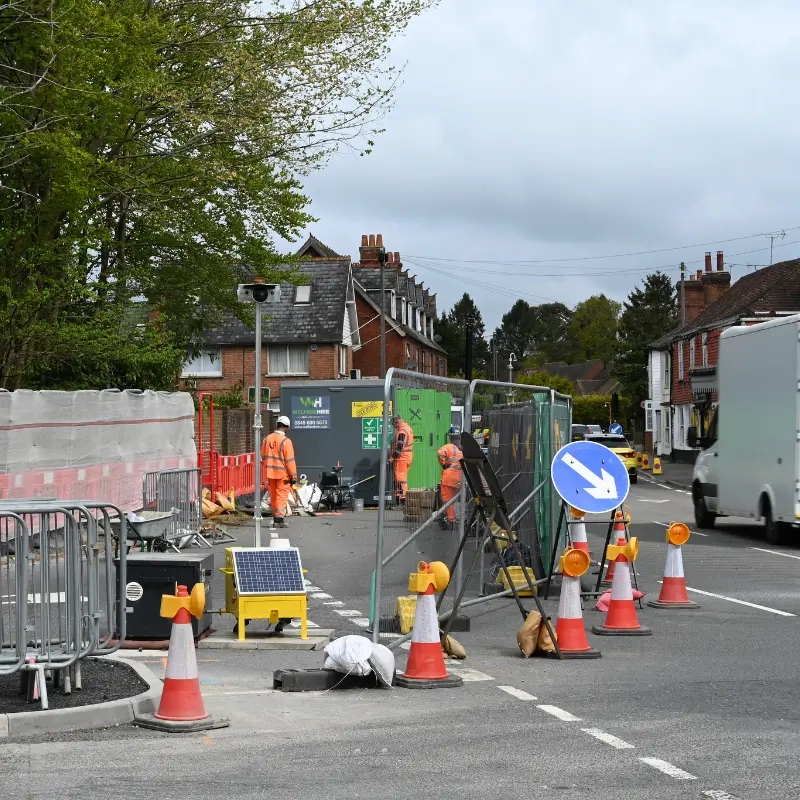
Create a Consistent Monitoring Standard Across Your Portfolio
Standardised portfolio monitoring helps achieve visibility and control of every temporary traffic and highways project, preventing isolated weaknesses from pulling down overall performance.
This unified approach gives directors the portfolio-wide oversight and context they need to meet demanding operational targets. Done well, it protects margins, strengthens your position with clients and regulators and provides the confidence of knowing what's happening across every scheme, everywhere.
Our CCTV Towers, AI-powered tools and cloud-based management platform offer consistent, deployable oversight that scales with your programme, whatever its size and geographical spread.
Contact us when you're ready to discuss how our standardised monitoring solutions could work across your UK highways and traffic projects.

