
As highways and traffic management contractors take on more roadworks and temporary traffic schemes, the challenge becomes maintaining the same level of visibility and control over a larger, more geographically spread portfolio.
Without consistent processes and a strong monitoring platform, directors risk stretching themselves increasingly thin, relying on site visits and updates from busy working teams to keep track of operations.
Poor visibility and inconsistent reporting create gaps in oversight, complicate decision-making and make it less certain that every scheme is managed to the standards expected. Unless control can be effectively implemented at every new location, scaling can be a costly risk.
This article explores what “control at scale” in highways projects means, and how directors can achieve it. We discuss how standardised processes and CCTV monitoring platforms help directors introduce greater consistency across their portfolios, and also explain how centralised management of environmental, security and safety risks simplifies and strengthens oversight.
Control Risks When Managing Multiple Highways and Traffic Schemes
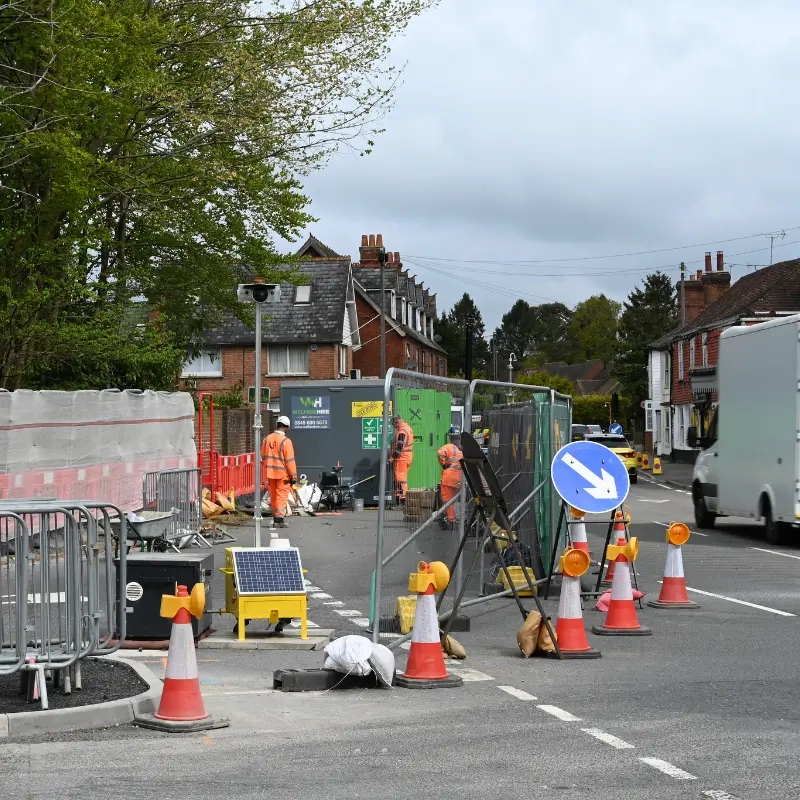
Highways and traffic schemes are challenging, highly regulated environments where different teams and subcontractors work alongside live traffic and project managers have different working approaches.
Without standardised controls, individual sites naturally develop their own way of operating. Each reports slightly differently; some crews and managers follow compliance rules strictly while others are more lax, and no site deals with adverse weather conditions in the same way.
Every new project or construction phase that becomes active creates new risks, challenges and often admin too. When a portfolio expands, there is often a tendency to create more reports or additional inspection processes. But this only fragments reporting further, and information remains largely siloed, stalling growth ambitions.
Poor alignment between sites makes it difficult for directors to control operations effectively and confidently. Gaps show up everywhere, and small blind spots can become major vulnerabilities, financial loss, commercial risk and reputational damage:
- Chapter 8 signage is poorly managed at a site, increasing the already high risk of driver incursions into work zones, endangering workers' and public safety.
- Vital temporary traffic measures supporting a road layout change (barriers, temporary signals, congestion control, worker protections) aren't consistently managed, causing disruption, confusion and complaints.
- Unmonitored environmental hazards go unnoticed until noise or air pollutant levels breach local council thresholds and regulators step in to halt work and/or fine the company.
- A suspicious vehicle circles 2 nearby sites but is only detected at one and not reported to the other. As a consequence, the second sites later experience theft and loses valuable assets.
- Project management teams slip into a reactive mode. Instead of proactively preventing incidents and accidents, they merely report them after the fact.
When processes aren't consistent, it's nearly impossible to scale best practices, or even identify which systems could work well across the portfolio.
Establishing controls that can grow with the portfolio requires a uniform approach to how sites are monitored and reported. Control at scale is about a standard model and shared platform to connect new operations seamlessly, ensuring all teams work to the same safety and performance standards.
In the following sections, we discuss the standardised approaches, technology and platforms that make scaling control possible.
Read more:
How Standardisation Improves Control Across Highways Projects
Standardisation gives directors a consistentent framework for managing operations across all active locations. It sets consistent procedures for all teams to follow wherever they work. Instead of each site handling monitoring, reporting, compliance and record-keeping their own way, they work to one shared system.
With all traffic projects following the same model, directors can quickly compare performance without having to first understand each project's processes. It becomes easier to identify exceptions and weaknesses that could compromise operations and profits if left unchecked. Flagging underperforming areas allows you to investigate root causes and provide extra support or resources where necessary.
Beyond providing better visibility and control of performance, standardisation improves communication, decision-making, project documentation and makes scaling easier.
The table below shows a breakdown of the benefits of constructing a standard shared model, compared to working with scores of disconnected systems.
|
Growth challenges |
What non-standardised control looks like |
Moving to standardised control and structure |
|
More traffic schemes and highway works must be overseen simultaneously |
Each team has their own monitoring and reporting methods (e.g., emails, spreadsheets, WhatsApp Groups, paper trails, standalone tools). Inconsistencies, inefficiencies and delays create knowledge and visibility gaps. |
Every scheme follows the same reporting and monitoring framework, helping directors understand events everywhere more quickly and clearly. |
|
More subcontractors are involved across the larger portfolio |
Safety, security, compliance and quality standards and team supervision vary widely. |
Expectations, standards and compliance rules are consistent across all sites, and clearly set and communicated. |
|
Sites are geographically dispersed |
Directors rely on site visits, phone calls and often delayed reports to understand what's happening at each location. |
Up-to-date project data and reporting across the portfolio is available centrally and can be viewed remotely. |
|
Leaders must investigate more incidents, claims, regulatory and stakeholder issues |
Investigations are hindered because incident records must be reconstructed from several different sources and accounts. Documentation is stored locally at sites, is inconsistent, often flawed and slow to retrieve. |
Reliable documentation, including footage and reports, is housed in a central place. Users know where to find it, and it is easy to retrieve when needed. |
|
New schemes are mobilised frequently |
Project managers and teams must recreate processes on every new project, wasting valuable time and creating unnecessary costs. |
Projects are connected into an established operational framework from day 1, making mobilisation (and scaling) relatively quick and seamless. |
Read on to see how Standard Operating Procedures (SOPs) and centralised monitoring help you successfully implement a standardised approach.
Create Consistent SOPs and Centralise Monitoring and Reporting
Successfully implementing a uniform strategy requires creating Standard Operating Procedures (SOPs) to help apply best practices across all highways schemes. It also requires effective monitoring and reinforcement, and here CCTV and specialist safety, security, vehicle movement and environmental monitoring tools are invaluable.
Standard Operating Procedures (SOPS)
Clear, detailed SOPs are key to developing standard expectations and practices. These procedures translate business expectations into consistent processes that guide teams in their everyday tasks and responsibilities.
Risk management and safety compliance SOPs for traffic projects might cover:
- How sites are monitored for safety and security risks and what information needs to be recorded.
- How teams manage changing road layouts, temporary traffic signals, lane closures, diversions, signage, vehicle access and driver-incursion risks.
- How traffic-management incidents, near-misses, accidents and injuries are handled, reported and escalated.
- What evidence should be retained for reporting, claims, complaints, insurance and regulatory purposes.
- Critical environmental limits and thresholds, such as noise regulations and hazardous substances limits.
SOPs ensure that when a new scheme starts, you don't need to create systems from scratch because a proven operating model already exists. The test of a good SOP is what happens when someone new arrives: Can a new project manager or subcontractor pick up the SOP, understand what's expected and be up to speed in days rather than weeks?
Centralised CCTV monitoring and reporting
Modern CCTV systems and platform-based control are playing a vital role in supporting consistent monitoring standards across dispersed locations. This technology helps leaders remotely monitor site conditions and activities from their office, vehicle or after conducting a final inspection on a distant rural route.
For traffic-management contractors, remote CCTV can provide visibility across lane closures, work zones, diversion routes, site access points and temporary road layouts without requiring directors to visit every scheme.
We offer mobile, rapidly deployable CCTV setups that give you "eyes on the ground" quickly wherever you need it. Our solar-powered, 4G/5G wireless CCTV Towers can be commissioned without existing infrastructure (power, internet, local utilities). WCCTV's team handles all setups and can have CCTV operational at your site within 20 minutes for basic installations.
Towers feature high-definition PTZ (pan-tilt-zoom) cameras with infrared (IR) illumination and low-light sensors to deliver clear video day and night from up to 200 metres away. They are well-suited for almost any temporary (or longer-term) operations, from major infrastructure projects to emergency street repairs and rolling traffic management assignments.
Scaling coverage simply involves adding more cameras, which we manage for you too, together with ongoing support.
All CCTV systems are supported by our dedicated cloud-based monitoring platform and specialist software that brings video streams together and enables camera management in one place. Cloud connectivity lets you log in remotely and view live and recorded footage from up to 81 camera feeds.
Read more:
How WCCTV Can Help You Scale Controls Across Highways and Traffic Projects
Our CCTV solutions and dedicated cloud monitoring platform provide a foundation that helps you extend remote project oversight across growing portfolios.
Depending on your operational needs, our fully NDAA-compliant cameras are deployed on 6-metre-tall CCTV Towers, specialist Traffic Management units and compact Mini Towers.
To scale risk management and control over fast-developing highways schemes, our standard CCTV Towers support the integration of various security, environmental, access controls and smart detection tools.
- Our CCTV with Intrusion Detection safeguards dispersed sites from a central control point. The system uses AI analytics to analyse live footage and alert designated contacts when unauthorised individuals/vehicles try to enter any off-limits zones. The fully-managed security service is backed by NSI Gold Accredited monitoring partners, with trained operators in a remote control centre who verify threats and take swift action to prevent theft and vandalism.
- For further intervention, you can also choose a Mobile Keyholding Response service that sends a trained keyholder to any threatened site.
- Our Automatic Number Plate Recognition (ANPR) systems record vehicles entering highways projects or restricted traffic zones, improving access controls and flagging unsafe driving and suspicious or stolen vehicles. ANPR is also used to monitor material deliveries at busy sites.
- PPE Detection and Monitoring flags and alerts teams/managers if personnel are not wearing the required protective gear. This helps enforce the same compliance standards across every project and protects crews on busy roadsides.
- Smoke and Fire Detection systems alert designated contacts to early signs of smoke and fire, enabling a rapid response to protect traffic and project assets everywhere you work. These AI-enabled detection systems perform well on outdoor projects, unlike traditional smoke alarms, which are not suitable for these environments.
Roadworks produce dust, toxins and noise that could violate regulations and negatively affect road users and nearby communities. Environmental Monitoring Sensors help highway and traffic contractors control the environmental impact of their operations. IoT-based sensors give teams the information they need to respond to emerging risks, comply with regulations and manage workplace sustainability targets.
- Noise Monitoring Sensors measure work zone sound (over ranges of 30-130 dB and 20Hz to 12.5kHz) and alert teams when noise levels reach compliance limits or become unsafe.
- Air Quality Sensors continuously monitor dust, CO₂, CO and other harmful emissions to help teams control airborne pollutants to limit the project's environmental impact.
- Weather Monitoring Sensors provide updates on weather conditions, including winds, rain and temperature affecting monitored sites. Accurate climate data allow teams to implement protective measures when conditions turn hazardous. Data-backed evidence helps leaders justify schedule adjustments and delays due to weather factors.
With video, data, alerts and incident reports all in one place, remotely viewable on mobile or desktop, you can actively oversee events on the ground, everywhere. Managers identify PPE, fire, security and environmental issues earlier and can intercept them before they disrupt traffic projects and impact margins.
Centralised reporting also improves communication and coordination between managers, teams, subcontractors and key stakeholders.
Scaling oversight with this model is straightforward, entailing one or more of the following steps:
- Adding and integrating additional CCTV Towers
- Onboarding new sites/users to the cloud platform
- Connecting additional solutions (for example, adding Weather Monitoring sensors in winter or exposed rural projects)
The platform securely stores end-to-end encrypted video, data and reporting records for however long they are needed. This ensures you always have complete, timestamped documentation to address liability claims, compliance, complaints and stakeholder enquiries.
Read more:
- AI-Powered Risk Detection: Smoke, Fire and PPE Compliance
- What are Environmental Monitoring Sensors?
- Weather Monitoring Tools for Construction Sites
Scale Traffic and Highways Projects Without Losing Control
Control at scale means building a portfolio-wide system where every site, from a strategic road network upgrade to a temporary traffic operation, reports, records and responds in the same way.
This consistency and structure lets you take on more roadworks, traffic-management schemes and highways upgrades, maintaining professional control of security, worker safety and traffic risks everywhere.
By adopting standardised, rapidly deployable CCTV and monitoring tools, clear SOPs and a centralised reporting platform, you have the foundation to grow your portfolio without losing visibility or creating unmanageable risk.
Get in touch with our team today to discuss how smart, scalable monitoring solutions can support control and growth across your portfolio.
