
Claims and disputes are a commercial reality in high-value, contract-driven highways and traffic projects. For traffic-management contractors, claims may involve delayed lane closures, missing signage, vehicle incursions, compliance failures, road-user injuries or weather-related disruption.
When operational directors investigate these demands, they often struggle to build a clear picture of events because records are split across disconnected systems and often rely on uncertain human accounts. Without solid evidence, leaders can get drawn into protracted disputes, and the firm may have to engage solicitors, incurring additional costs to resolve the matter.
This makes accurate evidence an invaluable asset for highways and traffic leaders. By continuously capturing video footage and critical data across all operations, you can build a time-stamped digital trail of events that strengthens your hand in dispute resolution.
In this guide, we explain how to reduce claims on highways projects with evidence collected and stored consistently in a standardised way across all contracts.
Why Evidence Matters in Highways Project Dispute Resolution Processes
Highways and traffic schemes are complex operations, involving multiple teams, subcontractors, councils and other stakeholders. Road users, residents and businesses usually experience inconvenience and disruption while projects are ongoing, with claims arising due to many factors.
Let's explore the common causes of highways project claims and how good record-keeping plays a significant role in resolving them efficiently.
- Delay-related disputes can get complicated because of disagreements over what caused a missed deadline: Weather, delayed materials, subcontractor error, a late design change or a combination of factors? Establishing the facts with solid evidence is the quickest path to resolve this question.
- Personal injury and liability claims often result after members of the public or workers are injured on projects (around 50,000 construction employees are injured annually). These claims may be relatively straightforward to settle if you can show, for example, that PPE was in use and that work zones were properly separated from public access.
- Traffic management claims can be limited with proof that barriers, cones, signs, incursion controls and temporary lights were installed and maintained as required.
- Compliance breaches, including missing PPE, excessive noise, air pollutants and Chapter 8 signage, open the door to regulatory penalties and compensation claims. These can be hard to counter unless you have solid proof of due diligence across all work zones.
- Scope changes and design errors are major drivers of highway project disputes, emphasising the importance of properly drawn contracts and clear processes for variances and design changes.
- Security incidents (theft, vandalism, trespass) can trigger disputes over who was responsible for site protection. Insurers may delay and/or restrict payouts if you can't show reasonable security controls were in place.
- Arcadis's Global Construction Disputes Report advises that incomplete or unsubstantiated claims remain a common cause of construction disputes. Objective, time-stamped visuals can quickly confirm or disprove events, preventing weak claims from turning into protracted disagreements.
The common theme is that weak records and visibility gaps expose you to greater commercial risk, while strong oversight and documentation improve your risk profile.
What Strong Evidence Looks Like on Highways Projects
Reducing claim risks on highways, roadworks and traffic management projects depends on proving what happened, when it happened and who was responsible. Documentation that strengthens your position is typically objectively factual, clearly understood and easy to produce and present.
Here's what it looks like in practice:
- A single, standardised evidence trail across every project, including time-stamped video footage, sensor and event log data that can't easily be disputed.
- Consistently captured data, securely stored in a central platform, where users know where to find it. Quick and straightforward record retrieval helps teams respond to claims efficiently.
- Less reliance on manual reports, human record-keeping, physical inspections and project visits, because site condition evidence is available remotely and incident reports are generated automatically.
- Consistent proof of compliance (PPE, traffic management, environmental exposures) that supports both claims defence and regulatory requirements.
In the next section, we walk through how to build a strong evidence base that stands up to scrutiny and challenge.
How to Build Defensible Evidence that Reduces Highways Project Claims
Strong project evidence is built on standardised processes, CCTV video and safety, compliance and environmental data that document events across all operations. A cloud-based platform brings these records together for safekeeping and access whenever needed.
1. Create a standardised framework for evidence collection and reporting
Start by defining the relevant data that should be captured and reports that must be generated across all highways and traffic projects. These could include traffic-management safety compliance, Chapter 8 signage, environmental conditions, unauthorised access incidents, weather variables and PPE adherence.
It's also worth defining the evidence required for each phase of a traffic scheme, from initial traffic setup and mobilisation through to changes in road layout, night works and demobilisation.
To gather this evidence consistently and in a standardised way across a portfolio, create standard operating procedures (SOPs) to guide teams on what is expected.
The goal is to ensure all managers and crews (including subcontractors) work to the same standard within a shared framework. Standardisation reduces the inconsistencies, inaccuracies, and inefficiencies of fragmented reporting where documentation is scattered and varies widely in quality.
2. Make video evidence an essential part of your record
High-definition CCTV systems have become a central pillar of multi-site operational oversight and information gathering. CCTV platforms record site activities continuously, providing a reliable visual picture of events across all monitored schemes.
In settling claims, clear visual evidence often proves the deciding factor. It's difficult to challenge video footage that shows irrefutably what happened, when and how.
The "when" is important, and this is where timestamping comes in. Every video clip is tied to an exact date and time so it can be cross-referenced against contractual milestones, weather events, accidents and compliance breaches that help support successful claim resolutions. For instance, time-stamped records can be matched against lane-closure records and/or reported incidents on traffic-management schemes to help establish what happened and when.
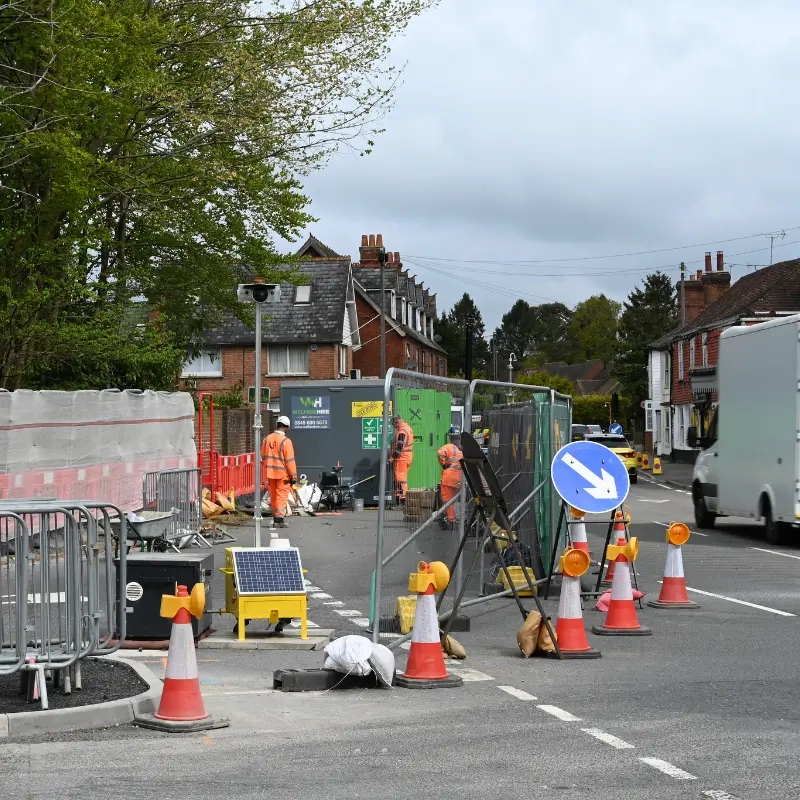
WCCTV's solar-powered, rapidly deployable CCTV Towers, Mini Towers and Traffic Management Towers (specifically designed to support traffic scheme contractors) can be quickly installed by our team wherever you need visibility. Infrared (IR) night vision captures clear footage in the dark, ensuring visibility and evidence collection day and night.
With basic setups deployed in 20 minutes, you can start capturing evidence from the first hour of operations. Ongoing support from our team ensures you retain essential coverage with minimal downtime.
Designed for temporary assignments, these mobile Towers and Mini Towers don't require mains power or internet, so they can be easily repositioned as schemes move through different phases. The compact Mini Tower can be moved by your team without needing any technical support from us
Specialist software and 4G/5G connectivity let you log in remotely to view time-stamped live and recorded footage in our CCTV-supporting cloud platform.
With better visibility into site conditions, you're able to act at an early stage, intercepting problems before they escalate into commercial risks.
3. Capture data and event logs automatically
Manual logs and reports are the weakest link in most evidence chains because they are often incomplete, inaccurate and subject to human memory and bias. Consistent, automated capture removes this risk, providing a more reliable, complete record across every location.
Automated data gathering ensures you capture objective information on the conditions surrounding a claim. For example, continuous environmental monitoring provides a precise time-stamped wind measurement or noise reading for the time/date in question. This means you no longer rely on incomplete spreadsheet information or someone remembering to take a manual reading.
Similarly, automated safety and security logging ensures unauthorised site access and perimeter breach attempts are captured the moment they occur, rather than after the fact or not at all. Automated logs can also record vehicle movements, traffic incursions, compliance standards and changes in work-zone conditions.
These records help you track delivery arrivals and investigate incidents involving road users, subcontractors, intruders and temporary traffic controls.
We'll cover the specific tools that enable automated capture, reporting and oversight (including integrated CCTV, smart detection for PPE and fire, AI-powered security, access control and environmental sensors) in more detail below.
4. Store everything securely in one place, ready to retrieve whenever required
Business research shows 85% of workers spend up to 2 hours a day searching for job-related information because it's scattered across disconnected systems.
To reduce this inefficiency and vendor sprawl, operations directors invest in centralised record management and storage. A single cloud-based platform can combine video, sensor data, alerts and reports in one place. AES-256 encrypted and securely stored, authorised users can review records from any connected device, wherever they are.
This means when you're asked about an incident, you have easily retrievable time-stamped details showing you what happened. Centralised records help you respond professionally to any traffic or works claim, on any site, with a transparent account of events.
How WCCTV's Smart Monitoring Can Help You Create Defensible Evidence on Traffic Projects
To help operations directors build a strong evidence base across all schemes, our cloud-based monitoring solutions combine CCTV with safety, security and environmental monitoring tools in a single evidence-led platform.
Security solutions that strengthen claim defenceSecurity solutions that strengthen claim defence
Site security breaches on highways and traffic schemes can result in stolen/damaged assets, personal liability claims, unauthorised vehicle access, project delays, arguments over responsibility and insurance complications. When theft, vandalism or trespass occurs, owners and other stakeholders expect you to explain what happened and how you plan to prevent repeat incidents.
Our CCTV Security Towers, integrated with AI-driven Intrusion Detection Systems and live remote monitoring, not only reduce unauthorised access and protect assets but also create a documented record of security incidents and responses. This evidence is captured in high-definition detail by PTZ cameras day and night.
As part of a fully-managed service, this security solution enables teams to review time-stamped video and incident logs to establish what occurred, how the threat was handled and check whether the expected security measures (e.g., site lighting, perimeter barriers, locked facilities, access controls, etc.) were in place.
A clear visual record helps show where responsibility lies and can reduce the money spent resolving disputes. It also assists investigations, recovery efforts, security reviews and improvements.
Read more:
- Our Guide on How Fully Managed Security Services Work
- The Real Cost of Site Security Across Traffic Management Projects
Safety monitoring that demonstrates safe practicesSafety monitoring that demonstrates safe practices
Many contractors face liability claims alleging they failed to protect workers and the public, or they violated regulatory standards. Without evidence of reasonable due diligence, it's difficult to defend these claims, and you may be forced into expensive settlements.
On live-road and temporary traffic management projects, this may include proving that pedestrian routes, exclusion zones, barriers, signage, vehicle controls and proper PPE were in place.
Our CCTV Towers, enhanced by AI smart detection, help you manage safety hazards more effectively and generate records to demonstrate compliance.
- PPE Monitoring and Detection Systems spot and flag when crews are not wearing proper PPE as required by HSE
- Automatic Number Plate Recognition (ANPR) logs vehicles entering work zones and restricted areas. ANPR can help tighten access control, prevent unauthorised traffic, mitigate theft and collision risks and verify that contractual delays were caused by late material or equipment deliveries.
- Smoke and Fire Detection Systems generate alerts at the first signs of smoke and fire, enabling teams to respond rapidly, limiting the danger to crews, property and the public.
These systems all retain time-stamped video and data records of events. So when a claimant alleges unsafe conditions, responsible contractors can demonstrate they were aware of the risks and took the actions expected under project safety rules and contractual terms.
Read more:
Environmental records that help show responsible operations
Noise complaints, air quality concerns and disputes around weather-related delays are easier to address if you have valid data and visual context of the incident.
Our IoT Environmental Monitoring sensors fitted to CCTV Towers provide objective, time-stamped data that can be reviewed alongside video evidence. This is particularly useful where works trigger complaints about noise, dust, air quality or disruption to nearby residents and businesses.
- Noise Monitoring Sensors record ambient sound over ranges of 30-130 dB and 20Hz to 12.5kHz to help teams manage workplace noise within legal exposure thresholds.
- Air Quality Sensors continuously monitor dust, fine particulate matter, TVOCs, CO and CO₂. This data helps managers control airborne hazards responsibly and avoid liability exposures under the Control of Substances Hazardous to Health Regulations (COSHH).
- Weather Monitoring Sensors deliver precise wind, rainfall, humidity and temperature readings for each tracked location. This data enables managers to modify schedules and plan emergency responses to minimise weather disruptions and liabilities.
Consistently recorded environmental information makes it easier to investigate complaints, assess delays and prove environmental compliance, reducing claim risks. For instance, maintaining accurate, consistent weather data could help you show that disruptive weather justifies a completion date extension, avoiding performance penalties.
Read more:
One platform for centralised records and stronger control
As mentioned, a strong claims defence depends on centralised record storage and the ability to pull documentation quickly after a claim is submitted to your office.
Our smart cloud-based management platform unifies and securely stores video footage from up to 81 cameras together with alerts, incident reports and monitoring data in one place. Instead of waiting for your team to reconstruct events from fragmented, second-hand reports, you can view the information you need in a central [dashboard] with a single login.
When you can produce complete time-stamped records promptly and professionally, it's often enough to prove claims in your favour, avoiding unnecessary costs that shrink project margins.
Beyond better record-keeping, managing multi-site projects from our secure central platform streamlines communication and improves data quality and decision-making. It also delivers control at scale, helping ensure every traffic and highways scheme operates to the same standard regardless of location or delivery team.
Improve Project Dispute Resolution with Time-Stamped Records on Highways Projects
When faced with a project dispute or claim, weak record-keeping can expose highways and traffic contractors to lengthy disagreements and potential litigation, with all the costs and headaches that entails.
Smart CCTV monitoring and cloud-based platforms help you avoid conflict and stay out of court. These systems can capture and secure time-stamped records of incidents and critical conditions across all projects 24/7.
A standardised model provides the consistent, data-backed evidence you need to deal confidently with claims across your portfolio, avoiding the stress, costs and distraction they bring.
To strengthen your operational evidence with CCTV, safety/security monitoring and record-keeping in one platform, contact our team, request a demo, and let’s find the right solution for your programme.
