
If you manage an active portfolio of highways schemes, you know how difficult it is to reduce costs without increasing risk. With a duty to protect high-value assets and critical infrastructure, security spending should always be a priority focus.
Many leaders still rely on security controls that differ widely from one scheme to the next. Different suppliers, monitoring technologies and procedures create costs without always delivering the expected value.
UK highways teams can successfully reduce security overheads by adopting a single monitoring platform, consistent reporting and relying less on traditional methods (where appropriate). This standardised, technology-supported approach enables them to scale not only security, but also safety, environmental and performance controls without major cost increases.
To help you protect assets and keep projects running smoothly, our article explores how smart monitoring solutions can streamline security management and support safer, more profitable projects.
The Hidden Costs of Unlinked Security Systems on Highways Projects
Highways and traffic management security arrangements are often made on a location-by-location basis, which is understandable. Projects are geographically dispersed, and each scheme has its own immediate need. The problem is, this creates a patchwork of fragmented systems and visibility gaps, while adding cost and making overall effectiveness harder to assess.
The costs of using multiple security methods, technologies, suppliers and processes include:
- Poor visibility into emerging threats across your portfolio
- Duplicated services and vendor costs
- Inconsistent standards between schemes
- Multiple reporting processes to understand and reconcile
- Delayed incident response (often too slow to prevent a loss)
- Poor evidence following theft and other security incidents
For a director overseeing multiple schemes, this inconsistency makes strategic decisions and control harder, because you lack a clear big-picture view across all operations.
Even a single theft of specialist equipment can erode already tight margins. Crime and vandalism are widely estimated to cost the construction industry around £800 million each year, but the real figure is likely much higher, considering:
- Project delays and extended traffic disruptions that can result
- Replacement costs of plant and equipment (if underinsured)
- Productivity slowdowns and work/materials rescheduling challenges
- Potential performance penalties
- Insurance claims, which may be disputed
- Reputational damage with clients and the public
This is why highways and traffic professionals increasingly see reliable security controls as central to project success and profitability.
Read more:
How to Tighten Project Security through Connected Monitoring
Securing highways and temporary traffic projects presents unique challenges to operational directors. You are expected to safeguard compounds, completed work, fuel, plant, vehicles, equipment and increasingly expensive materials across all locations, 24/7. To add to the challenge, scheme layouts and boundaries change and new teams/subcontractors rotate in and out regularly.
Fixed CCTV systems are not viable for securing temporary environments, and manned guarding also has limitations (discussed further below). Deployable CCTV offers a more flexible solution, providing surveillance that can move with the project as work zones change.
CCTV towers with high-definition PTZ (Pan-Tilt-Zoom) cameras provide near-360° coverage of active scheme environments and can be installed in as little as 20-minutes for basic setups. Powered by solar and battery technology and transmitting footage via wireless connectivity, these systems operate without fixed infrastructure.
Our solar CCTV Towers offer long-term, self-powered coverage suited to nearly any project environment. Our compact solar Mini Towers are ideal for covering events or rural projects and can be easily moved across work zones without requiring our support.
Our Traffic Management Towers are specifically designed to cover traffic operations, from busy urban centres to major highway infrastructure works and remote routes. They provide continuous oversight of traffic zones, access points, road users and vehicle movements, helping teams track events throughout the scheme.
Highly visible at up to 6 metres tall, CCTV and traffic towers act as an effective deterrent against theft and vandalism, and deterrence can be strengthened further by adding our AI-enabled smart detection systems:
- Intrusion detection systems use AI to identify suspicious behaviours and trigger near-immediate deterrents and alerts to trained professionals in remote monitoring centres. They verify alerts and respond with live audio voice-down challenges, siren warnings and/or strobe lights. To reduce unnecessary alarms, the system filters out common false triggers such as blowing materials, wildlife, shadows and authorised vehicles.
- Automatic Number Plate Recognition (ANPR) tracks vehicles entering and leaving your project or restricted zones. ANPR shows who is on location so that you can check deliveries and subcontractor vehicles against schedules, restricting non-authorised traffic and tightening security. It also allows you to monitor suspicious vehicle activity and driving patterns (e.g., regular circling) and manage the potential threat proactively.
All systems can be managed through a secure cloud-based platform, with specialist software letting you review live and recorded footage, alerts and reporting data from any connected laptop, desktop or mobile device.
Read more:
- When is Deployable CCTV Necessary on Highways Projects
- How to Standardise Monitoring Across Multiple Highways Projects
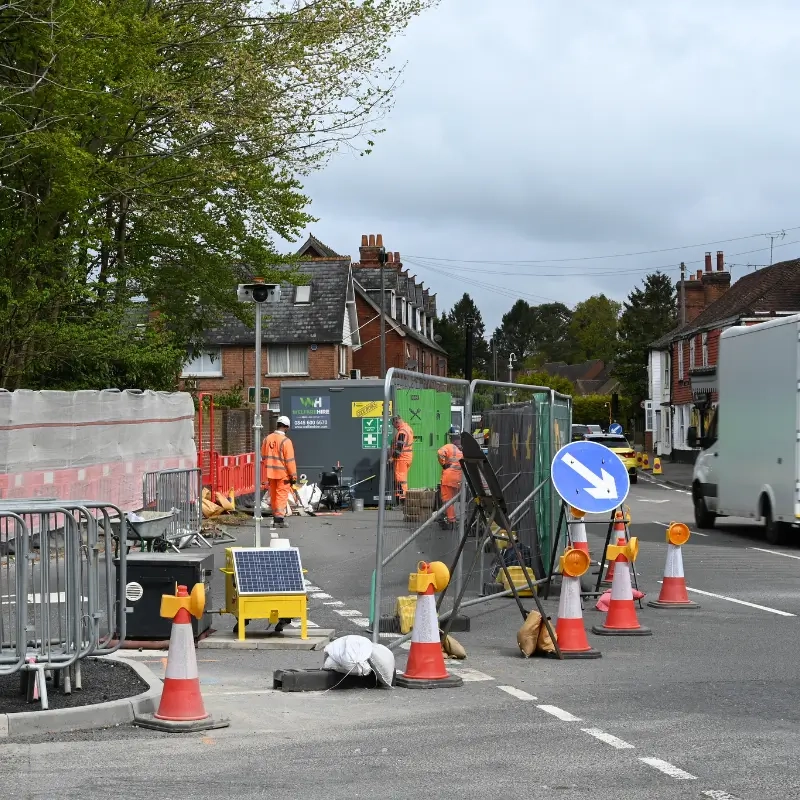
Reducing reliance on traditional guarding
Traditional security guards can play an important role in certain risk environments, such as protecting a high-value storage facility, but they may not be the most appropriate option in every circumstance.
Guard patrols can't cover every corner of a large compound 24/7, and performance and reporting standards can vary widely depending on the crew/ manager on duty. In some locations, such as alongside busy, live carriageways, safety considerations may limit the number of people permitted on site, making traditional guarding less practical.
A security guard's wage ranges from £14 - £30+ hourly (an annual costs is around £25,000 to £35,000+ per person). So, securing multiple projects with a guarding complement represents a significant expense. Beyond salary, you must factor in additional costs, such as :
- Recruitment and vetting
- Management and admin overheads, including shift scheduling and supervision
- Absence and holiday cover
- Inconsistent reporting and evidence following an incident (potentially weakening insurance and liability claims)
Deployable CCTV supported by remote monitoring partners records and reacts to events without a break. A CCTV camera scans day and night, with infrared technology delivering low-light and night-vision recording, capturing details that on-site guards might miss.
Rather than relying on guards to patrol large areas with multiple access points, technology can monitor these locations more effectively 24/7.
For managing several workplaces, the cost of tech-enabled monitoring compares favourably with the total cost of traditional guarding. By using mobile CCTV and centralising oversight, some companies have saved up to 88% on security costs compared to guard patrols.
Read more:
- The Real Cost of Site Security Across Traffic Management Projects
- CCTV Towers vs On-Site Security: Coverage and Cost in Highways Environments
3 Benefits of Centralised Security Monitoring for Highways Projects
Replacing disconnected systems with standardised monitoring not only cuts overheads, but it can also significantly strengthen risk management across operations.
Mobile remote monitoring and centralised cloud control help highways teams protect critical infrastructure and maintain service delivery on road networks more confidently. Project leaders can also do more with less, scaling security, safety and evidence gathering without substantially increasing costs or headcount.
1. Consistent standards across every scheme
A consistent monitoring framework across all projects simplifies reporting and reduces training requirements. Greater visibility into emerging risks helps you identify and intercept them before they disrupt projects and hit margins.
Most importantly, consistency helps ensure high standards are practised across every location, reducing the visibility gaps and blind spots that criminals typically exploit.
2. Easy scaling as your portfolio grows
As you take on more contracts, managing different suppliers and systems can create administration that adds no business value. In fact, the extra work often distracts from productivity and delivery targets.
Standardised monitoring makes it easier to scale without adding management burdens. New sites can be integrated into the same platform, aligning reporting, reducing admin and driving efficiency from day one.
This model not only supports growth planning, but it also makes it easier to reinforce best practices day-to-day, whether you're securing long-term infrastructure work, ongoing maintenance contracts or short-term lane closures.
Read more:
3. Better evidence to reduce commercial risk
When a security incident occurs, a clear understanding of events is vital to manage the aftermath and reduce commercial exposures.
Poor or missing footage, incomplete logs and conflicting accounts can complicate insurance claims, investigations and dispute resolution. For example, a trespasser injured on your site can claim damages, and the demand may be difficult to defend without clear evidence that they entered a restricted area without permission.
A centralised platform provides the evidence you need through timestamped footage, automated alerts and incident reports. Security and safety leaders can access trusted information to conduct thorough investigations, resolve damage claims and improve controls, while insurance teams can manage claims quickly and confidently.
Read more:
Bringing More Than Security To Highways Projects
Modern cloud platforms support advanced project oversight by integrating security tools with other risk management solutions, including environmental, safety and compliance monitoring.
When you manage multiple locations and responsibilities from a single platform, you reduce the vendor and time costs of operating several disjointed systems and gain stronger, more immediate visibility of all monitored areas, enhanced by AI insights.
Below we summarise the solutions you can integrate into our CCTV and cloud platform:
|
Safety Area |
Purpose and Capabilities |
Key Benefits |
|
Intrusion Detection Systems |
Uses AI analytics to detect unauthorised access and suspicious activity in real-time. Alerts are sent to a remote monitoring centre where trained security experts verify incidents and coordinate an appropriate response. All events are logged for investigation and review. An add-on Mobile Keyholding Service sends a trained keyholder to investigate verified alerts at project locations. |
Helps prevent theft, trespass and vandalism without the cost of on-site guards. Enables faster incident responses, reduces security spending and provides an audit trail of threat events. |
|
Automatic Number Plate Recognition (ANPR) |
ANPR systems with AI imaging and Optical Character Recognition (OCR) identify and record vehicle details (registrations, make, model, speed, colour) entering and leaving monitored zones. |
Enhances scheme security and helps improve traffic management. Reduces unauthorised vehicle access, incursions, theft and accidents. Provides vital evidence for investigations and enforcement actions. |
|
IoT-enabled sensors and connected cameras continuously monitor and report when noise levels reach preset thresholds. Sensors measure dB levels (30-130 dB) and frequency range (20 Hz–12.5 kHz). The system logs all noise-related incidents. |
Protects workers and local communities from excessive noise. Helps avoid complaints, fines and compensation claims while demonstrating compliance. Supports data-driven environmental decisions. |
|
|
IoT sensors measure dust, particulate matter, and gases (CO, CO₂, VOCs). Based on preset limits, alerts of airborne hazards are sent to designated managers so conditions can be addressed. The system logs and documents air-quality incidents. |
Reduces exposure to harmful emissions and helps avoid complaints or regulatory problems. Provides evidence of environmental compliance and supports ESG targets. |
|
|
Tracks and logs location-specific weather conditions in real-time (temperature, winds, rain, dew point). Retains a record of all weather-related incidents. |
Improves worker safety and operational planning. Helps minimise weather-related delays, damage and cost overruns. Provides evidence to support weather-associated work adjustments or disruptions. |
|
|
AI analytics recognise smoke and fire signatures at an early stage and alert responders near-instantly. Fire incidents and responses are logged in the platform. |
Protects workers, assets and infrastructure. Minimises damage and disruption and demonstrates effective emergency preparedness. |
|
|
AI analytics track and notify when workers fail to wear the required personal protective equipment (helmets, footwear, face and eye masks, gloves, high-vis vests, etc.). Logs and documents all incidents with visual evidence. |
Reduces safety risks, penalties, disruptions and work stoppage orders caused by PPE violations. Demonstrates proactive crew and road safety management and regulatory compliance. |
Depending on the scope of your security, environmental and safety monitoring needs, you can integrate all or some of the above.
Our teams work closely with you, assessing your monitoring requirements, installing the systems and providing support throughout every project, maintaining reliable oversight where you need it most.
All of the tools sit within the same secure platform: you manage one system with a unified view from up to 81 cameras across all operations. To protect your video and reporting data, our platform uses AES-256 end-to-end encryption with strict access controls.
Read more:
- Improving Site Performance Through Smart Monitoring
- IoT Environmental Sensors for Traffic Management: Benefits for Highway Projects
- Unifying Security and Site Monitoring: The New Standard for UK Contractors
- AI-Powered Risk Detection: Smoke, Fire and PPE Compliance
Reduce Costs and Improve Traffic Project Security Monitoring
Reducing security costs on traffic projects does not have to mean accepting greater risk. In many cases, a centralised, technology-led platform delivers stronger protection across your portfolio.
Connected CCTV, remote monitoring, ANPR and integrated AI detection provide the flexibility to adapt security as projects develop and your risk assessment changes. This means smarter, more responsive coverage that can be closely matched with budgets and requirements.
Our trusted cloud-based management platform helps highways leaders protect their budgets, while strengthening security and safety outcomes for workers, assets and the public.
If you're looking to reduce risk and spending without compromising protection, get in touch with our team to discuss the right solution for your projects
