
Many highways contractors develop monitoring systems on a project-by-project basis. One scheme uses only CCTV, another integrates environmental sensors and each project follows its own reporting methods.
Maintaining confident control over dispersed schemes and teams is complex. Fragmented oversight can easily create weak points and inefficiencies that threaten delivery and profitability.
A monitoring solution that scales without weakening control requires a solid operational framework. Today, operational directors are favouring smart, adaptable monitoring that can be deployed across different projects or over large sites, providing a centralised view of safety compliance, environmental performance and security, together with standardised reporting.
In this article, we'll cover 7 considerations on how to choose a highways monitoring solution to support successful project delivery as you grow your business.
1. Define Your Portfolio Monitoring Requirements
The first step in choosing a monitoring system is to establish what you need to monitor and how those requirements vary between contracts.
At one location, the client may place a premium on security because of the critical highway infrastructure and high-value equipment involved. On another project, work affects residents and nearby schools, making noise control, environmental impact and road safety key priorities.
A scalable solution should support these different scenarios without requiring a separate platform for every function and scheme.
Start by assessing:
- Project security: Where are the risks of theft, vandalism, unauthorised access or damage to plant, structures and equipment?
- Workforce safety: Which activities or areas present particular risks, and where could additional remote oversight help? Safety includes compliance with regulations such as Personal Protective Equipment (PPE) standards, the Control of Pollution Act 1974 and Reporting of Injuries, Diseases and Dangerous Occurrences Regulations (RIDDOR).
- Traffic flow and road users: Are vehicle movements, restricted access points, congestion, temporary traffic management arrangements or Chapter 8 signage important to monitor? Is there a great concern of driver incursions into work zones?
- Environmental conditions: Do noise, dust, air quality or weather conditions need to be monitored and recorded for compliance and crew, commuter and community safety?
- Evidence and reporting: What records will senior highway managers need for client reviews, complaints, investigations, compliance checks or contractual disputes?
Not every traffic or highways project will need every capability. The goal is to create a consistent framework that accommodates the oversight you need when you need it (e.g., weather monitoring for a climate-exposed rural project).
Read more:
2. Choose a Connected Monitoring Platform
Once you know your requirements, consider how the monitoring solution brings information together into an organised view across all operations. An effective monitoring scheme unifies control and information in central dashboards.
This centralised overview reduces visibility gaps and can also reveal actionable insights that help you direct resources and attention where they are needed most.
Centralise access across multiple projects
Efficient directors track projects without relying on 5 or more logins, inconsistent field reports or time-consuming site visits to understand what's going on.
Cloud-supported CCTV platforms can play an invaluable role. Look for a platform that lets you remotely view live and recorded footage and reports on a mobile device to understand project conditions from wherever you are (the office, travelling, visiting a rural scheme). A core benefit of cloud services is that they can scale easily to provide more storage and resources as your monitoring needs expand.
When evaluating a platform, check how it handles multiple projects, video footage, reports and evidence recording.
WCCTV's temporary CCTV Towers and cloud-based software can gather data from up to 81 CCTV camera feeds simultaneously. This wealth of information helps you understand project conditions without an inspection of each location. The data gathered can also help your teams do their jobs more effectively, protecting themselves, residents, road users and valuable assets.
Although our tools and equipment can be customised to the specific scheme, data flows into the central platform, meaning you can accurately compare schemes that monitor the same metrics/responsibilities (e.g., theft attempts, traffic incursions, environmental data).
Connect monitoring with operational decisions
CCTV provides visual evidence, but other technologies can help you understand risks that cameras alone cannot identify. Environmental monitoring sensors and smart detection systems can add useful information about conditions and activity across your portfolio.
Ask suppliers how their different monitoring tools work together to provide deeper visibility to strengthen overall project oversight. Does the solution offer actionable insights that help you make better-informed decisions about crucial safety and security priorities, such as an unsecured access route or subcontractor PPE failures? (We discuss these further in section 5 below).
Read more:
3. Prioritise Reliable Evidence and Consistent Reporting
Effective monitoring systems simplify incident investigations, helping you establish what happened, when and how. A clear record of events is vital to addressing concerns from clients, local authorities, insurers, stakeholders, community groups and regulators.
Look for timestamped footage and easily retrievable records
On any day, you might need to investigate a report of unauthorised access, a site incursion, damage to traffic equipment or respond to a complaint about dust. Recorded footage can show the circumstances surrounding these incidents, while supporting records provide context for reviews and corrective steps.
The right system makes it easy to pull relevant timestamped footage and records without searching scattered files or reconciling individual, incomplete and/or subjective reports.
When evaluating solutions, find out:
- How long footage and reports are retained
- How records are retrieved
- Who is authorised to access or share evidence
- Options for exporting files to assist legal, compliance, insurance and performance reviews
Access permissions and record storage should fit with your reporting needs, data use and regulatory requirements. For example, Regulation 12 of RIDDOR, enforced by the Health and Safety Executive (HSE) requires accurate records to be kept for safety-related incidents, occupational diseases and injuries that incapacitate workers for more than 3 days.
Cloud-based access and reporting platforms can support this by securely storing records for the required period. Cloud connectivity and timestamped logs make it easy to retrieve and share files with authorised stakeholders from connected devices.
Reliable data-backed evidence does not guarantee a successful outcome, but the stronger your documentation, the better prepared you are to defend liability claims such as contractual penalties, compliance fines, damage claims or insurance disputes.
Read more:
4. Ease of Deployment and Scalability
Project monitoring is often needed at short notice, sometimes even to support emergency responses (to safeguard sites after flooding or an environmental spill has occurred, for example). Systems must work reliably in diverse environments, from remote rural roads and temporary diversions to major infrastructure upgrades and high-risk traffic intersections.
Equipment that requires fixed power, communications infrastructure and extensive setup is usually impractical for fast-developing coverage situations.
Deployment, connectivity and power
Look for equipment that can be deployed quickly and operate without fixed infrastructure or local utilities. When assessing suppliers, consider:
- Setup time: How quickly can the system be up and running?
- Connectivity: Can it reliably capture and transmit video and data from your project locations?
- Power: Are solar-powered or other off-grid options available?
- Relocation: Can equipment be moved as work areas and traffic management requirements change?
- Support: What installation and technical support is available throughout the project?
- Temporary rentals: Can equipment be flexibly rented to cover a temporary need and returned when the requirement ends?
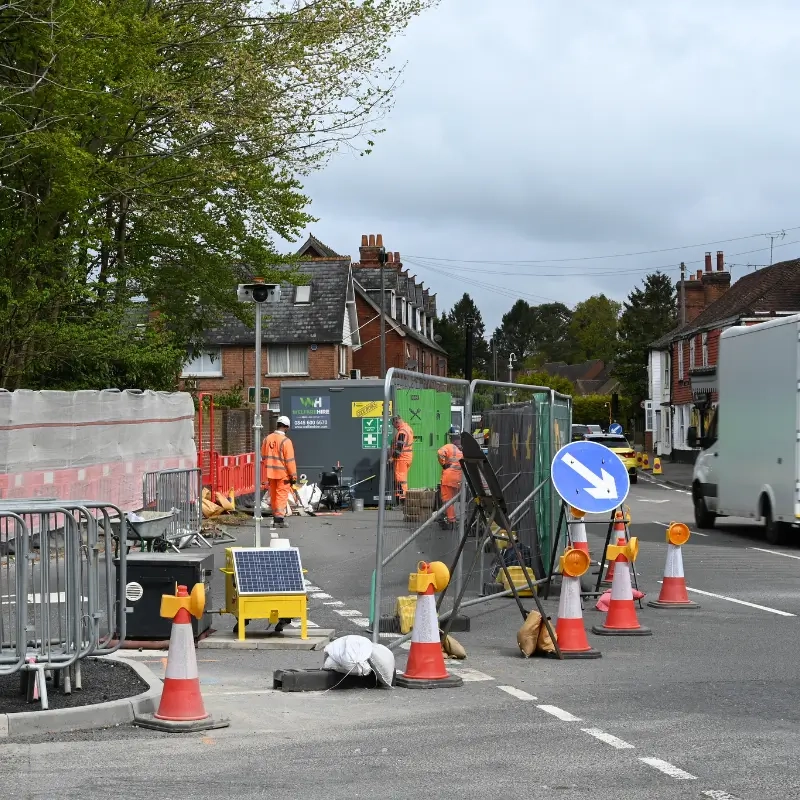
Our solar-powered CCTV Towers and compact Mini Towers can be rapidly installed within 20-minutes for basic setups, without any fixed cabling. They use 4G/5G connectivity to transfer video, effectively giving you coverage from the first hour of operations.
Our Traffic Management Towers can also be quickly mobilised to cover traffic operations, from busy infrastructure works to remote rural routes. Deployable CCTV can be easily relocated as projects develop, with our professional team helping you with installations, repositioning and ongoing technical support. Our compact Mini Tower is so straightforward to relocate that your team can manage it without our support.
Read more:
- When is Deployable CCTV Necessary on Highways Projects
- What Does "Control at Scale" Look Like in Highways Projects
Match the solution to the project
The right deployment model will depend on the duration, location and risk profile of each project. A short-term traffic scheme may need different controls from ongoing road surface works.
Assess whether a supplier can support different project types, rather than trying to force an out-of-the-box solution into different scenarios. The idea is to achieve consistent standards and controls across all projects, using tools that are flexible enough to accommodate this.
Read more:
5. Expand Oversight with CCTV Intrusion Monitoring and Smart Workforce Safety Systems
Real-time monitoring provides essential visibility into highways and traffic operations, which can help improve:
- Security oversight
- Incident reporting
- Help improve traffic flows
However, many projects need more targeted visibility into specific safety, compliance, weather and environmental risks.
Modern solutions offer this by consolidating several risk management tools into one, removing the need for multiple disconnected systems and extra vendor fees. The following systems help catch threats earlier, generate incident reports and retain video evidence for review and investigation.
Security and intrusion detection
Modern scalable platforms incorporate artificial intelligence, computer vision and remote monitoring in fully-managed CCTV solutions that can significantly reduce highways and construction site theft.
When evaluating a security solution, consider its detection features, how alerts are generated, how false triggers are treated and how incidents are recorded.
Our Intrusion Detection Systems combine CCTV with AI-powered video analytics to identify suspicious behaviours and trigger near-immediate deterrents and human intervention, including live audio voice-down challenges from NSI Gold monitoring partners. These systems intelligently filter out false triggers such as blowing materials and wildlife, while keeping timestamped visual records of all security events.
An add-on Mobile Keyholding Service sends a trained keyholder to investigate confirmed threat alerts at project compounds. Swift intervention by a trained professional, supported by the police in need, goes a long way to interrupt criminal activity and protect your assets and facilities. When a keyholder responds, you can be kept informed of the situation without necessarily attending a risky callout yourself.
Read more:
- How Artificial Intelligence is Revolutionising CCTV Tower Monitoring
- CCTV Towers vs On-Site Security
Workforce and asset safety
Integrating AI-enabled smart detection, including vehicle tracking, fire and PPE monitoring, can significantly strengthen site access controls, workforce safety and asset protection.
Our Automatic Number Plate Recognition (ANPR) solutions use AI imaging and optical character recognition (OCR) to track vehicles entering and leaving your projects, traffic schemes and restricted zones. ANPR systems record vehicle type, registration, colour and speed, offering insights into traffic problems or unsafe driving behaviours that need tackling before an incident occurs.
Consistent access controls and vehicle logging across all schemes improve security and incident investigations and can help prevent accidents. It also helps to track delivery vehicles and subcontractor arrivals against defined schedule
Our PPE Detection and Monitoring Systems use CCTV and AI analytics to identify protective gear breaches and send alerts to managers and audio reminders to non-compliant personnel.
Consistent, active PPE interventions can improve safety and, over time, build a compliance culture where highway teams take ownership and check themselves without depending on supervisors.
To safeguard compounds, plant, flammable materials and fuel stores from fire dangers, our Smoke and Fire Detection Systems recognise and alert relevant contacts to the early signs of smoke and fire.
These AI-enabled detection systems are designed for highways/traffic operations, helping to filter out common false alarms such as exhaust fumes, dust, debris and safe, insulated hot work. Prompt alerts enable a rapid response to protect your people and property.
Read more:
6. Treat Environmental Impacts as a Core Monitoring Requirement
With companies being fined thousands of pounds and suffering reputational damage for breaching regulations such as the Control of Noise at Work Regulations 2005 and the Control of Substances Hazardous to Health (COSHH), project leaders can't afford to ignore their impact on the environment and surrounding neighbourhoods.
Dust, air pollutants, machinery emissions and other environmental factors can all affect workers and nearby communities unless they're effectively controlled. Periodic, manual checks are inadequate to manage environmental exposures across large, active, noisy workplaces.
Highway contractors are increasingly adopting IoT-based environmental sensors for continuous data collection and reporting. To ensure safety and environmental compliance, these systems issue alerts when specified limits are reached, allowing teams to act to manage exposures.
When assessing environmental monitoring solutions, consider:
- Relevant measurements: Can the system monitor the conditions you need to track and control?
- Alert thresholds: Can you preset alerts to notify when conditions reach unsafe or illegal limits?
- Evidence and reporting: Can teams retrieve records to investigate complaints, answer inspectors, report to stakeholders and perform data analysis to reveal useful management information?
- Response procedures: Are responsibilities clear when readings reach predefined thresholds?
Our Environmental Monitoring Sensors can monitor noise, air quality, dust and particulate pollution, and weather conditions, helping your teams to identify developing issues and respond promptly.
- Noise Monitoring Sensors measure work zone sound (over ranges of 30-130 dB and 20Hz to 12.5kHz) and alert teams when preset noise levels are reached.
- Air Quality Sensors continuously monitor dust, CO₂, CO and other harmful emissions to help teams control airborne pollutants to limit harm to workers and the surrounding community.
- Weather Monitoring Sensors provide updates on weather conditions, including winds, rain and temperature affecting monitored worksites. Accurate climate data allow teams to implement protective measures when conditions turn hazardous. Data-backed evidence helps leaders justify schedule adjustments and weather-related delays.
Read more:
7. Create a Repeatable Operational Model
The best monitoring solutions help directors reinforce consistent procedures and reporting across different environments. Before committing to a solution, you should have a good idea of the operating model that will work for your business.
It should support efficiency, safety, security, environmental and operational best practices, irrespective of location or scheme. Here are a few key considerations:
- Deployment standards: Decide when monitoring is required, who approves the setup and how equipment is commissioned.
- Reporting routines: Detail the information each project must provide (e.g., noise data, PPE failures, vehicle behaviour) and how it is used to improve delivery.
- Alert processes: Define who receives alerts, how incidents are assessed, who responds and when issues should be escalated.
- Evidence management: Set common rules for recording, retaining, retrieving and sharing footage and reports.
- Roles and responsibilities: Document the responsibilities of project teams, supervisors, managers, subcontractors and admin staff.
These standards should be consistent enough to support portfolio-wide control while allowing for differences in project risks and client requirements. One project might use one or two tools while another integrates a more comprehensive set.
However, tools are customised to individual sites, a good system lets manager/directors view all projects in one place, supporting smarter, simpler, standardised oversight.
A repeatable model enables you to implement proven procedures rather than developing systems from scratch every time you commence a new project. It also means performance reviews compare the same metrics, making weaknesses and improvement opportunities easier to spot and act on.
Read more:
- Improving Site Performance Through Smart Monitoring
- The 2027 Traffic and Highways Checklist for Greater Efficiency
Let WCCTV Help You Scale Highways Project Monitoring
We provide a range of monitoring solutions designed for fast-developing, temporary, remote and highways-based environments.
Our solar-powered CCTV Towers can be installed where and when you need coverage, with an advanced cloud platform that lets you connect specific monitoring tools, from AI-assisted safety and security alerts to environmental tracking. The platform supports efficient centralised control with evidence and reporting securely held in one place.
Whether it's for a temporary traffic scheme or a major infrastructure project, our team can help you design a monitoring strategy that aligns with your operational needs. Contact us if you're interested in discussing how smart connected monitoring can support your projects as you expand.

