
A major challenge for directors overseeing multiple highways and traffic management contracts is maintaining consistent safety and delivery standards across all projects, especially as their portfolio expands. Adding projects inevitably adds risk and complexity, and a site-level issue can quickly become a portfolio-wide problem when multiplied across several undertakings.
Pollution, subcontractor personal protective equipment (PPE) breaches, unauthorised access, incomplete reporting and delayed safety responses can all negatively impact delivery, community relations, client confidence and profitability.
Effectively controlling these risks depends on properly understanding them, which requires deep visibility into project conditions and activities. Best practices show that successful multi-project traffic risk management is built on a scalable central framework that ensures every project is monitored, managed and governed to the same standard.
Our guide highlights the major risks facing traffic and highways projects and explains how a standardised operational model across all schemes helps improve management. It also shows how intelligently connected monitoring strengthens and simplifies control, giving leaders greater confidence that every project is operating to the same high standard.
What are the Major Risks in Multi-Project Traffic Management?
These are the main risks traffic and highways leaders must manage to deliver safe, compliant and high-performing projects.
Limited visibility and blind spots
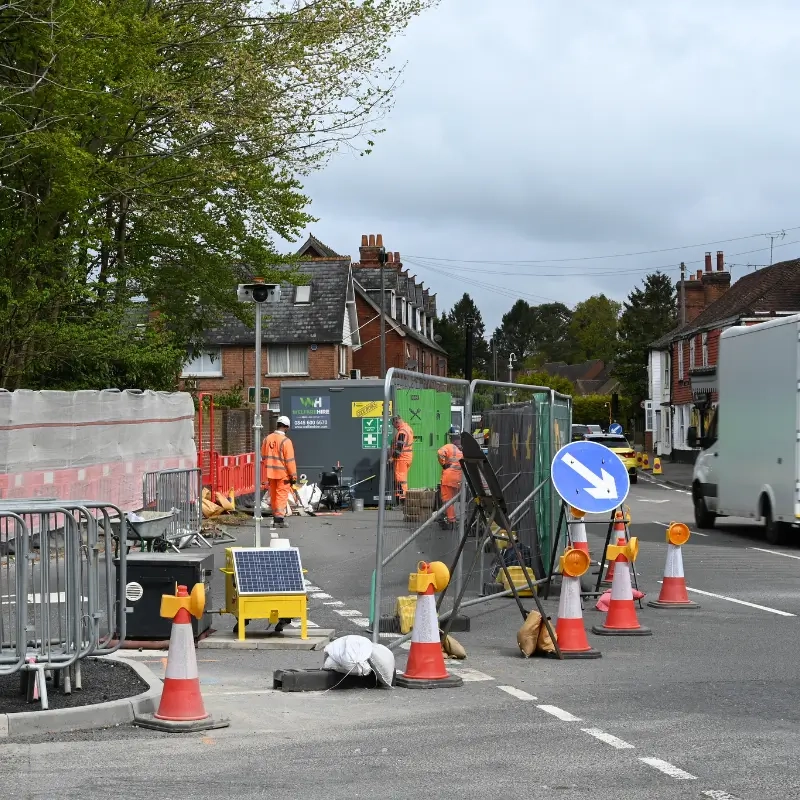
In multi-site portfolios, highways and temporary traffic projects are usually geographically dispersed and often take place in remote and rural regions. Without clear visibility across live operations, it's difficult to enforce standards and check that activities are being carried out as planned.
When oversight is weak, shortcuts, safety management lapses, compliance violations and performance issues are more likely, increasing commercial risk and eroding margins.
Relying on site visits and project managers' reports to monitor constantly changing environments is not always the answer. Since site conditions can change quickly, a new problem might surface immediately after an inspection and go undetected for hours, even days.
Read more:
Inconsistent reporting standards
Traditional highways portfolio reporting often involves multiple disconnected systems, spreadsheets, manual logs and site-specific tools. When each project uses its own reporting method and timetable, management information is inconsistent and may reach decision-makers too late to be of use.
Inconsistent standards and slow reporting make it harder to conduct a portfolio-wide risk assessment, and weaknesses like the following stay hidden:
- Teams not using required PPE (hard hats, high-visibility clothing, safety boots and glasses, etc.)
- Slow reactions to potential hazards (noise, fire dangers, adverse weather)
- Inadequate vehicle and pedestrian movement controls
- Poorly secured access points
- Compliance training gaps
- Inconsistent incident reports and project data
Fragmented reporting complicates decision-making, weakens project documentation, limits scaling and makes it harder to show clients and stakeholders that operations are well managed.
Read more:
Safety hazards
Project work produces high levels of noise, dust, fumes, vapours and chemical contaminants. If these aren't controlled within safe limits, they present health risks to workers, road users, pedestrians and residents.
Active operations near live traffic expose crews to dangerous driver incursions into work zones. National Highways recorded 6,271 incursions into roadworks on England's motorways and major A-roads in 2024, up from 2,149 in 2023.
Managing traffic and environmental safety across multiple schemes takes more than policies and rules. Enforcing PPE use, hazardous substance handling, legal signage and accident reporting on every shift requires careful planning, visible oversight and ongoing education and reinforcement.
Security and asset risks
Security is getting harder to manage for directors overseeing traffic operations and construction projects. Weakly secured and monitored schemes are often a soft target for both organised and opportunistic criminals.
Beyond the direct loss, materials and equipment theft can also cause:
- Project delays, disruptions and penalties for missed deadlines
- Out-of-pocket replacement costs
- Disputed insurance claims and higher premiums
- Liability claims, including from trespassers injured on your site under the Occupiers' Liability Act 1984 (England and Wales)
2 or 3 incidents across the portfolio can throw the larger delivery schedule off track and threaten profitability. Clients and owners may also begin to question your competence and control.
Read more:
Regulatory compliance
Highways and traffic management projects operate in a highly regulated environment. To keep sites compliant and avoid problems with local inspectors or government agencies, project leaders must navigate and effectively manage a raft of regulations, including:
- Health and Safety at Work etc. Act 1974: Requires employers to protect employees and members of the public affected by work activities.
- Reporting of Injuries, Diseases and Dangerous Occurrences Regulations (RIDDOR): Require certain incidents, injuries and dangerous occurrences to be formally reported and investigated.
- Control of Substances Hazardous to Health (COSHH) Regulations: Govern exposure to hazardous substances, including the dust, fumes and airborne contaminants common on highways works.
- Environmental Protection Act 1990: Provides powers relating to environmental nuisances, including excessive noise, dust and emissions affecting local communities.
- Traffic Signs Manual (Chapter 8) and temporary traffic management requirements: Set standards for safe traffic management, signage, road user protection and work zone operation.
- Construction (Design and Management) Regulations 2015 (CDM 2015): Require clients and principal contractors to plan and manage projects safely, including steps to prevent unauthorised access to the site.
Maintaining compliance across multiple projects involving risky construction work, live traffic and environmental hazards can be extremely difficult. Minor breaches are often missed until they develop into major violations, bringing regulatory inspectors to your site. That's why consistent compliance monitoring and evidence collection are needed to prove due diligence.
Increasing environmental pressures
As the UK works toward its target of net zero carbon emissions by 2050, there is growing focus on eco-friendly and sustainable work practices and resources. Modern highways project leaders must balance operational and productivity demands with their responsibility to control environmental impacts such as dust, noise, machinery emissions, chemical exposures and water pollutants.
Failure to do so endangers employees and nearby residents and opens the door to regulatory inspections, negative publicity, fines and enforced work stoppages. Public unhappiness with your environmental control can escalate into social media campaigns and even activism targeted at your site and staff.
Claims and liability become harder to manage
As project portfolios expand, the risk of liability claims and legal disputes increases. Resolving these disputes in your favour often depends on proving your team followed procedures and acted responsibly during the incident.
Without reliable records, you find yourself relying on conflicting accounts, outdated or flawed data, incomplete reports and rushed investigations that can be challenged by the opposing party.
The many potential exposures you could face here include:
- Personal injury claims by workers or members of the public
- Damage to vehicles, infrastructure or third-party property
- Environmental complaints relating to noise and pollution
- Contractor performance disputes and penalties
- Regulatory non-compliance actions including penalties and work stoppages
- Theft, vandalism, anti-social behaviour (ASB) or unauthorised access events
- Allegations of inadequate emergency services access, traffic management or public safety controls
When similar issues occur across multiple traffic projects/construction sites, the admin burden of investigating incidents and gathering evidence increases significantly, and the commercial costs can pile up.
Read more:
What are the Costs of Weak Multi-Project Risk Management?
Across a dozen or more busy projects, a few seemingly minor issues (equipment theft, excessive noise, trespassing, traffic incursions) can quickly multiply and significantly impact costs, safety, performance and reputations.
Here are common real-world costs, both direct and indirect:
Direct costs
- Asset theft and damage: Crime and vandalism are widely estimated to cost the construction industry around £800 million annually, but the real figure is much higher, taking into account the disruptive effects.
- Project disruption: Accidents, theft of traffic/project assets, regulatory investigations and enforced work stoppages can upset timetables and erode contract profits.
- Rework and additional resources: If traffic control infrastructure is damaged following unauthorised access, it adds labour, time and often equipment costs.
- Regulatory penalties and enforcement measures: Traffic schemes that breach health and safety and environmental standards can face significant fines and, in serious cases, prosecution. Regulatory enforcement can halt your operations and require costly corrective measures before you can resume.
- Worker injuries and fatalities: Beyond the financial consequences, accidents during live operations cause life-changing injuries and even fatalities, affecting crews, families and fellow team members.
Indirect costs
- Management distraction: Investigating incidents and dealing with disputes, regulatory audits, complaints and serious stakeholder enquiries can take up valuable management time. Handling these issues across multiple locations can be an expensive distraction, compromising core project deliverables.
- Public complaints: Weak safety controls, poor traffic control measures, excessive noise and dust and avoidable disruptions can all trigger complaints. These often come from residents, local businesses, road users, pedestrians and community groups, and require time and effort to resolve.
- Contractor disputes and penalties: Incomplete records make it harder to resolve disagreements over responsibility, delays and costs. A delay can cause missed deadlines, resulting in penalties and client unhappiness.
- Reputational damage: Problems with environmental control, security, safety or performance can undermine confidence in your ability to manage projects effectively. Ongoing issues can affect public perceptions, client relationships and future opportunities.
A Practical Framework for Reducing Risk Across Every Project
A reliable way to reduce portfolio-wide risk is to establish one consistent operational model across every project, combining standardised monitoring and centralised control.
A rapidly deployable CCTV network provides a platform to integrate cloud-based tools that support multi-site project oversight through AI-driven risk detection and automated alerts and reporting.
The table summarises the essential components of a connected management framework.
|
WCCTV Solution |
Core Purpose |
Operational and Business Benefits |
|
Deployable CCTV and Traffic Management towers create continuous visibility across temporary highways and traffic management sites. |
Improves oversight, reduces site visits, supports investigations and enables consistent monitoring across multiple projects. |
|
|
CCTV with PPE Detection and Monitoring |
Identifies workers not wearing required PPE and notifies them/their managers with a breach alert. |
Supports PPE compliance, improves safety performance and creates auditable records of safety breaches. |
|
CCTV with Smoke and Fire Detection |
Detects early warnings of fire and smoke and alerts response teams so that they can react to extinguish the danger. |
Accelerates responses, protects assets and strengthens incident management and fire prevention. |
|
CCTV with Intrusion Detection and Remote Monitoring |
Detects unauthorised access, theft, vandalism and suspicious activity and alerts live remote monitoring partners. |
Protects compounds, plant and materials while providing 24/7 security oversight and timestamped incident records. |
|
Air Quality Monitoring Sensors on CCTV towers |
Measures dust, particulate matter and air-quality conditions and alerts teams when predefined thresholds are reached. |
Supports environmental compliance, sustainability reporting and evidence-based responses to complaints. |
|
Noise Monitoring Sensors on CCTV towers |
Monitors work noise levels (30 dB to130 dB and 20Hz to 12.5kHz). Alerts when predefined limits are reached. |
Helps manage traffic projects and construction site noise to protect crews and community relations and demonstrate compliance/due diligence. |
|
Weather Monitoring Sensors on CCTV towers |
Tracks site-specific climate conditions such as wind, rainfall, temperature and humidity. Can issue alerts based on preconfigured thresholds (e.g., wind exceeding 70 mph). |
Improves planning and safety around weather events and provides evidence to explain work pauses/delays. |
|
Records vehicle movements around sites and restricted zones (construction area and nearby intersections). Captures the vehicle's number plate, make, model, speed and colour. |
Strengthens access control, improves accountability and supports investigations. Reduces risks of theft and dangerous driver incursion and helps control traffic flow on site. |
These solutions can be integrated into our dedicated cloud platform, offering stronger, clearer oversight with deeper visibility into all projects and risk areas. To help you customise your system, you can connect one, several or all of the above solutions depending on your monitoring needs.
In the following sections, we discuss how this connected monitoring framework improves safety, security, environmental and operational risk across multi-location portfolios.
Creating consistent visibility across every project
Reducing risk across traffic projects and construction activities starts with creating a consistent view of operations across every location. Deployable CCTV and traffic management towers and cloud-based oversight provide a scalable way to create this standardised control.
Managing your project portfolio from a central cloud platform lets you review live and recorded footage, environmental data, alerts and reports in one place, through a mobile or desktop app. Centralised dashboards consolidate management information into a detailed view, giving you a clear understanding of operations everywhere. Easily shareable information helps your teams intercept risks earlier and understand the standards expected of them.
Decision-makers now have comprehensive, real-time insights and visual evidence to help them direct focus and course-correct before threats derail operations. The result is stronger, more consistent performance, safety and control across all projects.
Our deployable CCTV systems form the foundation for this remote visibility across your portfolio:
- Our Traffic Management Towers are designed specifically for traffic management schemes: carriageway works, risky diversions, route closures, road layout redesigns. They can be deployed quickly and run without fixed power or internet, so they suit locations with limited or poor infrastructure, such as rural routes.
- Our CCTV Towers can be installed in 20-minutes (for basic setups), delivering high-definition PTZ (Pan-Tilt-Zoom) camera coverage from heights of up to 6 metres.
- For temporary priority zones needing fast, flexible monitoring, our Mini CCTV Towers can be installed by a single person and repositioned without specialist assistance. Like the other units, the Mini Tower is solar-powered with 4G/5G connectivity and fully NDAA-compliant.
Read more:
Improving safety performance and subcontractor compliance
To operate safe, compliant highways projects, teams need to identify potential hazards early and intervene before they cause loss or damage. Flexible, temporary CCTV with built-in smart detection that generates quick alerts in a central dashboard can provide this capability.
Our AI-driven PPE Detection Systems use AI-video analytics to recognise workers not wearing required protective equipment when they should be. The tool alerts the relevant manager and can also issue live audio warnings to workers not adhering to safety gear protocols.
The system produces timestamped images and footage to help drive continual improvements and encourage safer behaviours from both your team and subcontractors.
Environmental monitoring sensors connected to CCTV towers help you protect your people and property from weather hazards, air pollutants and harmful noise. These systems can issue alerts when predefined limits are reached, allowing teams to halt or adjust operations before conditions become unsafe. You can view footage together with the data to see and clearly understand what was happening at the time.
Automatic Number Plate Recognition (ANPR) uses Optical Character Recognition (OCR) to record all vehicles entering and exiting work zones, including their make, model and speeds. Tracking vehicle movements strengthens access control and can help manage traffic flow on site.
It's also useful to monitor subcontractors' arrivals, moderate speeds, reduce incursions and ensure compliance with project traffic measures.
By standardising safety monitoring and automating key checks and alerts, you can identify and tackle problems earlier. The approach also reduces reliance on manual inspections and eases the reporting burdens from busy supervisors and project managers.
Read more:
Protecting sites, assets and critical infrastructure
By standardising security monitoring across all highways and traffic schemes, you can protect assets and infrastructure more confidently throughout the project duration. While adequate lighting, strong perimeter fencing, locked stores and proper training contribute to site security, our AI-powered detection and reporting solutions offer another level of protection.
Intrusion Detection Systems, added to CCTV cameras with night vision, scan for suspicious activity around your boundary and the designated zones you set. AI analytics capture potential threats (unauthorised access, theft attempts, trespassing, loitering and vandalism) and generate near-immediate alerts to connected NSI Gold Accredited monitoring centres. Here, trained professionals verify threats and initiate voice, light and/or siren warnings to protect your assets and compounds.
Intrusion detection distinguishes genuine incidents from routine activity and produces timestamped incident reports and video evidence for investigations and further action, including security evaluations.
Our optional Mobile Keyholding Response service offers an extra safeguard by dispatching a trained security operator to investigate confirmed intruder alarms.
ANPR logs vehicles travelling into worksites and restricted zones, and can add another layer to your security efforts. Besides detecting suspicious vehicles, ANPR also supports safety by monitoring driving behaviour and speed. The system retains reports and video footage for investigations, analysis, insurance and complaint handling.
Our Smoke and Fire Detection uses AI to pinpoint and flag the early signs of smoke or fire, filtering out false alarms. Intelligent video-based detection operates reliably in external environments where many conventional alarms are less effective.
The system automatically retains timestamped logs and visuals of all fire signals captured and alerts for investigations, insurance and review.
Strengthening environmental compliance and responsibility
Air quality, noise and weather monitoring sensors provide continuous visibility into project conditions, helping teams catch potential issues before they escalate, helping to avoid compliance breaches and/or public complaints.
These IoT sensors create an objective record of environmental conditions over time. When addressing resident complaints, council enquiries, regulatory inspections or client requests for information, you can respond with verified data rather than best guesses.
- Noise monitoring sensors record ambient sound over ranges of 30-130 dB and 20Hz to 12.5kHz. Real-time alerts when preconfigured thresholds are reached allow teams to act to maintain noise exposures within safe, legal limits, protecting workers and the local community.
- Air quality monitoring sensors track airborne hazards and pollutants, including particulate matter, total volatile organic compounds (TVOCs), carbon dioxide and carbon monoxide. Teams receive alerts when preset limits are reached, allowing them to adjust work to reduce readings.
- Weather monitoring sensors provide real-time weather data (temperature, wind speed, rainfall, etc.), assisting teams to prepare for conditions that could affect worker and public safety, service delivery or work scheduling. Hard data provides evidence to justify work pauses for safety reasons.
Consistently gathered data and an evidence-led approach help you identify recurring problems and investigate complaints. Combined with appropriate response procedures, these tools support regulatory compliance and responsible environmental management.
Read more:
Building stronger governance, reporting and claims defence
The key element underpinning good governance is accurate information/data that all parties trust. Records must also be easily accessible and shareable to keep the relevant teams informed and accountable.
Our dedicated cloud management platform brings accurate project information together, giving directors, site managers and teams a centralised view of activity and performance across their work areas.
Our platform can integrate up to 81 camera feeds with environmental data, safety/security alerts and reports. Timestamped footage, sensor readings and digital audit trails create detailed, factual project documentation. This is invaluable evidence when you need to defend compensation and contractual claims, settle insurance issues or pursue investigations.
Data-backed evidence also strengthens stakeholder and compliance reporting. Complete reports with supporting data/video can be easily pulled from the platform to show what happened, when and the actions taken in response.
With AES-256 encryption securing the platform, your files are protected against unauthorised access, hacking and other cyber threats while remaining accessible and exportable for authorised users.
Read more:
7 Benefits of a Standardised Risk and Monitoring Platform
Below, we highlight 7 key advantages of smart risk monitoring through a centralised platform:
- Stronger portfolio-wide governance: One set of standards across all operations makes it easier to confirm that work is being carried out in line with expectations. Directors can verify this remotely and actively reinforce performance standards and delivery.
- Faster incident detection and response: Connected systems help close the blind spots where threats and breaches go unnoticed. Issues are spotted earlier and escalated sooner, minimising damage, theft, downtime, complaints and liability claims.
- More efficient operations: Replacing separate reporting methods and monitoring systems with a shared platform cuts admin and vendor costs. Teams spend less time jumping between applications, searching for information, reconciling reports and chasing updates. This enables them to focus productively on their core tasks.
- Improved environmental oversight: Consistent environmental monitoring helps you track dust, noise, harmful emissions and weather conditions across every location, and act before they impact safety or compliance. It also gives you a clear record to assist environmental audits and ESG initiatives.
- Better claims defence: Reliable, timestamped records of project conditions and activity put you in a stronger position when responding to injury and damage allegations. Good documentation also helps resolve contractual disputes fairly and supports smoother insurance claims, limiting premium increases.
- Better decision-making through high-quality data: When every site reports in the same format and on the same timescale, portfolio-wide risk assessment becomes realistic. Information arrives in time to be useful, supporting better decisions, more effective management and proper planning.
- Greater confidence for clients, owners, regulators and key stakeholders: A disciplined risk assessment and management framework shows that your operations are proactively, professionally controlled. This strengthens relationships with clients, owners, regulators and local communities, protecting your profitability and public image.
Reduce Risks Across Your Traffic Projects with Connected Monitoring
As project portfolios expand, the risk of critical controls slipping increases. Even trained personnel can take shortcuts or neglect environmental and safety protocols when under pressure. Minimising these risks across vast portfolios requires smart visibility into all operations, everywhere.
A single standardised framework for monitoring and evidence collection can help strengthen project oversight and control. Technology, including AI risk detection, automated data gathering and cloud-based reporting, plays a key role in building this framework.
If you're an operations director looking to strengthen multi-project traffic risk management, our CCTV and cloud-based platform can help. Contact our experienced team today to discuss how we can help ensure every project operates to the same high safety and performance standards

